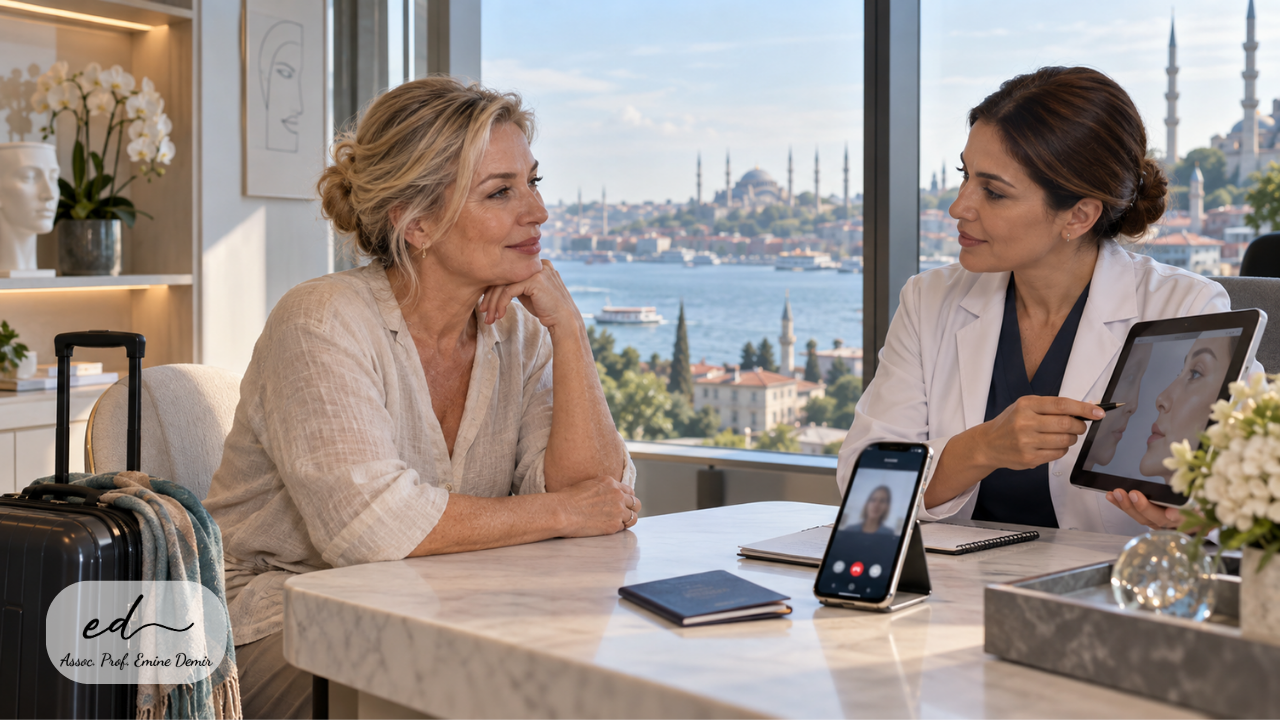
The price difference between Turkey and Western countries is structural rather than a reflection of surgical quality — driven by operating costs, liability insurance, exchange rates and procedural volume. What genuinely differs for an international patient is not the operation but the logistics around it: follow-up, the timing of complications, and legal recourse. Understanding those three is what separates a good decision from a cheap one.
Most patients researching facelift surgery abroad arrive at the same question, usually phrased carefully: “If it costs a third of the price, what am I not getting?”
It is a reasonable question and it deserves a direct answer rather than reassurance.
The short version: the price gap is real and it is largely explained by economics. But the low price also creates a market where excellent and poor providers sit side by side — and the specific risks of having surgery abroad are not about surgical skill. They are about what happens after you leave the operating theatre.
This article covers all three: what drives the cost, how to assess quality, and what the patient journey actually involves.
Why the price difference exists
Published comparisons put current ranges roughly as follows:
| Country | Typical range, full facelift |
|---|---|
| Turkey | £4,500–£6,500 |
| United Kingdom | £8,000–£20,000 |
| United States | $15,000–$50,000+ |
Sources describe savings of roughly 50 to 75 per cent for comparable procedures.
One honest qualifier first: deep plane techniques are typically priced above standard facelift in any country, because they involve longer operating time and greater technical demand. A quote at the bottom of a general facelift range is unlikely to be for deep plane surgery, and it is worth asking directly which technique a quoted figure covers.
What actually drives the gap
The explanation given consistently across independent comparisons is economic rather than clinical:
- Operating expenses. Staffing, facility costs and overheads are lower.
- Medical liability insurance. Costs in this category differ substantially between markets and feed directly into surgical fees.
- Exchange rates. Favourable currency conversion for patients paying in pounds, dollars or euros.
- Procedural volume. High volume allows clinics to operate efficiently.
- Pricing structure. Turkish clinics typically quote all-inclusive packages; UK and US pricing is itemised, producing a higher total.
As one comparison puts it plainly: the difference is driven by economics rather than a difference in surgical quality.
The currency caveat
One practical point rarely mentioned. Because the Turkish lira fluctuates, a quoted price in pounds or dollars can shift between the month you enquire and the month you travel.
Ask whether your quote is fixed and for how long. This is a reasonable question and a clear answer is a good sign.
Does cheaper mean riskier? The honest answer
Two things are true at once, and most articles on this subject only tell you one of them.
First: the price gap is not produced by cutting clinical corners. It is produced by a different cost base. An accredited facility in Istanbul operating to international standards still costs less to run than an equivalent facility in London or New York.
Second: the same low price attracts operators who do cut corners. A market with genuine cost advantages will contain both excellent providers and poor ones — and from a distance, their websites can look similar.
So the accurate framing is not “is Turkey safe” but “how do I distinguish between providers?”
And there is a third point that gets lost entirely: the risks specific to having surgery abroad are not surgical. They are about follow-up access, the timing of complications, revision logistics and legal recourse. Those exist even with an excellent surgeon, and they are managed rather than eliminated.
Assessing quality: what to actually check
Accreditation — and the question most people forget to ask
Joint Commission International accreditation applies the same benchmarks worldwide. As one comparison notes, an accredited hospital in Turkey meets the same standards as one in the United States. Turkey has a substantial number of JCI-accredited facilities.
But here is the specific check that matters, and it is easy to miss:
Confirm that the accreditation is current, and that the accredited facility is the one where your surgery and your overnight care will actually take place.
A clinic may be associated with an accredited hospital without your procedure being performed there. Ask for the name of the facility, and verify it yourself.
Separately, the Turkish Ministry of Health operates an authorisation system for health tourism providers and facilitators. Ask whether the provider holds this authorisation.
Surgeon credentials
For deep plane facelift specifically, look for:
- Specialty training relevant to facial surgery
- Board certification and society membership
- How many deep plane facelifts they perform annually — not facelifts generally
- Whether they will show you healed results from cases comparable to yours
The third point matters because deep plane is a distinct technique, not a variation of a standard lift. The anatomical difference is covered in the article on technique, and the comparison with SMAS approaches in a separate piece.
What the package actually includes
Package structures vary widely between providers. Sources note that some include only short hotel stays and basic follow-up, while others provide extended recovery coordination, interpreter services and complication monitoring after discharge.
Ask for an itemised, date-stamped quote and confirm specifically:
- Surgeon, anaesthesia and facility fees
- Which facility, and how many nights of inpatient care
- Hotel nights and transfers
- Medication and dressings
- Number and format of follow-up appointments before departure
- What remote follow-up consists of after you leave
- The revision policy — in writing
- What happens, and who pays, if a complication extends your stay
The last two points are where packages differ most and where quotes are least comparable.
The patient journey
Before travel: consultation
Remote consultation typically involves photographs from defined angles, a video call and a medical history review.
What it can establish: broad candidacy, the likely scope of surgery, and whether your expectations are achievable.
What it cannot fully establish: skin elasticity, tissue quality, the precise extent of neck involvement, and how your anatomy will behave. A plan agreed remotely may need adjusting after examination in person — and a surgeon who says so is describing reality rather than hedging.
Candidacy criteria are covered in more detail in a separate article.
Why the stay is the length it is
This is the part of the journey that is usually presented as logistics but is actually clinical, and it deserves explaining properly.
Typical stays run seven to ten days: one to two nights of inpatient care, then hotel accommodation, with review before departure.
That duration is not arbitrary.
Haematoma — a collection of blood beneath the skin — is the most common facelift complication requiring return to theatre. It presents almost always within the first 24 to 48 hours, and identified early it is straightforward to manage.
So the first two days are the period during which the time-critical complication occurs, and the stay is built around being monitored and reachable during that window.
The practical implication: a package that has you flying home on day three or four is not saving you money. It is moving you away from the team during the period that matters most.
Complications generally are covered in the article on risks.
After you return home
This is where international surgery genuinely differs, and it should be stated rather than glossed over.
As one comparison puts it: local surgery offers easier follow-up, while international surgery requires a clear remote aftercare protocol.
Ask what that protocol consists of. A good answer includes defined check-in points, structured photo review at set intervals, a named contact and a stated response time, and a plan for what happens if something concerns you at week three.
Also relevant: some patients take extended travel insurance covering post-operative complications for a defined period after returning home. This is worth investigating before you book rather than after.
The long timeline
One further point specific to travelling patients.
Deep plane facelift results settle over months. Swelling subsides progressively, the shape defines between three and six months, and scars continue to mature for far longer.
Which means you will assess your result from another country, long after you left. Knowing in advance that the three-month appearance is not the final result prevents unnecessary alarm — and prevents premature revision requests.
What natural results actually look like at each stage is covered in a separate article, and scar maturation in the piece on incisions.
The things that are genuinely different — and not in your favour
An honest article has to include this section.
1. Legal framework
Patient protection and legal recourse differ between countries. Sources advising on medical travel are consistent on this point: understand the framework before committing.
This does not mean there is no recourse. It means the mechanism differs from the one you would use at home, and you should know what it is before rather than discovering it if something goes wrong.
2. Revision logistics
If a revision were needed, it would involve travelling again. Ask what the revision policy is, what it covers, over what period, and who bears travel costs.
A provider with a clear written answer has thought about this. One that treats the question as pessimistic has not.
3. Follow-up transitions to remote
Once you leave, your surgeon cannot examine you. Photographs and video are useful but they are not examination.
This is manageable with a good protocol, and it is a real difference from having surgery twenty minutes from home.
4. Total cost is not the quoted cost
For a true comparison, add flights, any additional accommodation, travel insurance and a companion’s costs if you bring one.
The comparison usually still favours Turkey substantially — but it should be made honestly rather than on the package price alone.
Questions worth asking before you book
- Which technique does this quote cover? Deep plane, SMAS or something else?
- How many deep plane facelifts do you perform each year?
- Which facility will my surgery and overnight care take place in, and is its accreditation current?
- How many nights am I staying, and why that number?
- What is your haematoma protocol and who monitors me in the first 48 hours?
- What does remote follow-up consist of — how often, in what format, with what response time?
- What is your revision policy, in writing?
- Is this quote fixed, and for how long?
- What happens, and who pays, if a complication extends my stay?
Question four is the one I would pay most attention to. A provider who explains the stay in terms of the haematoma window is describing clinical reasoning. One who presents it purely as hotel nights is describing a package.
Question two matters because volume in a specific technique is not the same as volume in facelift generally.
Warning signs
- Pressure to decide quickly, or a discount that expires
- A quote given without photographs or medical history
- Reluctance to name the facility
- No written revision policy
- A stay shorter than the first-week review point
- Communication only through a coordinator, with no access to the surgeon before booking
- Before-and-after images that cannot be attributed to the surgeon who would operate on you
- Guarantees of a specific result
The last point is worth stating plainly: no surgeon can guarantee an aesthetic outcome. Individual anatomy, healing and tissue behaviour determine what is achievable, and any promise that ignores this should reduce rather than increase your confidence.
In summary
The cost difference between Turkey and Western markets is substantial and structurally explained — operating costs, liability insurance, exchange rates, volume and pricing structure. Independent comparisons attribute it to economics rather than to a difference in surgical quality.
But the same price environment contains providers of very different standards, and the patient’s task is to distinguish between them. Accreditation, surgeon volume in the specific technique, and a written revision policy are the three most useful filters.
The risks genuinely specific to operating abroad are not surgical. They concern follow-up access, revision logistics and legal framework — and they are managed with a clear protocol rather than eliminated.
Above all: the length of your stay is a clinical decision, not a hospitality one. Haematoma presents in the first 24 to 48 hours, and a stay built around that window is a sign that safety, not itinerary, is driving the plan.
If you would like your own anatomy assessed and a realistic plan discussed, you can arrange a free video consultation.
Frequently Asked Questions
Why is facelift surgery cheaper in Turkey?
Published comparisons attribute the difference to structural economic factors: lower operating expenses, lower medical liability insurance costs, favourable exchange rates, high procedural volume and all-inclusive rather than itemised pricing. Sources describe the gap as driven by economics rather than a difference in surgical quality.
What does a deep plane facelift cost in Turkey?
Published ranges for full facelift in Turkey sit around £4,500–£6,500, against £8,000–£20,000 in the UK and $15,000–$50,000+ in the US. Deep plane techniques are typically priced above standard facelift because of longer operating time and greater technical demand, so confirm which technique a quote covers.
Does a lower price mean lower quality?
The price gap itself is structural rather than clinical. However, the same low price attracts providers of very different standards, so the relevant question is how to distinguish between them — through accreditation, surgeon volume in the specific technique and a written revision policy.
How do I verify a clinic’s accreditation?
JCI accreditation applies the same benchmarks worldwide. Confirm that the accreditation is current and, importantly, that the accredited facility is the one where your surgery and overnight care will actually take place. Turkey’s Ministry of Health also operates an authorisation system for health tourism providers.
How long should I stay in Turkey?
Typical stays run seven to ten days. The reason is clinical rather than logistical: haematoma is the most common facelift complication requiring return to theatre and presents almost always within the first 24 to 48 hours. A package that has you flying home on day three moves you away from the team during the period that matters most.
What happens with follow-up after I go home?
Follow-up transitions to remote. Ask what the protocol consists of: defined check-in points, structured photo review at set intervals, a named contact and a stated response time. Some patients also take extended travel insurance covering post-operative complications after returning home.
What if I need a revision?
Revision would involve travelling again. Ask for the revision policy in writing — what it covers, over what period, and who bears travel costs. A provider with a clear written answer has considered this in advance.
When will I see my final result?
Swelling subsides progressively, the shape defines between three and six months, and scars continue maturing well beyond that. You will assess your result from another country, months after leaving — which is why knowing the timeline in advance prevents unnecessary concern and premature revision requests.
Assoc. Prof. Dr. Emine Demir — Facial Aesthetic Surgeon specialising in deep plane facelift, neck lift and endoscopic facial rejuvenation. About Dr. Demir
This content is for informational purposes only and does not constitute medical advice. Prices cited are published market ranges and do not represent a quotation; individual quotes depend on the procedure planned and are provided after assessment. Individual anatomy determines achievable outcomes and results vary between patients. Please consult a qualified physician regarding your own situation.
References
- Facelift Cost by Country: A Global Price Comparison, 2026.
- Facelift Price Comparison 2026: Turkey and the UK.
- Facelift Cost in Turkey: 2026 Price Guide.
- How to Prevent and Treat Complications in Facelift Surgery, Part 1: Short-Term Complications. PMC8240741.