
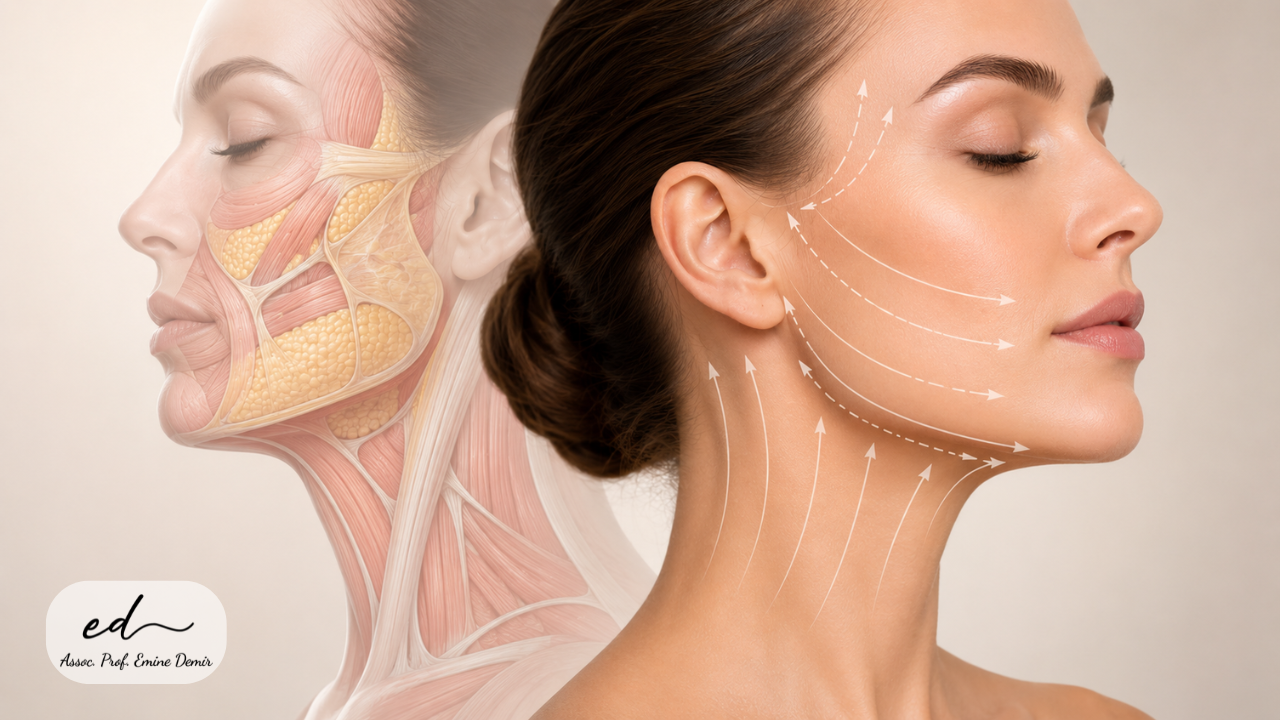
If you have started researching facial rejuvenation, you have probably come across the term “deep plane facelift.” It sounds advanced, maybe even a little technical. And to be honest, it is technical. But the idea behind it can be explained in a simple way.
A deep plane facelift is a modern facial rejuvenation surgery that works beneath the superficial layers of the face. Instead of only pulling the skin tighter, it focuses on repositioning the deeper facial structures that have shifted downward over time. These structures include the SMAS layer, facial retaining ligaments, and deep fat compartments that support the cheeks, jawline, and lower face.
So, what is deep plane facelift surgery really about?
In plain language, it is a facelift technique that aims to lift the face from deeper anatomical layers rather than stretching the skin from the surface. This is why many surgeons describe it as a structural approach. The goal is not simply to make the skin tighter. The goal is to restore facial tissues to a more natural and balanced position.
For patients considering facial rejuvenation in İstanbul, Türkiye, deep plane facelift surgery is often discussed as part of a full face rejuvenation plan. This is especially relevant when the patient has concerns such as sagging cheeks, deep nasolabial folds, jowls, jawline laxity, or neck aging.
Assoc. Prof. Emine Demir, an Ear, Nose and Throat specialist and founder of Facelift Academy Türkiye, approaches facial rejuvenation through anatomy, balance, and natural facial identity. In a VIP-level patient experience, deep plane facelift planning should not be rushed or standardized. It should be tailored to the person’s facial structure, aging pattern, and realistic expectations.
What Is Deep Plane Facelift?
A deep plane facelift is a surgical facelift technique that lifts and repositions deeper facial tissues as a unit. Unlike older skin-focused facelift techniques, it does not rely mainly on pulling the skin tight. Instead, it works beneath the SMAS layer and releases certain retaining ligaments that hold sagging tissues in a descended position.
This allows the surgeon to reposition the cheek, lower face, and jawline more naturally.
To understand this better, imagine the face as a layered structure. The skin is only the outer covering. Under the skin, there are fat compartments, connective tissues, muscles, ligaments, and deeper support layers. Aging does not affect only the skin. It affects the whole facial support system.
That is why a skin-only approach may sometimes create a tight but not necessarily youthful appearance. The skin may look stretched, yet the cheeks, jowls, and deeper tissues may still show signs of descent.
Deep plane facelift surgery aims to address this deeper aging pattern.
It is especially known for its ability to improve the midface, nasolabial folds, lower face, jawline, and neck contour in suitable patients. However, it is not a magic procedure and not every patient needs the same technique. A detailed anatomical evaluation is essential.
Why Is It Called “Deep Plane”?
The name comes from the surgical plane used during the procedure.
In facial surgery, a “plane” means a natural tissue layer or space where surgical dissection can be performed. In a deep plane facelift, the surgeon works deeper than the skin and superficial tissue layers. The procedure involves the deeper layer beneath or within the SMAS-related structures, depending on the specific technique and facial region.
This is different from traditional skin-only facelifts, where the skin is separated and pulled while the deeper tissues may receive limited support.
The deep plane concept is based on one important idea: facial aging is not just skin looseness. It is also the downward movement of deeper structures.
When those deeper structures are released and repositioned, the skin can follow more naturally. In many cases, this may reduce the need for excessive skin tension.
And this is one of the reasons the technique is valued in modern facial rejuvenation.
A Brief History: Hamra and the 1990 Deep Plane Concept
The deep plane facelift is closely associated with the work of Dr. Sam T. Hamra. In 1990, Hamra published an important study titled “The Deep-Plane Rhytidectomy” in Plastic and Reconstructive Surgery.
At that time, many facelift techniques were effective in improving the jawline and lower face, but the midface and nasolabial folds were more difficult to address. Hamra’s deep plane approach brought attention to a more comprehensive anatomical lift by working beneath the superficial musculoaponeurotic system, known as the SMAS.
His work helped shift the conversation from simply tightening the skin to repositioning deeper facial structures.
Of course, the technique has continued to evolve since 1990. Today, surgeons may use variations such as extended deep plane facelift, deep plane face and neck lift, or deep plane facelift combined with other facial rejuvenation procedures. But Hamra’s contribution remains an important reference point in the history of modern facelift surgery.
For a new reader, the main idea is simple: deep plane facelift became important because it tried to solve a limitation of older techniques — the inability to fully address deeper facial descent, especially in the midface and nasolabial area.
Basic Facial Anatomy: Why the Deep Plane Matters
To understand why deep plane facelift is different, we need to look at the face as a layered structure.
Do not worry; we will keep this simple.
The face is not just skin over bone. Between the skin and the deeper facial skeleton, there are multiple layers that move, support, and shape facial expression.
The most important structures for understanding deep plane facelift are:
The skin
Subcutaneous fat
SMAS layer
Facial retaining ligaments
Deep fat pads
Facial muscles
Deeper connective tissues
Aging affects all these layers differently.
The skin loses elasticity. Fat compartments may shift or shrink. Ligaments become part of the visible aging pattern because they hold certain tissues while surrounding tissues descend. The SMAS and deeper facial layers may lose their youthful position.
This is why a good facelift is not only about removing extra skin. It is about understanding where the face has changed structurally.
What Is the SMAS Layer?
SMAS stands for superficial musculoaponeurotic system. It sounds complicated, but the concept is not too difficult.
The SMAS is a fibrous tissue layer under the skin and subcutaneous fat. It is connected to facial muscles and plays an important role in facial movement and support. In facelift surgery, the SMAS is important because it is stronger than skin and can provide deeper lifting support.
Traditional SMAS facelift techniques usually tighten or reposition this layer separately from the skin. This can be effective in many patients, especially when performed by an experienced surgeon.
However, deep plane facelift goes further. Instead of lifting the skin and SMAS separately in a more superficial way, the deep plane technique often lifts the skin and SMAS as a connected unit in certain regions. It also releases retaining ligaments that restrict movement of descended facial tissues.
This is one of the major differences.
In simple terms:
A skin-only facelift pulls the outer layer.
A SMAS facelift supports a deeper layer.
A deep plane facelift releases deeper attachments and repositions facial tissues more structurally.
That does not mean one technique is automatically right for everyone. But it does explain why the deep plane approach is anatomically different.
What Are Retaining Ligaments?
Facial retaining ligaments are strong connective tissue structures that anchor the soft tissues of the face to deeper layers. They help keep facial tissues in place.
When we are young, these ligaments support facial shape. But with aging, facial tissues around them may descend, while the ligaments continue to hold certain points. This can contribute to folds, shadows, and sagging patterns.
Think of a curtain attached at fixed points. If the fabric begins to loosen, the areas around the fixed points may fold or bunch. Something similar can happen in the face.
In deep plane facelift surgery, selected retaining ligaments may be released. This allows the descended facial tissues to move more freely and be repositioned in a more natural direction.
This is especially important in areas such as:
The cheek
Nasolabial fold region
Jowls
Jawline
Lower face
Neck, in extended techniques
Ligament release is one of the key reasons deep plane facelift differs from simple skin-tightening methods. Rather than pulling against fixed attachments, the surgeon releases specific restrictions and then repositions the tissue.
This can allow a more natural lift with less surface tension on the skin.
What Are Deep Fat Pads?
Facial fat is not just one smooth layer. It is arranged in compartments. Some are superficial, some are deeper. These fat pads give the face youthful fullness, contour, and support.
Over time, these fat compartments may descend, deflate, or change shape. The cheek may look lower. The area around the nasolabial fold may deepen. The jawline may become less defined. Jowls may appear.
In deep plane facelift surgery, the goal is not simply to pull the skin over these changes. Instead, the deeper tissues, including parts of the fat compartments, may be repositioned.
This is particularly important for the midface.
When the deeper cheek fat pads are repositioned, the face may look more naturally refreshed because the lift is coming from the structures that actually moved with aging.
This is also why deep plane facelift is often described as a more three-dimensional approach. It does not only think about the face as a flat surface. It considers volume, support, and tissue direction.
How Is Deep Plane Facelift Different From Skin-Tightening Facelift?
This is one of the most important sections for patients.
Older facelift techniques sometimes focused heavily on pulling and removing excess skin. While skin redraping is still part of facelift surgery, relying mostly on skin tension can create certain problems.
A skin-tightening approach may improve loose skin, but it may not fully correct deeper sagging. It may also create a pulled appearance if the skin carries too much tension.
Deep plane facelift is different because it aims to move the deeper facial tissues first. The skin is then redraped more naturally over the repositioned foundation.
Here is a simple analogy.
Imagine a sofa with a loose cover. If the cushions underneath have slipped, pulling the fabric tighter may make the cover look smoother for a while, but the shape underneath is still wrong. A more structural solution would be to reposition the cushions first, then adjust the fabric.
The face works in a similar way.
In deep plane facelift surgery, the “cushions” are the deeper facial tissues, SMAS-related structures, fat pads, and support layers. The skin is important, but it should not be the only layer carrying the result.
This is why a deep plane facelift may provide a softer, less pulled appearance in suitable patients when performed with appropriate technique.
Deep Plane Facelift vs. SMAS Facelift
A SMAS facelift and a deep plane facelift are both deeper than a skin-only facelift. But they are not the same.
In many SMAS facelift techniques, the skin is lifted separately, and the SMAS layer is tightened, folded, repositioned, or supported. This can improve the lower face and jawline in many patients.
In a deep plane facelift, the surgeon works in a deeper anatomical plane and often lifts the skin and SMAS together as a composite flap in certain regions. The retaining ligaments are released to allow deeper repositioning of the facial tissues.
The difference is not simply “deep plane is better” and “SMAS is worse.” That would be too simplistic.
A well-performed SMAS facelift can be very effective in the right patient. A poorly performed deep plane facelift is not automatically better just because of its name. Technique matters, but surgeon experience, patient selection, anatomy, and surgical judgment matter just as much.
The real difference is anatomical strategy.
SMAS facelift often focuses on tightening or repositioning the SMAS layer.
Deep plane facelift focuses on releasing deeper attachments and repositioning the face as a more mobile composite unit.
For patients in İstanbul, Türkiye researching full face rejuvenation, the key is not choosing a trendy term. The key is understanding which technique fits the face.
Deep Plane Facelift vs. Mini Facelift
A mini facelift is usually a more limited facelift procedure. It may be considered for patients with early signs of lower face laxity and mild jowling.
A deep plane facelift is generally more comprehensive. It is designed to address deeper facial descent and may involve more extensive release and repositioning.
The difference is not just incision length. It is the depth and scope of the operation.
A mini facelift may be appropriate for selected younger patients or those with mild aging changes. But if the patient has significant midface descent, deep nasolabial folds, jowling, and neck laxity, a mini facelift may not address the full problem.
Deep plane facelift may be considered when the aging pattern is more structural.
Again, consultation is essential. The most suitable procedure depends on anatomy, not marketing names.
What Areas Can a Deep Plane Facelift Improve?
A deep plane facelift may be evaluated for several aging concerns in the midface and lower face.
These may include:
Sagging cheeks
Deep nasolabial folds
Jowls
Loss of jawline definition
Lower face laxity
Soft tissue descent
Marionette lines
Neck laxity when combined with neck lift
Facial heaviness caused by tissue descent
In some patients, the most visible improvement may be around the jawline. In others, the cheek and nasolabial fold area may be the main focus. Some patients need a combined face and neck lift for better harmony.
It is important to understand that a deep plane facelift does not treat every facial concern. It does not replace eyelid surgery, brow lift, skin resurfacing, or volume restoration when those are needed.
That is why full face rejuvenation planning is so valuable.
Deep Plane Facelift and Full Face Rejuvenation
Deep plane facelift is often a central part of full face rejuvenation, but it is not always the only procedure.
Full face rejuvenation means evaluating the face as a complete structure. The upper face, eyes, midface, lower face, jawline, and neck are considered together. The goal is balance.
For example:
If the cheeks and jawline are lifted but the neck remains loose, the result may look incomplete.
If the lower face is rejuvenated but the eyelids still appear heavy, facial harmony may be reduced.
If the neck is improved but the midface is not addressed, the face may still look tired.
This is why deep plane facelift may be combined with:
Neck lift
Blepharoplasty
Temporal lift
Brow lift
Fat transfer
Skin quality treatments
Endoscopic facial rejuvenation
Full face rejuvenation combo procedures
Assoc. Prof. Emine Demir’s focus on full face rejuvenation in İstanbul, Türkiye is especially relevant here. A deep plane facelift should not be planned as an isolated technical move. It should be part of a thoughtful aesthetic strategy that respects the patient’s natural identity.
For VIP-level patients, the ideal goal is often not obvious transformation. It is refined, balanced, elegant rejuvenation.
Who May Be a Candidate for Deep Plane Facelift?
A person may be evaluated for deep plane facelift surgery if they have moderate to significant facial descent, jowls, sagging cheeks, deep nasolabial folds, lower face laxity, or neck aging.
However, candidacy depends on more than visible aging.
A proper evaluation includes:
General health condition
Skin quality
Facial anatomy
Degree of soft tissue descent
Bone structure
Neck condition
Previous facial procedures
Smoking status
Medication use
Healing capacity
Personal expectations
Recovery availability
A patient with mild skin looseness may not need a deep plane facelift. Another patient with significant deep tissue descent may benefit from a more structural approach.
Some people think facelift surgery is only for older patients. That is not always true. Facial aging patterns vary. Genetics, weight changes, skin quality, sun exposure, and facial structure all play a role.
The best candidate is not defined by age alone. The best candidate is someone whose anatomy matches the procedure and whose expectations are realistic.
What Happens During a Deep Plane Facelift Consultation?
A deep plane facelift consultation should be detailed. It should not be a quick look in the mirror followed by a standard surgical recommendation.
The surgeon evaluates the face from multiple angles. The cheeks, nasolabial folds, jawline, jowls, neck, skin quality, facial volume, and symmetry are examined. The patient’s expressions and natural facial movement may also be observed.
Important questions include:
Where has the face descended?
Is the issue mainly skin, SMAS, fat pads, ligaments, or neck laxity?
Is the midface involved?
Is the neck involved?
Would deep plane facelift alone be enough?
Should blepharoplasty or neck lift be considered?
What type of result would look natural for this face?
How much recovery time does the patient have?
Are there medical risk factors?
For international patients traveling to İstanbul, Türkiye, consultation should also include travel timing, accommodation, postoperative controls, and return planning.
A VIP-level process should be calm, organized, private, and realistic. The patient should understand the procedure clearly before making a decision.
How Is Deep Plane Facelift Surgery Performed?
The exact technique varies depending on the surgeon’s method and the patient’s anatomy. Still, the core idea is similar: release and reposition deeper facial tissues rather than relying mainly on skin tension.
Incisions are usually planned around natural facial and ear contours. Through these incisions, the surgeon accesses the deeper facial layers. In the deep plane approach, selected retaining ligaments are released. This allows the cheek, lower face, and jawline tissues to be repositioned more freely.
The deeper tissue layer is lifted and secured in a more youthful direction. The skin is then redraped without excessive tension. Any excess skin is carefully removed.
If a neck lift is included, deeper neck structures, platysma bands, under-chin fullness, and skin laxity may also be addressed.
The surgery is typically performed under anesthesia in an appropriate surgical setting. The duration depends on whether it is a standalone deep plane facelift or part of a full face rejuvenation combo.
The key principle is structural repositioning.
The face should not be pulled sideways like a mask. Instead, the descended tissues should be repositioned in a way that respects natural anatomy.
Why Ligament Release Matters
Retaining ligaments are one of the reasons deep plane facelift can be different from more superficial techniques.
If the surgeon tries to lift the face without releasing important retaining ligaments, the tissues may not move freely. This can limit the lift or require more tension on the skin.
When selected ligaments are released in a controlled and anatomical way, the facial tissues can be repositioned more naturally. This may help improve areas such as the cheek, nasolabial fold, jowl, and jawline.
Of course, ligament release requires detailed anatomical knowledge. The face contains important nerves, vessels, and muscles. Deep plane surgery should be performed by a surgeon with appropriate training and experience in facial anatomy.
This is not a technique that should be reduced to a marketing phrase.
The word “deep” does not automatically mean better. It means the surgery involves deeper anatomical planes, which must be handled carefully.
Why Deep Fat Pad Repositioning Matters
A youthful face is not only tight; it has shape.
This is why fat pads are important. The cheeks, midface, and lower face depend on well-positioned fat compartments for contour and softness. With aging, these fat pads may descend or change volume.
If only the skin is pulled, the deeper fat compartments may remain in a lower position. This can create a tightened but not truly rejuvenated appearance.
Deep plane facelift surgery aims to reposition the soft tissue foundation, including important fat compartments. This may help restore a more natural cheek contour and improve the transition between the midface and lower face.
This is especially relevant for patients with:
Sagging cheeks
Deep nasolabial folds
Heavy lower face
Jowls
Loss of youthful facial shape
The aim is not to overfill or overpull. The aim is to reposition.
That difference matters.
Why Deep Plane Facelift May Look More Natural
Many patients researching facelift surgery are afraid of looking “pulled.” This fear is understandable. We have all seen examples where the face looks tight, flat, or unnatural.
A deep plane facelift may reduce this risk in suitable patients because the lift comes from deeper tissue repositioning rather than strong skin tension.
When the deeper structures are moved, the skin does not need to be pulled as aggressively. This can help preserve natural facial softness and expression.
A natural-looking deep plane facelift should:
Improve facial sagging without looking tight
Support the cheeks without overfilling
Define the jawline without creating harsh angles
Improve the lower face without changing identity
Allow the skin to lie smoothly without excessive tension
Respect the patient’s natural facial character
The goal is not to make someone look like a different person. The goal is to help the face look more rested, structured, and balanced.
Is Deep Plane Facelift Better Than Other Facelift Techniques?
This is a common question, but the answer needs nuance.
Deep plane facelift is an advanced and powerful technique. It can be very effective for selected patients, especially when deeper facial descent is present. However, it is not automatically the best option for everyone.
A younger patient with mild laxity may not need a deep plane facelift. A patient with certain medical risks may require a different plan. A person with mainly skin quality concerns may also need non-surgical or skin-focused treatments instead.
Also, the name of the technique does not guarantee the quality of the result.
A well-performed facelift depends on:
Correct diagnosis
Patient selection
Surgeon experience
Anatomical knowledge
Safe technique
Natural aesthetic judgment
Postoperative care
Realistic expectations
So, rather than asking “Is deep plane facelift the best?” a better question is:
“Is deep plane facelift the right technique for my anatomy?”
That question leads to a much safer and more meaningful consultation.
Recovery After Deep Plane Facelift
Recovery after deep plane facelift varies from person to person. It also depends on whether the procedure is combined with neck lift, blepharoplasty, fat transfer, or other facial rejuvenation procedures.
In the early period, swelling, bruising, tightness, numbness, and mild discomfort are expected. The face may feel firm or heavy. These sensations usually improve gradually.
A general recovery pattern may look like this:
First few days: swelling, bruising, and tightness are more noticeable.
First week: rest and careful wound care are important.
Second week: many patients feel more comfortable with daily activities.
First month: swelling continues to decrease, and facial contours become clearer.
Following months: tissues settle, scars mature, and the result becomes more refined.
International patients coming to İstanbul, Türkiye should plan enough time for postoperative follow-up. Return travel should not be rushed. The surgeon’s recommendations should guide the timing.
A VIP-level recovery experience should include clear instructions, privacy, communication, and appropriate monitoring.
Will There Be Scars?
Every facelift involves incisions, and every incision creates a scar. The important point is how the incisions are designed, closed, and cared for.
In deep plane facelift surgery, incisions are usually placed around the ear and hairline areas, depending on the patient’s anatomy and surgical plan. If a neck lift is included, additional incision planning may be needed.
Over time, scars generally soften and become less noticeable. However, scar healing varies from person to person.
Scar quality can be affected by:
Genetics
Skin type
Smoking
Sun exposure
Tension on the incision
Postoperative care
Previous scars
Healing capacity
Patients should protect healing scars from sun exposure and follow the surgeon’s instructions carefully. Scar maturation can take months.
A good facelift result is not only about lifting. It is also about thoughtful incision placement and careful closure.
Risks and Limitations of Deep Plane Facelift
Deep plane facelift is a surgical procedure, and like all surgeries, it has possible risks.
These may include:
Bleeding
Infection
Swelling
Bruising
Hematoma
Scarring
Temporary or prolonged numbness
Facial nerve weakness or injury
Asymmetry
Hairline changes
Skin healing problems
Unsatisfactory result
Need for revision surgery
Anesthesia-related risks
The deep plane technique involves important anatomical structures. This is why surgeon training and experience are essential.
A responsible consultation should explain both benefits and risks. It should also make clear that no surgical procedure can stop aging or guarantee a specific result.
Facelift surgery can improve visible aging signs in suitable patients, but the face continues to age naturally over time.
Realistic expectations are not a small detail. They are part of patient safety.
Deep Plane Facelift in İstanbul, Türkiye
İstanbul, Türkiye has become a recognized destination for facial aesthetic surgery and international patient care. Many patients travel to İstanbul for procedures such as deep plane facelift, neck lift, blepharoplasty, and full face rejuvenation.
However, choosing İstanbul should not be only about travel convenience or popularity. Deep plane facelift is a highly anatomical procedure. Patients should focus on surgeon expertise, patient-specific planning, medical safety, and postoperative follow-up.
Important points for international patients include:
Clear preoperative communication
Detailed facial analysis
Realistic surgical planning
Safe surgical environment
Transparent recovery instructions
Postoperative control schedule
Enough time in İstanbul after surgery
Emergency communication process
Privacy and comfort during recovery
VIP-level care should mean more than luxury. In facial surgery, it should mean organization, discretion, medical responsibility, and personalized attention.
Assoc. Prof. Emine Demir’s facial rejuvenation-focused work in İstanbul, Türkiye offers a framework where deep plane facelift can be evaluated as part of a complete face and neck strategy rather than as a single isolated procedure.
Anatomical Visual / Diagram Suggestion
For this blog article, an anatomical visual can make the topic much easier to understand for new readers.
The recommended visual should be simple, elegant, and educational rather than overly surgical. It should not show blood, operating room scenes, incisions, or disturbing medical details.
A suitable visual concept:
A clean side-profile illustration of the female face and neck showing layered facial anatomy in a simplified way. The diagram may include the skin layer, SMAS layer, retaining ligaments, cheek fat pad, jawline, and neck region. Soft arrows can indicate the natural upward repositioning direction of deep facial tissues. The style should be minimal, premium, medical-aesthetic, and text-free, with neutral beige or soft clinical tones.
This type of visual would support the article because it helps readers understand the key difference: deep plane facelift works beneath the skin, around deeper support structures, rather than simply pulling the surface.
How to Prepare for Deep Plane Facelift Surgery
Preparation begins with medical evaluation and clear communication. Patients should be honest about their health history, medications, supplements, allergies, previous surgeries, smoking habits, and expectations.
Before surgery, the surgeon may recommend stopping certain medications or supplements that can increase bleeding risk. Smoking should be discussed seriously because it may affect healing.
For patients traveling to İstanbul, Türkiye, preparation may also include:
Planning enough recovery time
Avoiding tight flight schedules
Arranging comfortable accommodation
Staying close to the clinic if recommended
Preparing loose and comfortable clothing
Avoiding important events immediately after surgery
Understanding postoperative care instructions
Arranging support during the first days of recovery
A calm and organized preparation process can make the surgical journey feel more manageable.
Emotional Expectations: Looking Like Yourself, Not Someone Else
Facelift surgery is not only physical. It can also be emotional.
Many patients considering deep plane facelift say something similar: “I still feel energetic, but my face looks tired.” Others feel that their jawline, cheeks, or neck no longer reflect how they feel inside.
This emotional disconnect is real for many people. But it should be approached carefully.
A deep plane facelift should not be presented as a way to become someone else. It should not promise perfection. A healthier goal is to look like yourself, but more rested, balanced, and refreshed.
This is especially important in VIP-level facial rejuvenation. Many patients want privacy, naturalness, and elegance. They do not want an obvious or exaggerated change.
The best results usually respect identity.
Common Myths About Deep Plane Facelift
Deep plane facelift is only for older patients
Not always. Suitability depends on facial anatomy, degree of tissue descent, skin quality, and patient goals. Some patients develop structural facial aging earlier because of genetics or weight changes.
Deep plane facelift is the same as a regular facelift
No. Deep plane facelift works in deeper anatomical layers and involves release of selected retaining ligaments. It is different from skin-only tightening and also different from many traditional SMAS techniques.
Deep plane facelift always looks natural
Not automatically. Natural results depend on surgeon skill, patient selection, anatomical planning, and proper technique. The name of the procedure alone does not guarantee the outcome.
Deep plane facelift replaces eyelid surgery
No. Deep plane facelift mainly addresses the midface, lower face, jawline, and neck when combined with neck lift. Eyelid concerns may require blepharoplasty.
Deep plane facelift stops aging
No surgical procedure stops aging. A deep plane facelift may improve visible signs of facial descent, but natural aging continues over time.
Final Thoughts
So, what is deep plane facelift surgery?
It is a facial rejuvenation technique that focuses on deeper anatomical repositioning rather than simple skin tightening. It works with the SMAS layer, retaining ligaments, and deeper soft tissues to address facial descent more structurally.
Its modern importance is closely connected to the work of Sam T. Hamra, whose 1990 publication helped define the deep plane concept in facelift surgery. Since then, the technique has evolved, but the central idea remains the same: the face should be rejuvenated from its deeper support layers, not only from the surface.
For patients considering deep plane facelift in İstanbul, Türkiye, the most important step is a detailed, anatomy-based consultation. The procedure should be personalized, realistic, and planned within the context of full face harmony.
Assoc. Prof. Emine Demir, Ear, Nose and Throat specialist and founder of Facelift Academy Türkiye, focuses on facial rejuvenation with a whole-face perspective. In suitable patients, deep plane facelift may be part of a refined full face rejuvenation plan designed to support natural balance, facial identity, and elegant aging.
A good facelift should not make the face look pulled. It should help the face look more harmonious, refreshed, and naturally supported.
If this guide helped you understand deep plane facelift more clearly, you may share it with someone researching facial rejuvenation or use it as a starting point for the questions you may want to ask during a professional consultation.
Frequently Asked Questions
What is deep plane facelift?
Deep plane facelift is a surgical facial rejuvenation technique that works beneath the superficial layers of the face. It focuses on repositioning deeper tissues, including SMAS-related structures, retaining ligaments, and facial fat compartments, rather than relying mainly on skin tightening.
How is deep plane facelift different from a traditional facelift?
Traditional skin-focused facelifts may rely more on pulling and removing excess skin. Deep plane facelift releases deeper facial attachments and repositions the soft tissues more structurally. This may allow the skin to be redraped with less surface tension in suitable patients.
What is the SMAS layer?
SMAS stands for superficial musculoaponeurotic system. It is a fibrous layer under the skin that is connected to facial muscles and plays an important role in facial support and movement. It is a key structure in many facelift techniques.
What are retaining ligaments in facelift surgery?
Retaining ligaments are connective tissue structures that anchor facial soft tissues to deeper layers. In deep plane facelift surgery, selected ligaments may be released to allow descended tissues to move more freely and be repositioned.
Why is Hamra’s 1990 study important?
Sam T. Hamra’s 1990 publication, “The Deep-Plane Rhytidectomy,” is considered an important milestone in the development of deep plane facelift surgery. It helped shift attention from skin tightening toward deeper anatomical repositioning, especially for the midface and nasolabial fold region.
Does deep plane facelift include the neck?
Deep plane facelift may be combined with neck lift in suitable patients. When the neck, jawline, and lower face are all affected by aging, a combined face and neck approach may provide better harmony.
Is deep plane facelift suitable for everyone?
No. Suitability depends on facial anatomy, aging pattern, skin quality, general health, expectations, and surgeon evaluation. Not every patient needs a deep plane facelift.
Does deep plane facelift look natural?
It may provide natural-looking results in suitable patients when performed with careful technique and realistic planning. However, naturalness depends on surgeon experience, anatomy, and individualized surgical design.
How long is recovery after deep plane facelift?
Recovery varies. Swelling, bruising, tightness, and numbness are common in the early period. Many patients feel more comfortable after the first few weeks, while tissue settling and scar maturation continue for months.
Why consider deep plane facelift in İstanbul, Türkiye?
İstanbul, Türkiye is a recognized destination for facial rejuvenation and international patient care. Patients should prioritize surgeon expertise, anatomical planning, medical safety, clear communication, and postoperative follow-up.