
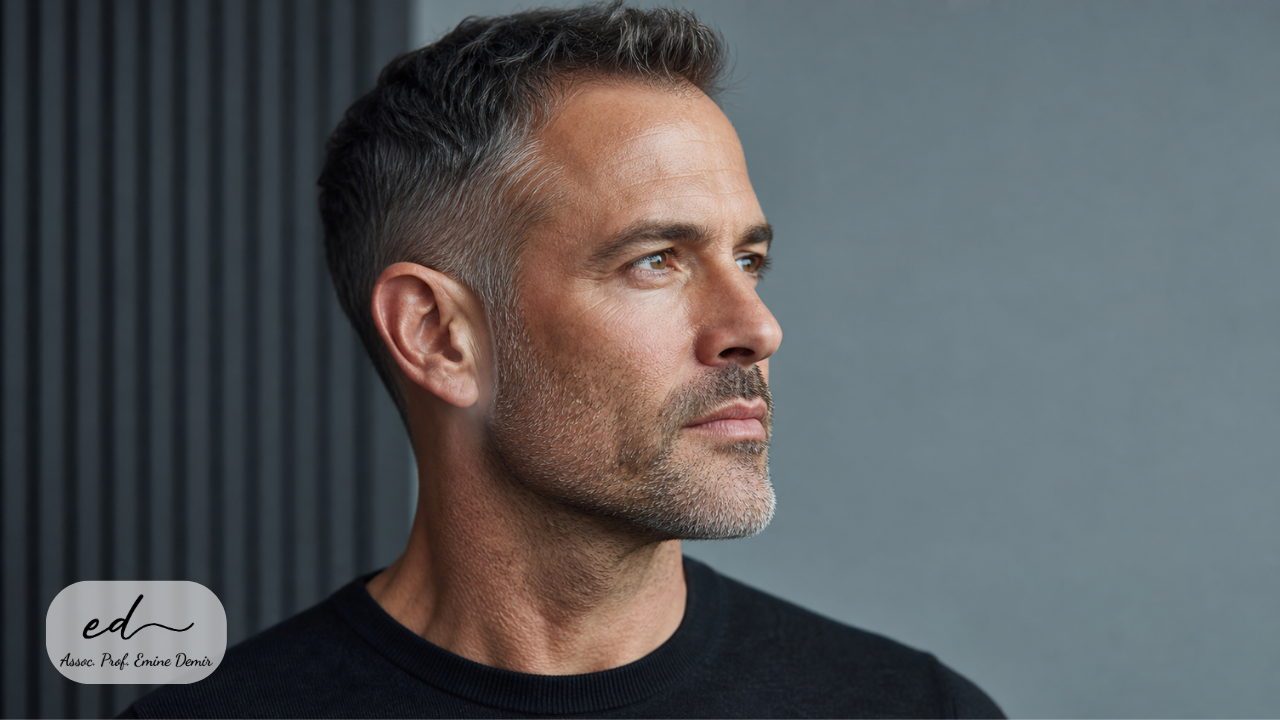
The surgical technique is the same in men; the planning is not. Male skin is thicker and more vascular, the SMAS is denser, and beard distribution constrains where incisions can be placed. Haematoma occurs at meaningfully higher rates in male patients, and the aesthetic objective is preservation of masculine landmarks rather than softening.
The question male patients open with is rarely about technique. It is about detectability.
“Will people know?”
The concern carries more weight than it might appear. Most men do not wear makeup — a point noted explicitly in the surgical literature on male facelift. Where a woman has some capacity to camouflage an early result or an imperfect scar, a man generally does not.
That single fact raises the stakes on every planning decision.
This article covers what actually differs in male deep plane facelift: the anatomy, the incision constraints, the elevated risks, and why “undetectable” is a technical requirement rather than a preference.
Three anatomical differences
1. Thicker, more vascular skin
Male facial skin is thicker than female skin and carries a denser network of blood vessels — largely because of the beard.
The consequences run in both directions.
For the result: thicker skin absorbs some of the refinement performed beneath it and influences how much repositioning is appropriate. It also changes swelling and bruising patterns during recovery.
For the risk: greater vascularity is directly associated with a higher rate of haematoma. More on this below, because it is the defining male-specific consideration.
2. A denser SMAS
The SMAS — the muscular-fascial layer that carries the lift in deep plane surgery — tends to be heavier and more fibrous in men.
This is not purely a disadvantage. A denser SMAS holds suspension well. But it resists reshaping, and the expert literature emphasises strong and stable SMAS suspension, particularly in the neck, as a defining goal of male facelift.
The anatomical logic of the deep plane approach is covered in more detail in the article on technique.
3. Beard and hairline anatomy
This is the difference that changes the operation most.
Male facial skin contains hair follicles across the cheek and jaw. Any repositioning of that skin moves the follicles with it. Which means incision planning must account not only for where the scar sits, but for where the hair ends up.
Incision planning: the male constraint
In female facelift, the incision is generally placed behind the tragal cartilage, where the contour conceals it. In men, that approach carries a specific hazard.
A retrotragal incision pulls beard-bearing skin toward the tragus and the ear canal region — producing a hair-bearing tragus, an outcome the surgical literature lists explicitly among those to be avoided.
For this reason the pretragal incision — running in front of the ear — is frequently preferred in male patients.
The baldness problem
This consideration is specific to men and almost never explained.
Incisions are conventionally hidden within hair. But in a male patient, hair that exists today may not exist in ten years. An incision concealed inside a hairline that later recedes becomes a visible scar in open scalp.
This is a further reason pretragal placement is often chosen: it does not depend on hair that may not persist.
Short-cropped hairstyles compound the issue. Where longer hair offers camouflage, a closely cut style offers none — narrowing the options further.
What the sideburn tells you
Among the stated goals of male facelift in the surgical literature: an unaltered hairline with natural sideburn length and shape, avoidance of a hair-bearing tragus, avoidance of surgical alopecia, and a natural-appearing earlobe.
Poorly planned incisions produce sideburns that sit too high, too low, or in an unnatural shape. This is described as one of the most common regrets following male facelift — and it is immediately visible to anyone who knew the patient before.
The practical implication: ask specifically where your sideburn will sit afterwards. It is a concrete question with a concrete answer, and it reveals how individually the planning has been done.
Incision placement generally is covered in more detail in the article on scars and incisions.
Haematoma: the defining male-specific risk
This section is the one that matters most, and it deserves stating plainly rather than softening.
Numerous studies have documented that male facelift patients are at greater risk of haematoma than female patients. Multiple large series report incidences two to several times higher in men.
Why
Three factors compound.
- Beard vascularity. The dense follicular blood supply of beard-bearing skin runs directly through the dissection plane.
- Thicker skin. Greater tissue bulk carries a richer vascular network.
- Blood pressure. Male patients tend to carry higher baseline blood pressures and more variable cardiovascular profiles.
What reduces it
The literature is specific here. Baker and colleagues initially reported that strict perioperative blood pressure control significantly reduced haematoma incidence in men, and subsequent work corroborated this.
But the same source adds an honest qualifier: even with blood pressure control regimens in place, haematoma rates remain higher in male patients than in female.
That sentence is worth reading twice. Control measures reduce the risk substantially. They do not eliminate the difference.
Alongside general medical screening, the risk factors identified as most relevant preoperatively are hypertension, smoking, non-steroidal anti-inflammatory and aspirin use, and antiplatelet or anticoagulant medication.
What this means for you
None of this disqualifies men from facelift surgery, and outcomes in male patients are excellent. What it means is that a serious approach applies tighter perioperative protocols, more meticulous intraoperative haemostasis, and closer early postoperative monitoring when the patient is male.
It also means the warning sign matters more. Haematoma is the most common facelift complication requiring return to theatre, and it typically presents within the first 24 hours: one-sided pain that increases rather than settles, with visible swelling on that side. This is a same-day call, not something to wait out.
Complication rates across facelift surgery generally are covered in the article on risks.
The aesthetic objective: preservation, not softening
The stated goals of male facelift in the expert literature read differently from the female equivalent:
- Restoration of a “well” appearance — rested rather than altered
- Strong and stable SMAS suspension, particularly in the neck
- Enhancement of deep malar and central facial volume
- Avoiding augmentation of the malar area, specifically to avoid feminisation
- Preservation of facial hair patterns
- Minimisation of postoperative haematoma
The fourth point is instructive. Malar volume that reads as attractive in a female face reads as feminine in a male one. The literature names this explicitly as a technical decision made to avoid feminisation — not an aesthetic preference.
The same logic applies across the operation. Excessive lifting can feminise a male face; the objective is a defined jawline and a rested appearance while masculine landmarks are preserved.
Why “undetectable” is a technical requirement for men
Here is the point the brief for this article rightly emphasises, and the literature supports it directly.
Achieving a natural postoperative result is described as paramount in male patients — with a specific reason given: most men do not wear makeup.
The implication is practical. A woman with a pink scar at six weeks has options. A man does not. A woman with an early result that is still settling can soften the transition. A man cannot.
So in male facelift, “natural” is not a stylistic goal that some patients prefer. It is a requirement imposed by the absence of any fallback.
What natural results actually look like is covered in a separate article.
The neck usually matters more in men
Male patients frequently present with the neck as their primary concern rather than the midface.
There is a reason the expert literature singles out SMAS suspension in the neck as a defining goal of male facelift. Submental fullness, platysmal banding and loss of jawline definition are the changes men most often want addressed — and the jawline is where masculine definition is most legible.
The anatomy of deep neck work, and why a facelift alone does not fully correct the neck, is covered in the article on the combined approach.
Recovery in male patients
Recovery follows the same course but with two differences.
- Swelling persists longer. Thicker skin holds oedema, and sources describe recovery in male patients extending toward three to four weeks for the visible phase.
- The final result appears later. Refinement performed under thicker skin takes longer to become visible.
Two practical points specific to men:
Shaving. Ask when you can resume shaving and how to manage the incision area. The taped and healing region needs protection, and beard growth over an incision line requires care during the early weeks.
Blood pressure. Given the haematoma association, any prescribed blood pressure management before and after surgery is not optional detail. It is among the few measures shown to reduce the specific risk you carry.
Travelling for surgery
Two considerations carry additional weight for male patients travelling for treatment.
First, the haematoma risk profile makes the first 24 to 48 hours more consequential. Haematoma is time-critical: identified early it is straightforward to manage, and it presents almost always within the first day. Being reachable, monitored and close to the operating team during that window matters more when your baseline risk is higher. Travel plans should be built around this rather than the other way round.
Second, incision planning cannot be finalised remotely. Beard distribution, sideburn position, current hairline and — importantly — the likely pattern of future hair loss all inform where the incision goes. Photographs convey some of this. A great deal of it is assessed in person.
A surgeon who asks about your family history of hair loss during a male facelift consultation is not making conversation. They are planning an incision that has to remain hidden in a decade.
Questions worth asking
- Will my incision be pretragal or retrotragal, and why?
- Where will my sideburn sit afterwards?
- How does my hairline — and any likely future recession — affect the plan?
- What is your haematoma protocol for male patients specifically?
- How will my blood pressure be managed before and after surgery?
- What are you doing to avoid a feminised result?
- When can I shave again?
- How long before the result stops looking recent?
Question four is the one that separates a general answer from a considered one. A surgeon who regularly operates on male patients will have a specific protocol and will be able to describe it.
Question six is worth asking plainly. It is the concern most male patients have and the one least often voiced.
In summary
Deep plane facelift in male patients uses the same technique with different planning.
Male skin is thicker and more vascular, the SMAS is denser, and beard distribution constrains where incisions can be placed. A retrotragal incision risks producing a hair-bearing tragus; incisions hidden in hair risk becoming visible if that hair recedes. Sideburn position is among the most common regrets after poorly planned male facelift.
Haematoma is the defining male-specific risk, occurring at rates reported as two to several times higher than in women. Perioperative blood pressure control reduces this significantly, but the literature is clear that rates remain higher in men even with control measures in place.
And the aesthetic objective differs: preservation of masculine landmarks rather than softening, with malar augmentation specifically avoided to prevent feminisation.
Above all, a natural result is not a preference in male patients. Without the option of camouflage, it is the requirement the whole plan is built around.
If you would like your own anatomy, beard pattern and hairline assessed, you can arrange a free video consultation.
Frequently Asked Questions
Is male facelift different from female facelift?
The technique is the same; the planning differs. Male skin is thicker and more vascular, the SMAS is denser, beard distribution constrains incision placement, and the aesthetic objective is preservation of masculine landmarks rather than softening.
Do men have a higher risk of haematoma?
Yes. Numerous studies have documented that male facelift patients are at greater risk than female patients, with multiple large series reporting incidences two to several times higher. Beard vascularity, thicker skin and higher baseline blood pressure all contribute.
Can that risk be reduced?
Substantially, yes. Strict perioperative blood pressure control has been shown to significantly reduce haematoma incidence in men, and subsequent work has corroborated this. However, the literature notes that even with control regimens, rates remain higher in male patients than in female.
Where will my incisions be?
Frequently in front of the tragus (pretragal) rather than behind it. A retrotragal incision risks pulling beard-bearing skin toward the tragus and ear canal, producing a hair-bearing tragus — an outcome the surgical literature lists among those to be avoided.
How does hair loss affect the plan?
Significantly. Incisions concealed within a hairline that later recedes become visible scars in open scalp. This is one reason pretragal placement is often preferred in male patients, since it does not depend on hair that may not persist.
Will my sideburn change?
It should not, and preserving natural sideburn length and shape is among the stated goals of male facelift. Poorly planned incisions can leave sideburns too high, too low or unnaturally shaped — described as one of the most common regrets after male facelift.
How do surgeons avoid a feminised result?
Through specific technical decisions. The expert literature names avoiding malar augmentation as a deliberate choice made to prevent feminisation, alongside preserving jawline definition and avoiding excessive lifting.
Does recovery take longer in men?
Somewhat. Thicker skin holds swelling longer, with sources describing the visible recovery phase extending toward three to four weeks in male patients, and the final refinement appearing later.
Assoc. Prof. Dr. Emine Demir — Facial Aesthetic Surgeon specialising in deep plane facelift, neck lift and endoscopic facial rejuvenation. About Dr. Demir
This content is for informational purposes only and does not constitute medical advice. Individual anatomy determines achievable outcomes and risk profile, and results vary between patients. Please consult a qualified physician regarding your own situation.
References
- How to Prevent and Treat Complications in Facelift Surgery, Part 1: Short-Term Complications. PMC8240741.
- Steinbrech DS, Cohen O. The Male Face-Lift. In: Facial Surgery.
- The Modern Male Rhytidectomy: Expert Technique.
- Baker DC, et al. Perioperative blood pressure control and haematoma incidence in male rhytidectomy.