
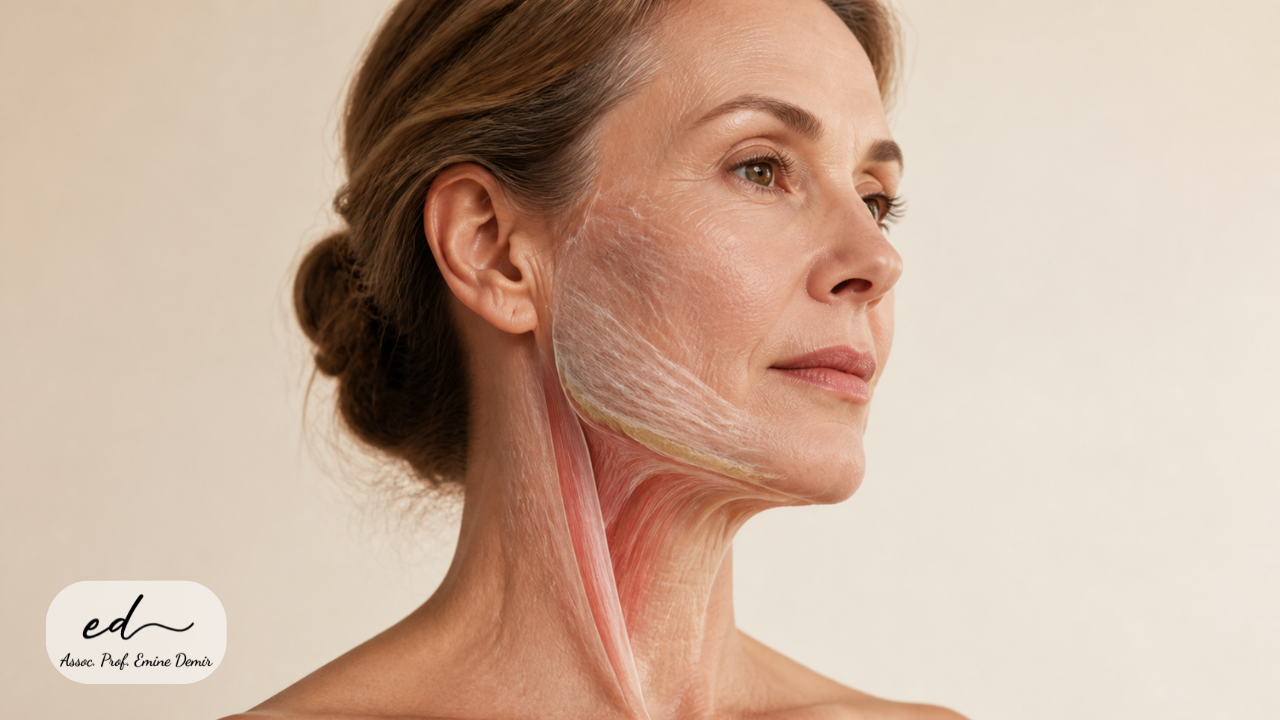
A facelift alone cannot fully correct the neck, because most of what creates neck fullness sits beneath the platysma muscle — where a lateral approach cannot reach. In deep cervicoplasty, subplatysmal volume reduction accounts for 73% of the total volume removal required to achieve an optimal cervicomental angle. Addressing face and neck together treats what is anatomically a single continuous system.
A specific frustration brings patients back for a second opinion: “I had a facelift. My face looks better. My neck doesn’t.”
It is a common outcome, and it is rarely a technical failure. It reflects an anatomical reality that is not always explained beforehand.
The face and neck age as one system but require two different surgical approaches. A procedure that addresses only one of them will produce exactly the result those patients describe.
This article explains why that happens, what a deep neck lift adds that a facelift cannot, why combining them makes anatomical sense, and where the honest limits of the result lie.
Why the face and neck are one system
The connection is not conceptual. It is anatomical and continuous.
The SMAS — the muscular-fascial layer that carries the lift in deep plane surgery — does not stop at the jawline. The platysma, the broad sheet muscle of the anterior neck, is the inferior continuation of the SMAS.
One layer, two regions. When it descends with age, it descends as a unit.
This is why treating the face without the neck creates an unnatural transition: the upper portion of a continuous structure is repositioned while the lower portion remains where age left it. The result is a rejuvenated face sitting above an untreated neck — and the eye reads the discrepancy immediately.
The same anatomical logic underpins my other articles on this technique, including the anatomy of the deep plane approach.
Why a facelift alone does not fix the neck
Two reasons, and both are structural rather than technical.
Reason one: the lift works in only one direction
A facelift repositions the SMAS-platysma continuum laterally — pulling from the sides, toward the ear and upward. That vector improves the jawline and the lateral neck considerably.
But the platysma has a midline component. With age, the medial borders of the muscle separate, producing the vertical cords patients call “neck bands.” These sit in the centre of the neck, and no amount of lateral tension corrects a midline separation.
Correcting them requires access from the midline — a small incision beneath the chin through which the separated borders are brought together and secured.
The cervicomental angle is restored by the combination of these two manoeuvres. Lateral repositioning alone provides one half of the equation.
Reason two: 73% of the volume is out of reach
This is the more decisive point, and the one patients almost never hear.
What blunts a neck angle is often not skin or muscle laxity at all. It is volume sitting beneath the platysma:
- Subplatysmal fat, which accumulates with age
- The anterior digastric muscles, which can hypertrophy and produce visible fullness under the chin
- The submandibular glands, which descend or enlarge with age
- The perihyoid fascia, which can thicken and blunt the angle
A study published in the Aesthetic Surgery Journal quantified this: during deep cervicoplasty, subplatysmal volume reduction accounted for 73% of the total volume reduction required to achieve an optimal cervicomental angle.
Read that figure alongside the anatomy and the conclusion follows: nearly three-quarters of what needs removing sits beneath a muscle that a lateral facelift approach does not open.
This explains a pattern seen frequently in consultation — a patient who has had submental liposuction, or a facelift with limited neck work, and whose neck fullness persists. The fat that was removed was the superficial fat. The fat causing the problem was underneath.
The neck relapses faster than the face
There is a second, independent argument for treating the neck definitively, and it comes from long-term follow-up data.
In a study using standardised photographs 5.5 years after surgery, the jowl had been elevated 6 mm at surgery, with a 21% relapse at follow-up — the correction remained statistically maintained.
The cervicomental angle told a different story. It had improved by 13 degrees at surgery but showed a 69% relapse over the same period. The authors described this as differential regional aging.
In plain terms: the midface holds; the neck softens first.
This has a direct implication for surgical planning. If the neck is the region that deteriorates fastest, it is the region that most warrants a definitive rather than a partial approach at the outset. Treating it superficially in the primary operation means revisiting it sooner.
What a deep neck lift involves
The term describes work performed beneath the platysma, through a small submental incision, in addition to the lateral work of the facelift.
Depending on individual anatomy, this may include:
| Structure | What is done | Why |
|---|---|---|
| Subplatysmal fat | Sculpted and reduced | The single largest contributor to a blunted angle |
| Anterior digastric muscles | Partial tangential reduction where hypertrophied | Produce visible fullness under the chin |
| Submandibular glands | Partial reduction of the lower pole where prominent | Descent or enlargement creates convexity |
| Platysma (midline) | Separated borders brought together and secured | Corrects vertical bands and restores continuity |
| Perihyoid fascia | Released where thickened | Deepens the cervicomental angle |
Not every patient needs every element. The assessment determines which structures are actually contributing to that individual’s neck contour — and this is why examination cannot be replaced by photographs.
Why this work requires specific expertise
The submental region contains structures that demand precise handling. The marginal mandibular branch of the facial nerve runs in proximity to the submandibular gland, and gland reduction is performed with a specific technique — intracapsular dissection — precisely to protect it.
Control of the gland’s blood supply is likewise deliberate, as bleeding in this space is difficult to manage after closure.
These are not reasons to avoid the procedure. They are reasons the procedure belongs in experienced hands and should be discussed specifically rather than bundled into a general description of “a facelift with a neck lift.”
The advantages of combining
Given that both regions need attention, the practical question is whether to treat them together.
- One anaesthetic. Anaesthetic risk is not taken twice.
- One recovery. Two separate operations mean two separate periods away from normal life.
- Continuous correction. The SMAS-platysma layer is treated as the single structure it is, rather than in two disconnected halves.
- Better transition. The jawline is where face meets neck. Treating both allows that junction to be shaped as one line.
- Intraoperative assessment. Deep neck contouring is iterative — after fat reduction the contour is reassessed, then digastric and gland work considered. Doing this in the same session as the lift means the whole lower face is evaluated as one result.
The fifth point deserves emphasis. Deep neck work is not a fixed protocol executed the same way every time. The contour is reassessed at each stage and the next decision follows what is seen. That process works better when the face is being addressed simultaneously.
I have covered neck surgery as a standalone procedure in a separate article on neck lift surgery, which is relevant for patients whose face does not yet require intervention.
The honest limits: what anatomy determines
This section matters, because expectations set here prevent disappointment later.
Not every neck can achieve the same angle, regardless of technique. Three anatomical factors constrain the result.
Hyoid position
The hyoid is a small horseshoe-shaped bone in the neck, and its position corresponds to the vertex of the cervicomental angle. Ideally it sits high. When positioned low and forward, the achievable angle is limited by skeletal anatomy rather than soft tissue.
Mandibular capacity
The published literature describes this directly: where the mandible has limited volumetric capacity to contain the subplatysmal contents, the platysma cannot compress those structures against the floor of the mouth within a fixed skeletal frame. There is, in effect, more content than container.
Chin projection
A recessed chin widens the cervicomental angle independently of any soft tissue issue. In these patients, the discussion may extend to chin augmentation as part of achieving a defined profile.
Why this matters for expectations
A relevant observation from the literature: a youthful neck is not always synonymous with an aesthetic neck. A widened cervicomental angle in a young person may result from a recessed chin, a low hyoid or congenital fat distribution — none of which are aging changes.
The practical implication: if you have never had a defined neck angle, surgery restores your anatomy rather than creating an anatomy you never had. A surgeon who assesses hyoid position and chin projection during consultation is telling you something useful about what is achievable.
Recovery when both are combined
Recovery after a combined procedure is more involved than a facelift alone, though considerably less than two separate operations.
- First days: swelling and tightness, most noticeable under the chin. A drain may be used.
- Weeks 1-2: bruising fades; the neck often feels tighter than the face at this stage.
- Weeks 3-6: swelling continues to settle. The submental area is typically the slowest region.
- Months 2-3: the jawline and neck angle begin to define.
- Months 6-12: final contour; scars continue to mature.
One point worth setting in advance: the neck settles more slowly than the face. Firmness and irregularity under the chin during the first weeks is expected as deep tissue heals, and is not an indication that the result has failed. This is the single most common source of unnecessary worry in the early weeks.
Scar placement, including the submental incision, is covered in the article on incisions and scars.
Who is a candidate for the combined approach?
The combination is generally appropriate where both regions show change:
- Loss of jawline definition with midface descent
- Visible platysmal bands in the neck
- Submental fullness that has not responded to weight loss
- A blunted cervicomental angle
- Reasonably preserved skin quality
- Good general health and realistic expectations
Conversely, a facelift alone may be sufficient where the neck is genuinely unaffected — though in practice this is less common than patients assume, particularly beyond the mid-fifties.
Candidacy criteria in more detail are covered in a separate article.
Travelling for combined surgery
For international patients, two points deserve advance consideration.
First, the extent of neck work cannot be finalised remotely. Whether subplatysmal fat reduction alone suffices, or whether digastric or glandular work is indicated, depends on findings during surgery as much as on examination. Photographs cannot reveal what sits beneath the platysma. Arriving with a defined plan for a specific technique is less useful than arriving with a clear understanding of the assessment process.
Second, combined procedures involve a longer operation and a longer stay. The neck settles more slowly, and the timing of return travel is confirmed by the operating surgeon based on recovery rather than on a booking made in advance.
In summary
The face and neck age as one system because they are one system: the platysma is the inferior continuation of the SMAS.
A facelift alone cannot fully correct the neck for two structural reasons. It applies a lateral vector only, while midline platysmal separation requires access from beneath the chin. And it does not open the plane beneath the platysma — where 73% of the volume requiring reduction is located.
Long-term data adds a further argument: at 5.5 years, jowl correction showed 21% relapse while the cervicomental angle showed 69%. The neck deteriorates faster, which makes a definitive rather than partial approach more logical at the outset.
Combining the procedures treats a continuous structure continuously, under one anaesthetic and one recovery. But the achievable result is bounded by anatomy — hyoid position, mandibular capacity and chin projection determine what any technique can deliver.
If you would like your own anatomy assessed and the appropriate extent of work discussed, you can arrange a free video consultation. Reviewing what natural results actually look like beforehand often makes that conversation more productive.
Frequently Asked Questions
Why doesn’t a facelift alone fix the neck?
For two structural reasons. A facelift applies a lateral vector, while midline platysmal separation requires access from beneath the chin. And it does not open the plane beneath the platysma, where subplatysmal volume reduction accounts for 73% of the total reduction needed to achieve an optimal cervicomental angle.
What is the platysma and why does it matter?
The platysma is the broad sheet muscle of the anterior neck and the inferior continuation of the SMAS — the layer that carries the lift in deep plane surgery. Face and neck are therefore one continuous structure rather than two separate regions.
What does a deep neck lift address that a facelift does not?
Subplatysmal fat, hypertrophied anterior digastric muscles, prominent submandibular glands, midline platysmal separation and thickened perihyoid fascia. These structures sit beneath the platysma and are reached through a submental incision.
Why does the neck relapse faster than the face?
Differential regional aging. In a study at 5.5 years after surgery, jowl correction showed 21% relapse while the cervicomental angle showed 69%. This is one reason a definitive approach to the neck at the primary operation is preferable to a partial one.
Can I have the neck done separately later?
It is possible, but combining offers advantages: one anaesthetic, one recovery, and treatment of the SMAS-platysma layer as the continuous structure it is. Staging also means the jawline transition is shaped across two separate operations rather than as one line.
Will my neck angle be perfect?
The achievable angle is bounded by anatomy. Hyoid position, mandibular capacity to contain subplatysmal contents, and chin projection all constrain the result regardless of technique. A widened angle in a young person may reflect congenital anatomy rather than aging.
Is combined surgery riskier?
Deep neck work involves structures requiring precise handling, including the marginal mandibular nerve near the submandibular gland, which is why gland reduction uses intracapsular dissection specifically to protect it. These considerations should be discussed individually rather than assumed.
How long does the neck take to settle?
Longer than the face. Firmness and irregularity under the chin during the first weeks is expected as deep tissue heals. The jawline and neck angle begin to define around two to three months, with the final contour emerging between six and twelve months.
Assoc. Prof. Dr. Emine Demir — Facial Aesthetic Surgeon specialising in deep plane facelift, neck lift and endoscopic facial rejuvenation. About Dr. Demir
This content is for informational purposes only and does not constitute medical advice. Individual anatomy determines achievable outcomes, and results vary between patients. Please consult a qualified physician regarding your own situation.
References
- Optimizing Outcomes in Neck Lift Surgery. Aesthetic Surgery Journal 2021;41(8):871.
- Jones BM, Lo SJ. How long does a face lift last? Objective and subjective measurements over a 5-year period.
- Deep neck surgery in deep plane facelifts — learning from evidence and experience, 2025.
- Deep Tissue Sculpture in Neck Rejuvenation: Review of 641 Consecutive Cases.
- A layered approach to neck lift — anatomical considerations in cervical rejuvenation.