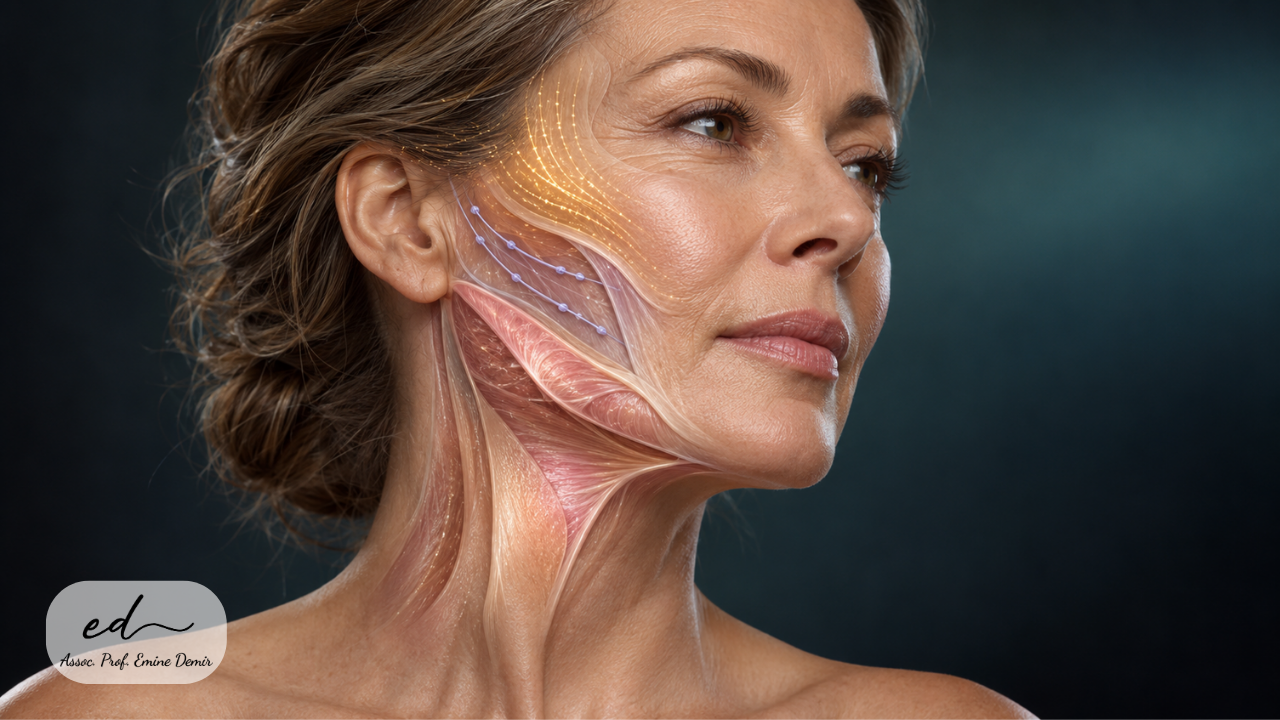

The single most useful thing to know before surgery is that swelling does not peak on day one — it peaks somewhere between days four and seven. You will look worse on day four than you did on day two, and that is the expected course rather than a setback. Numbness follows a predictable order too, because nerves regenerate at a fixed rate and the areas furthest from the surgery simply take longest. Knowing both patterns in advance turns an anxious wait into a sequence you can follow.
Most aftercare guides are lists of instructions. Useful, but they leave out the thing patients most want to know:
“Is what I’m seeing normal?”
So this guide is built around that question. What happens, when it happens, why it happens — and the specific signs that mean you should pick up the phone.
The first 48 hours
This period has one priority, and it is not comfort.
Why this window matters
Haematoma — a collection of blood beneath the skin — is the most common complication of facelift surgery requiring a return to theatre, and it characteristically presents in the first 24 to 48 hours.
It is also highly treatable when recognised early.
This is why someone stays with you, why you remain reachable, and why the stay length is what it is. Not because anything is expected to go wrong, but because this is the window in which early recognition matters most.
What to do
- Keep your head elevated. 30 to 45 degrees, from the first night.
- Rest, but do not lie flat.
- Keep blood pressure steady. Avoid straining, bending and sudden exertion.
- Take medication as prescribed, including any blood pressure medication you were told to continue.
- Have someone with you.
- Keep the surgical team’s number to hand — not saved somewhere, actually to hand.
The one sign that matters most
Sudden swelling on one side only.
Facelift swelling is symmetrical and gradual. One side becoming rapidly larger than the other, especially with increasing pain or tightness, is the signature of a haematoma.
Do not wait to see whether it settles. Call.
The wider picture of complications is covered in the article on risks.
Swelling: the timeline nobody warns you about
This section exists because of one predictable moment of panic.
It gets worse before it gets better
Published recovery guidance is consistent: swelling and bruising peak between days four and seven.
Which means the sequence looks like this:
| Period | What’s happening |
|---|---|
| Days 1-3 | Swelling builds, bruising develops |
| Days 4-7 | Peak — this is the worst it looks |
| Week 2 | Bruising fades, swelling visibly reduces |
| Weeks 3-4 | Residual swelling, mainly jawline and in front of the ears |
| Weeks 4-6 | Most visible swelling resolves |
| Weeks 6-8 | Obvious bruising gone |
| Months 2-3 | Most swelling resolved; subtle swelling can persist |
So if you feel discouraged on day four or five — that is the schedule, not a complication.
Deep swelling can take longer still, particularly where neck work or fat transfer was involved.
What helps
- Head elevation. The simplest and most effective measure. 30 to 45 degrees.
- Cold compresses in the early days, as directed — never applied directly to skin, and never to numb areas without care, because numbness removes your warning system for cold injury.
- Low salt intake. Salt holds fluid.
- Hydration. Counterintuitive, but dehydration worsens fluid retention.
- Gentle movement. Short walks indoors support circulation without raising blood pressure.
- Avoid heat. Hot showers, saunas and sun all dilate vessels and increase swelling.
What does not help
- Massaging the face unless specifically instructed. Early tissue is repositioning and should be left alone.
- Anti-inflammatory tablets unless approved — many affect bleeding.
- Checking the mirror hourly. Swelling shifts through the day; morning is always worse.
Sleeping: the position that does most of the work
Elevation is not a comfort preference. It is the main mechanical tool you have against swelling.
How
- 30 to 45 degrees, from the first night
- On your back, not on your side — side pressure distorts healing tissue and makes one side swell more
- A wedge pillow or recliner is more reliable than stacked pillows, which slide
- Pillows either side of your head help if you tend to turn in your sleep
How long
Guidance commonly describes lying flat becoming comfortable again toward the end of week two.
Many patients find they naturally stop needing elevation around that point. Your surgeon’s instruction governs.
If you can’t sleep
Common in the first nights, and worth expecting rather than being alarmed by. Sleeping upright is unfamiliar, and the tightness is at its most noticeable early.
A recliner often works better than a bed. Short daytime naps are fine. And this resolves — usually within the first week.
Numbness: why it follows an order
This is the symptom that generates the most worry, and the one best resolved by understanding the mechanism.
Why it happens
A deep plane facelift involves dissection beneath the SMAS, and the small sensory nerves supplying the skin are stretched, moved and temporarily disrupted. Swelling compresses them further.
The result is numbness — often described as a thick, padded sensation rather than absence of feeling.
And why it resolves in a predictable order
Here is the useful part.
Peripheral nerves regenerate at approximately 1 mm per day.
That fixed rate means recovery time depends mainly on distance. Areas closer to intact nerve supply recover first; areas further away take longer.
Which produces this sequence:
| Area | Typical return of sensation |
|---|---|
| Cheeks and temples | 2-4 weeks |
| Jaw and jowl | 4-8 weeks |
| Neck and behind the ears | 6-12 weeks |
| Along incision lines | Can remain slightly numb for several months |
So the earlobe and the area behind the ear being last is not a bad sign. That region is supplied by the great auricular nerve, the nerve most commonly affected in facelift surgery, and it simply has the furthest to travel.
What recovery feels like
Sensation does not switch back on. It returns through stages that can themselves be unsettling if unexpected:
- Tingling and pins and needles
- Itching — often intense, and a genuinely good sign
- Brief zinging or buzzing sensations
- Hypersensitivity in patches before normal feeling returns
- Numb areas shrinking rather than fading uniformly
The last point is worth highlighting: numbness recedes from the edges inward. Noticing that a numb patch is smaller than it was a fortnight ago is the clearest evidence of progress.
When numbness is not normal
Contact your surgeon if you notice:
- Numbness expanding after a period of improvement
- Weakness rather than numbness — difficulty moving part of the face, or an asymmetric smile
- Sharp, electric-shock pain
- Worsening burning pain
- No improvement at all over several months
The second point is the important distinction: numbness is sensory, weakness is motor. Not being able to feel an area is expected. Not being able to move it is not, and should be reported.
Week by week
Week 1
Dressings and possibly drains early on. Sutures typically removed around days five to seven. Swelling peaks mid-week. Rest, elevation, and short indoor walks. This is the hardest week and the one patients most often underestimate.
Week 2
Bruising fades, swelling visibly reduces. Lying flatter becomes comfortable toward the end. Desk or remote work becomes possible for some. Keep social plans modest.
Weeks 3-4
Most patients return to in-person work and resume social activity cautiously. Residual swelling persists along the jawline and in front of the ears. Tightness is often at its most noticeable — and it eases.
Weeks 4-6
Most visible swelling resolves. Strenuous exercise is generally resumed in this window, confirmed at follow-up. The face begins to look like itself.
Weeks 6-8
Obvious bruising gone, swelling much improved. Numbness continues receding, typically from the cheeks downward and outward.
Months 2-3 and beyond
Most swelling resolved. Subtle changes continue for months as deep swelling settles and scars mature. What natural results look like at this stage is covered in a separate article.
Returning to work, by role
| Type of work | Typical return |
|---|---|
| Desk or remote | 10-14 days |
| Public-facing | 2-3 weeks or longer |
| Physically demanding | 4-6 weeks |
Other sensations that are normal
Several of these cause more worry than they warrant.
Tightness. Expected, and often most noticeable around weeks two to four as swelling shifts. It eases as tissue settles.
Lumps and firm areas. Particularly along the jawline and in front of the ears. Usually swelling and scar tissue, which soften over months.
Asymmetry. The two sides almost never swell at the same rate. Comparing them in week two tells you about swelling, not about your result.
Ear sensations. Fullness, tenderness, or an odd feeling in the earlobe — common, given the dissection in that area.
Itching. A sign of nerve recovery and wound healing.
Feeling low around day four or five. Widely reported, and understandable: swelling peaks, anaesthetic has worn off, and the result is not yet visible. It passes.
🔴 When to call — the short list
Keep this somewhere you can find it.
Call urgently for:
- Sudden swelling on one side only
- Expanding bruising or active bleeding
- Pain not controlled by your prescribed medication
- Fever above 38°C
- Skin that looks darkening or dusky
- New facial weakness or droop
- Sudden visual changes
- Difficulty breathing
Published guidance notes these can indicate haematoma, infection or other complications that benefit from early intervention.
That phrase is the point. These are not situations to monitor at home — they are situations where contacting the team early changes the outcome.
And a principle worth stating plainly: calling about something that turns out to be normal costs nothing. Not calling about something that was not costs a great deal. No surgical team minds the first.
If you travelled for surgery
Two practical points.
Build the stay around the first window, not the itinerary. The 24 to 48 hours after surgery is when the time-critical complication presents, and being monitored and reachable through it is the reason stay lengths are what they are. Suture removal around days five to seven is the other practical anchor.
Establish the follow-up route before you fly home. Who you contact, through what channel, how quickly they respond, and what they will want — usually photographs in good natural light.
Numbness and settling continue for months after you leave. Knowing there is a defined route back for questions matters more than most people anticipate.
Considerations for international patients are covered in a separate guide.
What to have ready at home
- Wedge pillow or recliner
- Cold compresses and a cloth barrier
- Prescriptions, already filled
- Soft foods and straws
- Thermometer
- Front-fastening clothing
- The surgical team’s contact details, written down
- A companion for the first 24 hours
Preparation before surgery is covered in the pre-op checklist.
In summary
Two patterns make recovery far easier to live through.
Swelling peaks between days four and seven. You will look worse before you look better, and that is the schedule rather than a setback. Visible swelling largely resolves by weeks four to six, with subtle settling continuing for months.
Numbness resolves in order of distance. Nerves regenerate at roughly 1 mm per day, so cheeks and temples return first, the jawline next, and the neck and area behind the ears last. A numb earlobe at week eight is the expected sequence, not a complication.
Elevation at 30 to 45 degrees, sleeping on your back, avoiding heat and keeping blood pressure steady are the measures that genuinely influence swelling.
And one sign stands above the others: sudden swelling on one side only, particularly in the first 24 to 48 hours. That one is worth a phone call every time.
If you would like to discuss recovery for your own circumstances, you can arrange a free video consultation. The procedure itself is explained in the article on technique.
Frequently Asked Questions
When does swelling peak after a deep plane facelift?
Published recovery guidance consistently places the peak between days four and seven. Swelling builds over the first three days, peaks mid-week, then visibly reduces through week two. Looking worse on day four than day two is the expected course.
How long does swelling last?
Most visible swelling resolves by weeks four to six, with obvious bruising gone by weeks six to eight. Subtle swelling can persist for months, particularly where neck work or fat transfer was involved.
How should I sleep?
Head elevated at 30 to 45 degrees, on your back rather than your side, from the first night. A wedge pillow or recliner is more reliable than stacked pillows. Lying flatter commonly becomes comfortable toward the end of week two.
How long does numbness last?
It resolves in order of distance from the surgery, because nerves regenerate at roughly 1 mm per day. Cheeks and temples typically return at two to four weeks, the jaw and jowl at four to eight weeks, and the neck and area behind the ears at six to twelve weeks. Incision lines can remain slightly numb for several months.
Why is my earlobe still numb?
That area is supplied by the great auricular nerve, the nerve most commonly affected in facelift surgery, and it has the furthest distance to recover. Being last is the expected sequence rather than a complication.
Is itching normal?
Yes, and it is a good sign. Itching, tingling and brief zinging sensations typically accompany nerve recovery. Numb areas also shrink from the edges inward rather than fading uniformly.
When should I call the surgeon?
Urgently for sudden swelling on one side only, expanding bruising or bleeding, pain not controlled by medication, fever above 38°C, darkening or dusky skin, new facial weakness or droop, sudden visual changes, or breathing difficulty. Guidance notes these can indicate complications that benefit from early intervention.
What is the difference between numbness and weakness?
Numbness is sensory — you cannot feel an area, which is expected. Weakness is motor — you cannot move it, or your smile is asymmetric. Weakness should be reported rather than monitored.
When can I return to work?
Commonly cited: desk or remote work at 10 to 14 days, public-facing roles at two to three weeks or longer, and physically demanding work at four to six weeks. Strenuous exercise is generally resumed at four to six weeks, confirmed at follow-up.
Assoc. Prof. Dr. Emine Demir — Facial Aesthetic Surgeon specialising in deep plane facelift, neck lift and endoscopic facial rejuvenation. About Dr. Demir
This content is for informational purposes only and does not constitute medical advice. Recovery varies between patients and procedures; your surgeon’s own post-operative instructions take precedence over any general guidance. Contact your surgical team with any concern rather than waiting.