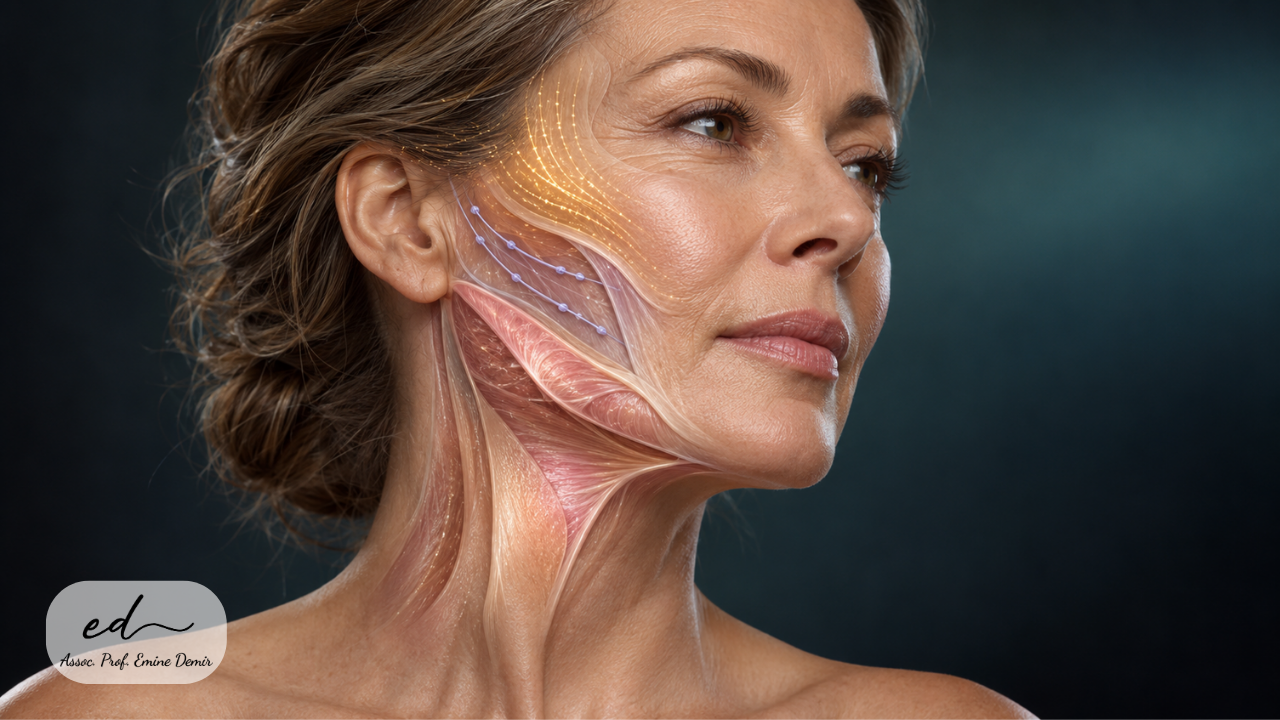
Energy devices and thread lifts are not smaller versions of a facelift — they are different tools doing a different job. Published systematic reviews measure microfocused ultrasound’s lift in millimetres: 0.47 to 1.7 mm at the brow. These treatments are effective for mild to moderate skin laxity. Where the underlying support structure has descended, no amount of surface tightening reaches it.
Almost every consultation reaches this question, usually phrased hopefully: “Is there something I can do that isn’t surgery?”
The honest answer has two parts, and most articles only give one of them.
Yes — there are non-surgical treatments with measurable effects, and for some patients they are genuinely the right choice.
And no — they do not do what a facelift does, and the difference is not a matter of degree. It is a matter of which anatomical layer is being treated.
This article explains both, with the published numbers.
The anatomy that decides everything
To compare these options meaningfully, one distinction has to come first.
Facial ageing involves several processes, but two matter here:
Skin changes. Collagen loss, reduced elasticity, textural change. The skin itself becomes looser and thinner.
Structural descent. The deeper layer — the SMAS, and the ligaments that anchor it — loosens, and the soft tissue of the midface descends. This is what produces jowls, a deepening nasolabial fold and loss of the jawline.
These are different problems. And they respond to different things.
Four mechanisms, four ceilings
Every option on the table does one of four things:
| Approach | Mechanism | Layer reached |
|---|---|---|
| Energy devices (MFU, RF) | Thermal tightening — collagen stimulation and tissue contraction in place | Skin and deeper layers, but tissue stays where it is |
| Threads | Mechanical suspension with sutures | Subcutaneous; tissue is held, not released |
| SMAS plication / mini lift | Gathering — the SMAS is bunched together | SMAS, but gathered rather than moved |
| Deep plane facelift | Release and reposition — the SMAS is freed and moved | SMAS repositioned to a new position |
Read the right-hand column. Only the last row moves tissue to a different place.
That is not a marketing claim — it is a description of what each technique physically does. And it explains why each has the ceiling it has.
The anatomy of the deep plane approach is covered in the article on technique.
Energy devices: what the measurements show
Microfocused ultrasound — Ultherapy is the best-known brand — and radiofrequency devices both work by delivering controlled thermal energy to stimulate collagen and contract tissue.
The effect is real and it has been measured.
The numbers
A systematic review of microfocused ultrasound for facial skin tightening reported:
- Brow lift: 0.47 to 1.7 millimetres
- Submental area: a 26 to 45 mm² reduction measured on lateral photographs
- Patient-reported improvement described as mild, rising from 42% at 90 days to 53% at 360 days
The review’s conclusion on indication is specific: microfocused ultrasound is effective for mildly to moderately lax skin.
These are genuine, statistically significant results. They are also, as one summary puts it, measured in millimetres.
How long does it last?
This is where the data is most useful, because it shows a curve rather than a plateau.
In the pooled data, the proportion of subjects achieving a brow lift greater than 0.5 mm was:
- 35% at 3 months
- 45% at 6 months
- 39% at 1 year
So the effect builds over roughly six months as new collagen forms, then begins to decline.
This is why maintenance treatments are recommended — not as upselling, but because that is how the biology behaves.
Ultherapy or radiofrequency — does it matter?
Less than most patients expect.
A randomised, split-face, evaluator-blind trial compared monopolar radiofrequency with microfocused ultrasound for lifting and tightening the face and upper neck.
The finding: both produced significant improvements in face and neck laxity, with no statistical differences between the two device types in investigator-assessed laxity, patient satisfaction or adverse events.
So the choice of device matters less than the choice of category — and whether the category fits the problem.
An honest note about the evidence itself
The meta-analysis of microfocused ultrasound includes a caveat worth repeating.
The authors note that the potential misclassification of neutral responses as positive may result in an overestimation of the treatment’s efficacy. The level of evidence is graded 3.
In other words: the published figures may be the optimistic end of the real range.
What it feels like
The systematic review describes treatment as moderately painful, causing transient redness with or without swelling.
Worth knowing in advance — “non-surgical” does not mean “nothing to feel.”
Threads
Thread lifts occupy a middle position, and the mechanism is different from energy devices.
Absorbable sutures with barbs or cones are passed beneath the skin and used to suspend tissue mechanically. The tissue is pulled and held in position by the thread.
Two things follow from that mechanism.
First, the effect is immediate — unlike energy devices, which build over months.
Second, it is temporary. The sutures are absorbable. As they dissolve, the mechanical suspension they provided is lost. Some residual effect from the tissue response may remain, but the lift itself is held by material that is designed to disappear.
A practical indication of how long tissue effects persist: clinical trials of other facial treatments commonly exclude patients who have had thread treatments within the previous year, which tells you the tissue changes are considered relevant for at least that long.
The structural limitation
Threads pull tissue upward. They do not release the ligaments holding that tissue down.
This matters because in structural descent, the soft tissue is tethered. Pulling against a tether produces tension rather than repositioning — and tension in facial tissue tends to resolve by the tissue returning or the anchor giving way.
This is the same reason the deep plane approach involves release before repositioning.
Where each option fits
Here is the practical summary.
| If the issue is | Consider |
|---|---|
| Skin texture and quality | Energy devices, skin treatments |
| Mild to moderate skin laxity | Energy devices |
| Early, subtle changes in someone in their thirties or early forties | Non-surgical |
| Volume loss | Fat grafting or fillers |
| Jowls and loss of jawline | Surgery |
| Midface descent | Surgery |
| Neck laxity and platysmal bands | Surgery |
| Deep nasolabial folds from descent rather than volume | Surgery |
The bottom half of this table is the part that matters. These are structural problems, and they sit in a layer that surface treatments do not move.
Candidacy for surgery specifically is covered in a separate article.
When is non-surgical enough?
This section matters as much as the rest, and it deserves to be answered directly rather than hedged.
Non-surgical treatment is genuinely the right choice in these situations.
1. Mild to moderate skin laxity
This is the indication the systematic review itself identifies. If the skin has lost some firmness but the underlying structure has not descended, energy devices address the actual problem.
2. Skin quality rather than position
Texture, fine lines, tone and dullness are skin-level issues. A facelift does not improve skin quality — it repositions structure. These are complementary, not competing.
3. Early changes
Patients in their thirties and early forties noticing the first signs of laxity often have exactly the problem energy devices are designed for. Surgery at this stage would be addressing something that has not yet happened.
4. You are not ready — and that is a valid answer
Readiness is not only clinical. Some patients know they will eventually want surgery but are not there yet, for reasons of time, circumstance or simply preference.
Non-surgical treatment in this period is a legitimate choice, provided the expectation is correct: it manages, it does not reverse.
5. Surgery is not advisable
Medical conditions, medication, or other factors may make surgery inappropriate. Non-surgical options may offer meaningful improvement where surgery is not available.
6. Maintenance after surgery
A facelift repositions structure. It does not stop ageing. Energy devices and skin treatments afterwards address the ongoing skin-level changes that surgery never claimed to treat.
These are the clearest indications. If none of them describes your situation and your concern is jowls, jawline or neck, non-surgical treatment will most likely disappoint — not because it fails, but because it was never designed for that problem.
“Will non-surgical treatment ruin a future facelift?”
This question comes up constantly, and it now has a published answer.
A 2025 systematic review examined it specifically and concluded that the scientific literature lacks supporting evidence that microfocused ultrasound compromises subsequent facelift surgery — while acknowledging that anecdotal and largely unverified reports exist.
So on current evidence, this concern is not a reason to avoid energy treatments.
What is worth doing is telling your surgeon what you have had and when. Not because it changes candidacy, but because a complete history always informs better planning.
The comparison patients actually want
| Energy devices | Threads | Deep plane facelift | |
|---|---|---|---|
| Addresses | Mild to moderate skin laxity | Mild descent, temporarily | Structural descent |
| Mechanism | Thermal tightening in place | Mechanical suspension | Release and reposition |
| Measured effect | Millimetres | Immediate but temporary | Structural |
| Onset | Builds over ~6 months | Immediate | Visible as swelling settles |
| Duration | Declines after ~6 months | Limited by suture absorption | Years |
| Downtime | Minimal | Short | Weeks |
| Addresses the neck | Submental tightening only | Limited | Yes, with appropriate technique |
| Anaesthesia | None | Local | Required |
How long surgical results last is covered in the article on longevity, and what natural results look like in a separate piece.
The sequence that wastes money
A pattern worth naming, because it is common and avoidable.
A patient with structural jowling begins with energy treatments. The result is subtle. They repeat it. Still subtle. They add threads. There is an improvement, then it fades. They try another device.
Three years and a significant sum later, they have surgery — which is what the anatomy required at the start.
The non-surgical treatments did not fail. They were applied to a problem they do not treat.
The way to avoid this is not to assume surgery, but to establish which problem you actually have before choosing a treatment for it. An honest assessment should tell you if non-surgical options will not achieve what you want — and a practitioner who offers only non-surgical treatment may not be positioned to tell you that.
Questions worth asking
- Is my concern skin laxity or structural descent?
- What specifically will this treatment improve, and by roughly how much?
- How long will it last, and what happens then?
- What will it not change?
- If I want the result I have described, is this the treatment that achieves it?
- Would you tell me if surgery were the better answer?
Question four is the most revealing. A practitioner who can clearly state the limits of what they are offering is giving you information you can act on.
Question six is worth asking plainly. The answer, and how it is given, tells you a great deal.
In summary
Energy devices and threads are not smaller facelifts. They are different interventions treating a different layer.
Microfocused ultrasound produces measurable results — a brow lift of 0.47 to 1.7 millimetres and a 26 to 45 mm² reduction in the submental area in published systematic review data — and the review identifies its indication as mildly to moderately lax skin. The effect builds over about six months and then begins to decline.
Randomised comparison found no statistical difference between microfocused ultrasound and monopolar radiofrequency, so the device category matters more than the brand.
Threads suspend tissue mechanically with absorbable material. The effect is immediate and, by the nature of the material, temporary.
Where the problem is structural descent — jowls, jawline, midface, neck — these approaches do not reach the layer involved. The deep plane technique is distinguished precisely by releasing and repositioning that layer rather than tightening or gathering it.
And non-surgical treatment is genuinely the right answer for mild to moderate laxity, for skin quality, for early changes, where surgery is not advisable, and as maintenance.
The question is not which treatment is better. It is which problem you have.
If you would like your own anatomy assessed and told honestly whether non-surgical treatment would achieve what you want, you can arrange a free video consultation.
Frequently Asked Questions
How much lift does Ultherapy actually produce?
A systematic review reported a measured brow lift of 0.47 to 1.7 millimetres and a 26 to 45 mm² reduction in the submental area on lateral photographs. Patient-reported improvement was described as mild. The review identifies the indication as mildly to moderately lax skin.
How long do energy treatments last?
In pooled data, the proportion achieving a brow lift greater than 0.5 mm was 35% at three months, 45% at six months and 39% at one year. The effect builds as collagen forms, then begins to decline — which is why maintenance is recommended.
Is Ultherapy better than radiofrequency?
A randomised, split-face, evaluator-blind trial found both produced significant improvements with no statistical difference between them in investigator-assessed laxity, patient satisfaction or adverse events.
Can non-surgical treatment replace a facelift?
Not where the problem is structural descent. Energy devices tighten tissue in place and threads suspend it mechanically; neither releases and repositions the SMAS. For jowls, jawline and neck laxity, these approaches do not reach the layer involved.
Will energy treatment make future surgery harder?
A 2025 systematic review examined this and concluded that the scientific literature lacks supporting evidence that microfocused ultrasound compromises subsequent facelift surgery, while acknowledging that anecdotal and largely unverified reports exist.
How long do thread lifts last?
The sutures are absorbable, so the mechanical suspension is temporary by design. Some residual tissue effect may persist — clinical trials of other treatments commonly exclude patients who have had threads within the previous year.
When is non-surgical treatment the right choice?
For mild to moderate skin laxity, for skin quality rather than position, for early changes in younger patients, where surgery is not advisable, and as maintenance after surgery. These are genuine indications, not consolation options.
Is the treatment painful?
The systematic review describes microfocused ultrasound as moderately painful, causing transient redness with or without swelling.
Assoc. Prof. Dr. Emine Demir — Facial Aesthetic Surgeon specialising in deep plane facelift, neck lift and endoscopic facial rejuvenation. About Dr. Demir
This content is for informational purposes only and does not constitute medical advice. Individual anatomy determines which treatments are appropriate and results vary between patients. Please consult a qualified physician regarding your own situation.
References
- A Systematic Review of the Efficacy of Microfocused Ultrasound for Facial Skin Tightening. International Journal of Environmental Research and Public Health 2023;20(2):1522. PMC9861614.
- Microfocused Ultrasound With Visualization (MFU-V) Effectiveness and Safety: A Systematic Review and Meta-Analysis. Aesthetic Surgery Journal. PMC11834976.
- Randomized, Split-Face, Evaluator-Blind Clinical Trial Comparing Monopolar Radiofrequency Versus Microfocused Ultrasound With Visualization.
- Humphrey S, et al. Systematic review on microfocused ultrasound and subsequent facelift surgery, 2025.