
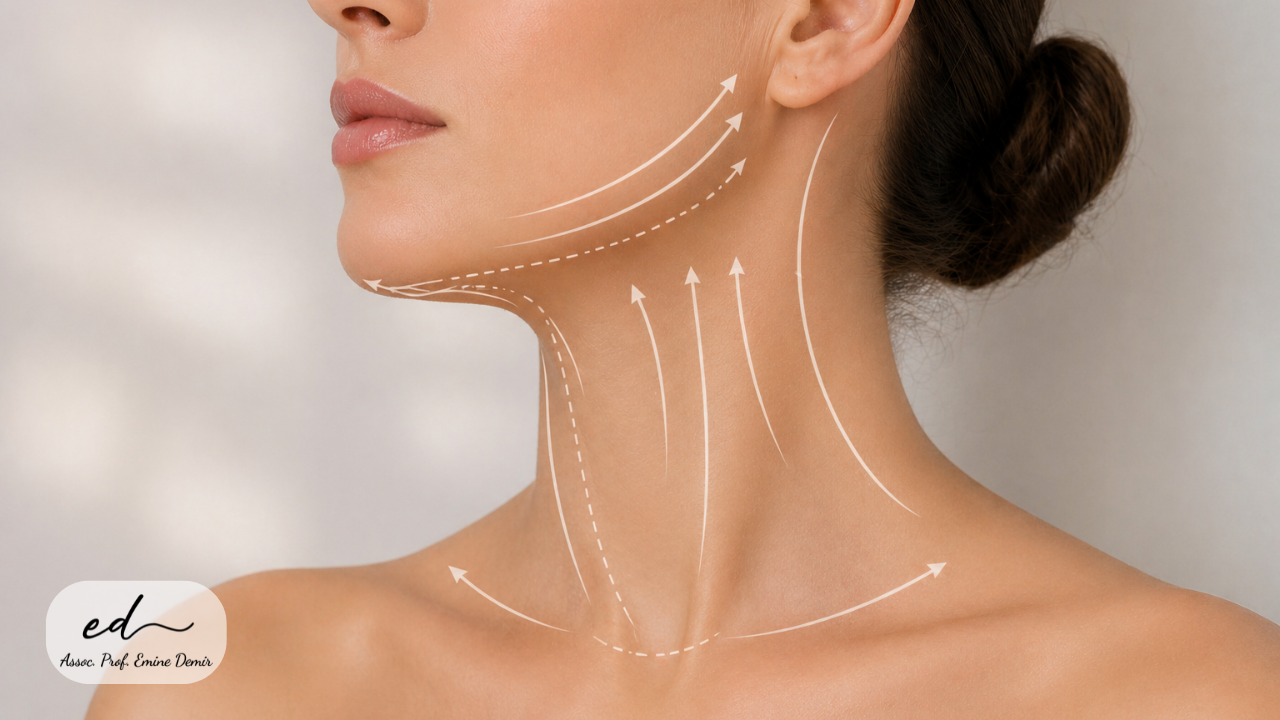
Neck lift surgery is a facial rejuvenation procedure designed to improve visible signs of aging in the neck, jawline, and lower face. Many people first notice facial aging not around the eyes or forehead, but just below the chin. The jawline begins to look softer, the skin under the chin may loosen, vertical neck bands may become more visible, and the elegant angle between the chin and neck may gradually fade.
This is where neck lift surgery becomes an important topic.
A neck lift is not simply “tightening loose skin.” It is a surgical procedure that may involve the skin, deeper connective tissues, platysma muscle, fat distribution, and the relationship between the lower face and neck. When planned correctly, it aims to create a more defined, balanced, and natural-looking neck contour while respecting the patient’s facial identity.
For patients considering facial rejuvenation in İstanbul, Türkiye, neck lift surgery is often discussed as part of a broader lower face and full face rejuvenation plan. This is especially important because the neck does not age separately from the jawline, cheeks, chin, and lower face.
Assoc. Prof. Emine Demir, an Ear, Nose and Throat specialist and founder of Facelift Academy Türkiye, approaches facial rejuvenation with a detailed understanding of facial anatomy, balance, and natural expression. In a VIP-level aesthetic journey, neck lift surgery should not be viewed as a standard operation. It should be evaluated personally, carefully, and in harmony with the entire face.

Understanding Neck Lift Surgery
Neck lift surgery is a procedure that focuses on improving the appearance of the neck and the lower face. It may address loose skin, excess fat under the chin, vertical neck bands, sagging under the jawline, and loss of neck definition.
In simple terms, neck lift surgery may help refine the transition between the face and neck.
However, the surgical plan can vary greatly from one person to another. Some patients mainly have excess skin. Some have fat accumulation under the chin. Others have visible platysma bands — the vertical muscle bands that may appear in the front of the neck with age. Some patients have a combination of all these concerns.
This is why the phrase “neck lift” can include different techniques.
A neck lift may involve:
Tightening or repositioning deeper neck tissues
Addressing platysma muscle bands
Removing or repositioning excess fat
Redraping loose skin
Improving jawline definition
Creating a smoother neck contour
Combining with facelift or full face rejuvenation when needed
The goal is not to make the neck look pulled or artificial. A well-planned neck lift should create a smoother, more balanced appearance that fits naturally with the face.
Why Does the Neck Age?
The neck is one of the most revealing areas of the face and body. Even when someone takes excellent care of their skin, the neck may show aging earlier than expected.
Why does this happen?
First, the skin of the neck is relatively thin and mobile. It is constantly affected by movement, posture, sun exposure, genetics, gravity, and natural collagen loss. Over time, skin elasticity decreases.
Second, the platysma muscle — a thin sheet-like muscle in the neck — may become more visible with age. This can create vertical bands in the front of the neck.
Third, fat distribution changes. Some people develop fullness under the chin, while others experience volume loss and tissue descent.
Fourth, the jawline may lose definition as lower facial tissues descend. This can create jowling and make the neck appear less firm.
And of course, genetics plays a major role. Some people develop neck laxity earlier, even if their face still looks relatively youthful.
This is why neck aging is not always about age alone. A person in their forties may have visible neck bands due to anatomy, while another person in their sixties may have better neck definition because of genetics and skin quality.
What Concerns Can Neck Lift Surgery Address?
Neck lift surgery may be evaluated for several concerns, especially when non-surgical treatments are not enough to address deeper tissue laxity or significant skin looseness.
Common concerns include:
Loose or sagging neck skin
Vertical neck bands
Loss of jawline definition
Jowls along the lower face
Fullness under the chin
A “turkey neck” appearance
Poor chin-neck angle
Soft or blurred lower facial contour
Aging mismatch between the face and neck
Many patients describe the concern in a very human way: “My face still looks like me, but my neck makes me look older.” This is a common feeling. The neck can create a visible contrast with the rest of the face.
For some people, the issue appears mainly in photos. The side profile may show fullness under the chin or loss of the neck angle. For others, the concern is visible from the front, especially when neck bands or loose skin become more noticeable.
A detailed consultation helps determine whether the concern is mostly skin, fat, muscle, facial descent, or a combination.
Neck Lift vs. Facelift: What is the Difference?
Neck lift and facelift are closely related, but they are not exactly the same procedure.
A facelift focuses mainly on the lower face, cheeks, jowls, and jawline. A neck lift focuses more directly on the neck, under-chin area, and neck contour.
However, the face and neck are anatomically connected. This is why many patients benefit from a combined face and neck lift rather than treating only one area.
For example, if a patient has jowls and neck laxity, a neck lift alone may not fully improve the lower face. Similarly, if a facelift improves the jawline but the neck bands remain untreated, the result may look incomplete.
This is where full face rejuvenation planning becomes valuable.
At Facelift Academy Türkiye in İstanbul, Türkiye, the face is evaluated as a connected structure. The goal is not to separate the neck from the jawline, or the jawline from the lower face. The goal is to understand how these areas influence each other.
In suitable patients, neck lift surgery may be combined with facelift, deep plane facelift, temporal lift, eyelid surgery, or other facial rejuvenation procedures. This combination approach should always be based on individual anatomy and medical suitability.
Neck Lift and Full Face Rejuvenation
Full face rejuvenation is a comprehensive approach that evaluates the face as a whole. Instead of focusing on one isolated concern, it considers the harmony between the forehead, brows, eyes, cheeks, jawline, neck, and skin quality.
Neck lift surgery often plays an important role in this plan.
Why? Because a rejuvenated face with an aged neck may look visually inconsistent. The opposite is also true: a smoother neck with untreated jowls or midface descent may not create enough harmony.
A full face rejuvenation combo may include neck lift surgery when the neck contributes significantly to the patient’s aging pattern. In this context, the neck lift is not an “extra” procedure. It is part of the structural balance.
For VIP-level patients, this distinction matters. Many people do not want an exaggerated change. They want to look refreshed, elegant, and natural. They want the face and neck to belong to the same person, at the same stage of aging.
A good facial rejuvenation plan does not chase trends. It follows anatomy.
Who May Be a Suitable Candidate for Neck Lift Surgery?
A person may be evaluated for neck lift surgery if they have visible neck laxity, sagging skin, vertical neck bands, fullness under the chin, or loss of jawline definition.
However, suitability depends on several factors.
A detailed assessment usually includes:
General health condition
Skin quality
Degree of neck laxity
Amount and location of fat
Platysma muscle structure
Jawline and chin anatomy
Facial aging pattern
Smoking status
Medication use
Previous surgeries
Expectations and recovery availability
A patient with mild under-chin fat and firm skin may not need a surgical neck lift. Another patient with significant skin laxity and platysma bands may not benefit enough from non-surgical treatments alone.
This is why there is no single answer that fits every patient.
Neck lift surgery may be more suitable for patients who want structural improvement and understand that surgery involves recovery, possible risks, and a personalized healing process.
What Happens During a Neck Lift Consultation?
A neck lift consultation should be detailed and honest. It should not feel like a quick decision based on a photo or a trend.
During consultation, the surgeon evaluates the neck from the front, side, and oblique angles. The jawline, chin, lower face, skin texture, fat distribution, and muscle bands are examined. Facial expressions and posture may also be considered.
The patient’s goals are equally important.
Some patients want better jawline definition. Some want to reduce the appearance of neck bands. Some feel bothered by loose skin under the chin. Others are planning full face rejuvenation and want the neck to match the lower face.
Important consultation questions may include:
Is the problem mainly skin, fat, muscle, or facial descent?
Would neck lift alone be enough?
Should facelift also be considered?
Is chin structure affecting the neck angle?
How much recovery time is needed?
What are the possible risks?
What result would look natural for this face?
How long should an international patient stay in İstanbul, Türkiye?
A high-quality consultation should also discuss limitations. No surgery can stop aging. No procedure should promise perfection. The purpose is to make an informed, realistic, and medically appropriate plan.
How is Neck Lift Surgery Performed?
The exact technique depends on the patient’s anatomy and surgical goals.
In many neck lift procedures, incisions may be placed around the ears and sometimes under the chin. Through these access points, the surgeon can adjust deeper tissues, address platysma bands, remove or reposition fat if needed, and redrape the skin more smoothly.
If the platysma muscle is separated or banded, it may be tightened or repaired. If there is excess fat under the chin, liposuction or direct fat removal may be considered in selected cases. If skin laxity is significant, the skin may be carefully repositioned without creating an overly tight appearance.
The surgical plan should be conservative where needed and structural where required.
This is important because the neck should not look pulled. Over-tightening may create an unnatural appearance. Under-correction may leave the concern unresolved. The balance requires experience, anatomical understanding, and careful planning.
When neck lift surgery is combined with facelift or full face rejuvenation, the operation becomes more comprehensive. In that case, the surgeon works not only on the neck but also on the lower face, jawline, cheeks, and other selected areas.
Neck Lift and Platysma Bands
One of the most common reasons patients consider neck lift surgery is the appearance of vertical neck bands. These bands are usually related to the platysma muscle.
The platysma is a thin muscle layer that extends from the lower face into the neck. Over time, the edges of this muscle may become more visible, especially when speaking, smiling, or tightening the neck.
Some people describe this as “cords” in the neck. Others notice two vertical lines in the front of the neck.
In selected patients, non-surgical treatments may temporarily soften mild platysma activity. However, when the bands are associated with structural aging, muscle separation, or significant skin laxity, surgical correction may be more appropriate.
During neck lift surgery, the platysma may be addressed to create a smoother neck contour. The technique depends on the patient’s anatomy.
Again, the goal is not to erase every natural line. The goal is to create a balanced and smoother appearance without making the neck look stiff.
Neck Lift and Under-Chin Fullness
Under-chin fullness can have several causes. It may be related to fat accumulation, skin laxity, muscle structure, chin position, or even anatomy under the platysma muscle.
Some patients assume that liposuction alone will solve the problem. Sometimes it may help, especially in younger patients with good skin elasticity and localized fat. But if there is loose skin or muscle laxity, liposuction alone may not be enough.
In fact, removing fat without addressing skin laxity may sometimes make looseness more visible.
This is why proper diagnosis is essential.
A neck lift may address under-chin fullness as part of a more complete plan. In some patients, fat is reduced. In others, deeper tissue support is more important. In some cases, chin anatomy also affects the neck angle and should be considered during planning.
The neck is not a flat surface. It is a three-dimensional structure. Successful planning should respect that.
Is Neck Lift Surgery Painful?
Pain levels vary from person to person, but many patients describe neck lift recovery as tightness, pressure, swelling, or discomfort rather than sharp pain. The feeling of tightness is common because deeper tissues have been adjusted.
If surgery is combined with facelift or full face rejuvenation, recovery may feel more extensive.
The surgeon may prescribe medications and give detailed instructions for comfort and healing. Patients should follow these instructions carefully and avoid comparing their recovery with others.
Some swelling, bruising, numbness, and tightness may be expected during the early period. Numbness can take time to improve because small sensory nerves need time to recover.
Severe pain, sudden swelling, bleeding, fever, breathing difficulty, or unusual symptoms should be reported immediately.
A neck lift is a surgical procedure. It deserves serious postoperative care.
Recovery After Neck Lift Surgery
Recovery after neck lift surgery depends on the surgical technique, the patient’s anatomy, and whether other procedures were performed at the same time.
In the early days, swelling and bruising are expected. The neck may feel tight. Some patients may wear a supportive garment if recommended by the surgeon. Sleeping with the head elevated may also be advised.
Most patients need to avoid strenuous activity during the early recovery period. Turning the neck too aggressively, heavy lifting, smoking, and intense exercise should be avoided until the surgeon allows.
A general recovery pattern may look like this:
First few days: swelling, tightness, and bruising are more noticeable.
First week: discomfort begins to reduce gradually.
Second week: many patients feel more comfortable in daily life.
First month: swelling continues to improve, and the neck contour becomes clearer.
Following months: tissues continue to settle and scars mature.
For international patients in İstanbul, Türkiye, the recovery timeline should be planned before surgery. Travel dates, follow-up visits, and return flights should be organized realistically.
A VIP-level surgical experience should include clear postoperative guidance, not only a comfortable surgery day.
Scars After Neck Lift Surgery
Scarring is a common concern. Since neck lift surgery involves incisions, scars are part of the healing process. However, incision placement is planned to make scars as discreet as possible.
Depending on the technique, incisions may be placed around the ear, behind the ear, and sometimes under the chin. Over time, scars usually soften and become less noticeable, but healing differs from person to person.
Scar quality may be influenced by:
Genetics
Skin type
Smoking
Sun exposure
Wound care
Tension on the incision
Surgical technique
Postoperative behavior
Patients should protect healing scars from direct sun exposure and follow all care instructions. Scar maturation takes time. Early redness or firmness does not always reflect the final scar appearance.
Patience is especially important in facial and neck surgery.
Neck Lift vs. Non-Surgical Neck Treatments
Non-surgical neck treatments are popular, and in selected cases, they may help mild concerns. These may include energy-based devices, injectables, skin quality treatments, or muscle-relaxing applications.
However, non-surgical treatments have limits.
If the main problem is significant loose skin, deep tissue laxity, strong platysma bands, or jowling, non-surgical methods may not provide the same structural improvement as surgery.
This does not mean surgery is always necessary. It means the treatment should match the problem.
A patient with mild early aging may benefit from non-surgical maintenance. A patient with advanced laxity may need surgical planning. A patient with both skin quality concerns and structural sagging may need a combined strategy.
The question should not be, “Which treatment is popular right now?” The better question is, “What does this neck actually need?”
Can Neck Lift Surgery Be Combined With Other Procedures?
Yes, neck lift surgery is often combined with other facial rejuvenation procedures in suitable patients.
Common combinations may include:
Neck lift with facelift
Neck lift with deep plane facelift
Neck lift with lower face rejuvenation
Neck lift with blepharoplasty
Neck lift with temporal lift
Neck lift as part of full face rejuvenation combo
The reason is simple: facial aging usually does not affect only one area.
If the neck is improved but the jowls remain, the result may not feel complete. If the lower face is lifted but the neck bands remain, harmony may be reduced. If the eyelids and face are refreshed but the neck still appears aged, there may be a visible mismatch.
A combination approach should not be excessive. It should be strategic.
Assoc. Prof. Emine Demir’s full face rejuvenation focus in İstanbul, Türkiye allows neck lift surgery to be considered within the larger facial structure. This can be especially meaningful for patients seeking a refined and balanced transformation rather than an isolated correction.
What Makes a Natural Neck Lift Result?
A natural neck lift result should not look tight, stretched, or artificial. The neck should appear smoother and better defined, but still natural in movement and expression.
A natural-looking result usually depends on several details:
The jawline should be defined but not over-sharpened.
The neck angle should improve without looking forced.
The skin should be redraped smoothly, not pulled aggressively.
The ears and incision areas should look natural.
The lower face and neck should match each other.
The patient’s age, anatomy, and identity should be respected.
A good neck lift does not create a different person. It supports the existing facial structure.
In my view, the most elegant facial rejuvenation results are often the quietest ones. They do not announce themselves. They simply make the person look more rested, balanced, and refreshed.
Neck Lift for Men
Neck lift surgery may also be evaluated for male patients. In men, the planning requires particular attention to masculine facial features, beard patterns, skin thickness, and jawline structure.
The goal is usually not to create an overly smooth or feminized neck. Instead, the plan should preserve masculine definition while addressing laxity, under-chin fullness, or neck bands.
Incision placement in male patients may also need special consideration because of facial hair distribution. The surgeon should evaluate beard lines and skin characteristics carefully.
As with female patients, suitability depends on anatomy and expectations. A natural male neck lift should look refreshed, not operated.
Neck Lift for International Patients in İstanbul, Türkiye
İstanbul, Türkiye is a well-known destination for facial aesthetic surgery and international patient care. Patients from different countries may choose İstanbul for neck lift surgery because of medical expertise, accessibility, and structured healthcare services.
However, international patients should be especially careful when planning surgery abroad.
Important factors include:
The surgeon’s experience in facial rejuvenation
Clear communication before travel
Realistic explanation of the procedure
Safe surgical environment
Postoperative follow-up planning
Recovery time in İstanbul
Emergency contact process
Travel timing after surgery
Personalized rather than standardized planning
VIP-level care should not only mean comfort or privacy. In a medical setting, it should also mean careful coordination, honest communication, and patient-specific planning.
For neck lift surgery, this is particularly important because early recovery requires monitoring, patience, and clear instructions.
How to Prepare for Neck Lift Surgery
Preparation begins with a detailed consultation and medical evaluation. Patients should share their full medical history, previous surgeries, allergies, medications, supplements, smoking habits, and any chronic conditions.
Before surgery, the surgeon may recommend stopping certain medications or supplements that may increase bleeding risk. Smoking should be discussed seriously because it can negatively affect healing.
Patients traveling to İstanbul, Türkiye should also prepare practically.
They may need to:
Plan enough time for recovery
Avoid tight travel schedules
Stay close to the clinic if possible
Arrange comfortable accommodation
Prepare button-up or loose clothing
Avoid important events immediately after surgery
Understand postoperative garment instructions if given
Arrange support for the first days if needed
Good preparation reduces stress. And in facial surgery, lower stress often makes the process feel more manageable.
Emotional Expectations Before Neck Lift Surgery
Many patients feel emotional about neck aging. The neck can be difficult to hide. It appears in photos, video calls, side profiles, and daily interactions.
Some people say, “I feel younger than my neck looks.” Others avoid certain angles in photos. Some begin wearing scarves or high collars not because they love the style, but because they feel self-conscious.
These feelings are understandable.
Still, neck lift surgery should be approached with balanced expectations. It may improve neck contour in suitable patients, but it does not stop aging. It cannot make every neck look the same. It cannot promise perfection.
A healthy expectation sounds more like this:
“I want my neck and lower face to look more balanced.”
“I want a more defined contour while still looking like myself.”
“I want to understand what is realistic for my anatomy.”
This mindset creates a better foundation for surgical planning.
Common Myths About Neck Lift Surgery
Neck lift surgery is only for older patients
Not always. Some patients develop neck laxity or under-chin fullness earlier because of genetics, weight changes, or anatomy. Suitability depends on individual evaluation, not age alone.
Liposuction and neck lift are the same
No. Liposuction addresses fat, while neck lift surgery may address skin, muscle, deeper tissues, and overall contour. Some patients need one, some need the other, and some may need both.
Neck lift surgery always looks tight
A well-planned neck lift should not look tight or artificial. Natural results depend on proper tissue handling, balanced correction, and individualized planning.
Non-surgical treatments can replace neck lift surgery
In mild cases, non-surgical treatments may help. But when there is significant skin laxity, platysma banding, or structural sagging, surgery may be more appropriate.
Neck lift only treats the neck
Not exactly. The neck is closely connected to the jawline and lower face. That is why neck lift surgery is often evaluated together with facelift or full face rejuvenation.
Choosing the Right Approach
The right neck lift approach depends on anatomy. It should not be chosen from a trend, a celebrity photo, or a social media before-and-after image.
A careful surgical plan considers:
Skin elasticity
Platysma bands
Fat distribution
Jawline structure
Chin-neck angle
Lower face sagging
Facial proportions
Patient expectations
Recovery capacity
Medical safety
Sometimes a limited neck lift may be enough. Sometimes a full face and neck lift is more appropriate. Sometimes non-surgical care may be recommended instead of surgery.
The most responsible answer is the personalized one.
Final Thoughts
Neck lift surgery is a facial rejuvenation procedure designed to improve the appearance of the neck, jawline, and lower face in suitable patients. It may address loose skin, neck bands, under-chin fullness, and loss of definition.
But the neck should never be evaluated alone. It is connected to the lower face, chin, jawline, and overall facial harmony.
For patients considering neck lift surgery in İstanbul, Türkiye, Assoc. Prof. Emine Demir’s facial rejuvenation-focused approach offers a perspective based on anatomy, balance, and individualized planning. As an Ear, Nose and Throat specialist and founder of Facelift Academy Türkiye, her work emphasizes the importance of understanding the face as a whole structure rather than treating isolated areas without context.
A neck lift should not aim to create a different person. It should support a more balanced, refined, and natural-looking appearance while respecting the patient’s identity.
If this guide helped you understand neck lift surgery more clearly, you may share it with someone researching facial rejuvenation or use it as a starting point for the questions you may want to ask during a professional consultation.
Frequently Asked Questions
What is neck lift surgery?
Neck lift surgery is a facial rejuvenation procedure that may address loose neck skin, platysma bands, under-chin fullness, jowls, and loss of jawline definition. The goal is to create a smoother and more balanced neck contour in suitable patients.
Who is a good candidate for neck lift surgery?
A suitable candidate may have neck laxity, visible neck bands, under-chin fullness, or loss of jawline definition. However, candidacy depends on health status, skin quality, anatomy, expectations, and surgeon evaluation.
Is neck lift surgery the same as facelift?
No. A facelift mainly focuses on the lower face, cheeks, jowls, and jawline, while a neck lift focuses more directly on the neck and under-chin area. In many patients, both procedures may be evaluated together.
Can neck lift surgery remove a double chin?
If the double chin is caused by fat, skin laxity, muscle structure, or a combination of these factors, neck lift surgery may be considered as part of the treatment plan. Some patients may need fat reduction, while others need deeper tissue support.
Does neck lift surgery treat neck bands?
Yes, in suitable patients, neck lift surgery may address visible platysma bands. The technique depends on the patient’s anatomy and the degree of muscle involvement.
How long does recovery take after neck lift surgery?
Recovery varies. Swelling, bruising, tightness, and numbness may occur in the early period. Many patients feel more comfortable after the first couple of weeks, but tissue settling and scar maturation continue for months.
Will neck lift surgery leave scars?
Yes, all surgical incisions create scars. However, incisions are usually planned around discreet areas such as the ear region and sometimes under the chin. Scar appearance varies depending on healing, skin type, aftercare, and surgical technique.
Can neck lift surgery be combined with blepharoplasty?
Yes, in suitable patients, neck lift surgery may be combined with blepharoplasty as part of a full face rejuvenation plan. This can help create better harmony between the eye area, lower face, and neck.
Is neck lift surgery suitable for men?
Yes. Male neck lift surgery may be evaluated for concerns such as neck laxity, under-chin fullness, or jawline definition. Planning should preserve masculine facial characteristics and natural expression.
Why consider neck lift surgery in İstanbul, Türkiye?
İstanbul, Türkiye is a recognized destination for facial aesthetic surgery and international patient care. Patients should prioritize personalized planning, surgeon experience, medical safety, clear communication, and postoperative follow-up.