

Blepharoplasty is one of the most commonly discussed facial aesthetic procedures, yet many people still think of it in very simple terms: “eyelid surgery.” Yes, that definition is technically correct. But in reality, blepharoplasty is much more than removing a little skin from the eyelids.
The eyes are one of the most expressive areas of the face. They show tiredness, energy, emotion, age, stress, and sometimes even lifestyle habits. When the eyelids become heavy, puffy, loose, or shadowed, the whole face may appear more tired than the person actually feels.
This is why blepharoplasty is not only about appearance. In some patients, excess upper eyelid skin may also create a feeling of heaviness or affect visual comfort. In others, lower eyelid bags may cause a constantly tired expression even after proper sleep.
For patients considering facial rejuvenation in İstanbul, Türkiye, blepharoplasty is often evaluated as part of a broader facial harmony plan. Especially in modern full face rejuvenation approaches, the eyelids are not viewed separately from the brows, temples, cheeks, jawline, and neck.
Assoc. Prof. Emine Demir, a specialist in Ear, Nose and Throat diseases and founder of Facelift Academy Türkiye, focuses on facial rejuvenation with an anatomy-based perspective. In a refined, VIP-level aesthetic journey, blepharoplasty should be planned carefully, naturally, and personally — not as a standard procedure applied the same way to everyone.
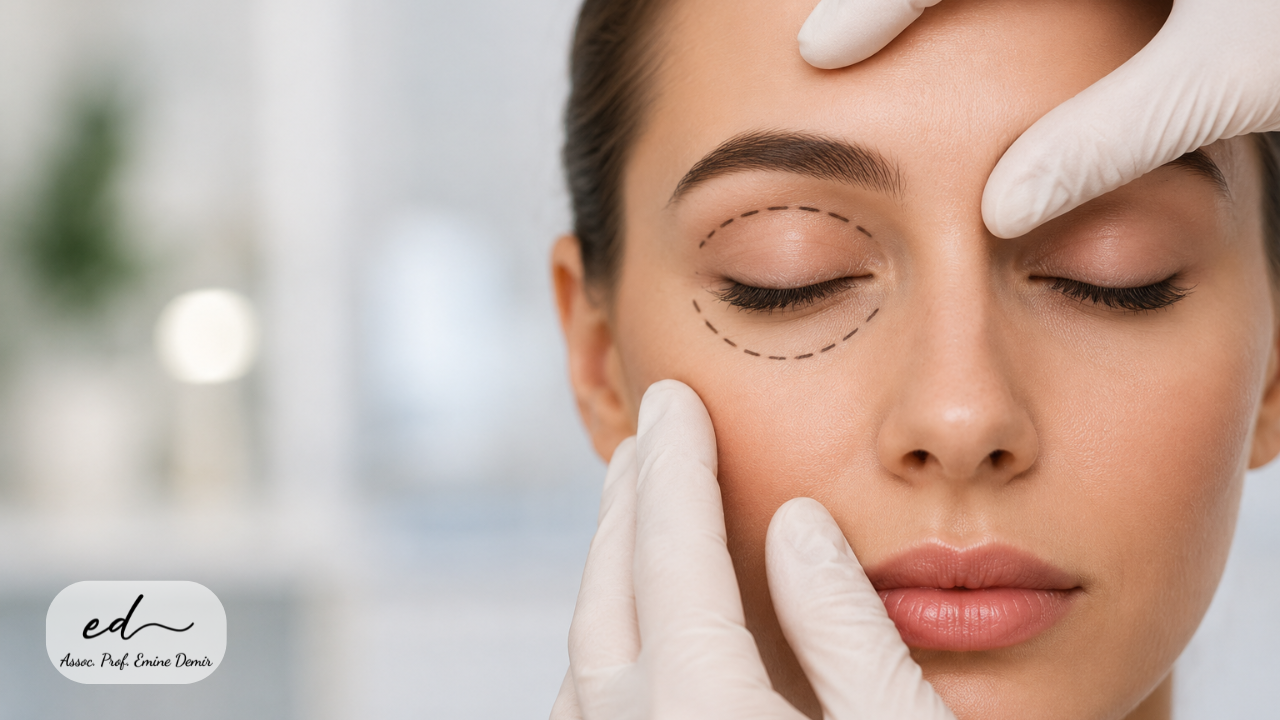
Understanding Blepharoplasty
Blepharoplasty is a surgical procedure performed on the upper eyelids, lower eyelids, or both. The main goal is to address excess skin, fat prominence, tissue laxity, or structural changes around the eyes.
In everyday language, people may call it:
Eyelid surgery
Upper eyelid surgery
Lower eyelid surgery
Eyelid lift
Eye rejuvenation surgery
However, the medical planning behind blepharoplasty is quite detailed. The surgeon evaluates the eyelid skin, fat pads, muscle tone, brow position, lower eyelid support, eye shape, facial symmetry, and overall facial balance.
This matters because the eyelid area is delicate. A few millimeters can change the expression of the eyes. Too much tissue removal may create an unnatural or hollow appearance. Too little correction may not adequately address the concern.
So, when we ask “What is a blepharoplasty?” the most accurate answer is this: it is a personalized eyelid surgery designed to improve eyelid appearance, support facial harmony, and, in selected cases, help functional comfort around the eyes.
Why Do Eyelids Age?
The eyelids are among the first facial areas to show signs of aging. The skin around the eyes is thin, mobile, and constantly active. Every blink, smile, squint, laugh, and facial expression involves the eyelid region.
Over time, several changes may become visible.
The upper eyelid skin may lose elasticity and begin to fold. Fat pads may become more noticeable. The brow may gradually descend, creating extra heaviness over the upper eyelid. In the lower eyelids, puffiness, bags, fine lines, and hollowness may appear.
But aging is not the only reason.
Some people naturally have hooded eyelids from a younger age. Others may have genetic under-eye bags. In some patients, lifestyle factors such as poor sleep, smoking, sun exposure, stress, and skin quality may make the eye area look more tired.
This is why blepharoplasty planning should never be based only on age. A person in their thirties may need evaluation for genetic eyelid heaviness, while another person in their sixties may require a more comprehensive full face rejuvenation plan.
The important question is not simply “How old is the patient?” The better question is: “What exactly is causing the tired or heavy appearance?”
Upper Blepharoplasty
Upper blepharoplasty focuses on the upper eyelid area. It is usually considered when there is excess upper eyelid skin, eyelid hooding, heaviness, or a tired-looking expression.
Some patients say, “My eyes look smaller than before.” Others mention difficulty applying makeup because the upper eyelid fold covers the eyelid crease. Some feel heaviness toward the end of the day, especially while reading or working on a screen.
In upper blepharoplasty, the incision is usually planned within the natural upper eyelid crease. Through this incision, excess skin may be removed, and in selected cases, underlying fat or muscle may be adjusted.
The goal is not to create an overly open or surprised look. A natural upper blepharoplasty should respect the patient’s original eye shape and facial identity.
Here, surgical judgment is very important. If the brow position is low, removing only eyelid skin may not be enough. Sometimes what appears to be “extra eyelid skin” is partly caused by brow descent. In that case, brow or temple support may also need to be evaluated.
This is why an experienced facial rejuvenation assessment looks at the whole upper face, not just the eyelid fold.
Lower Blepharoplasty
Lower blepharoplasty focuses on the under-eye area. It may be considered when a patient has under-eye bags, puffiness, loose lower eyelid skin, or a tired appearance caused by the lower eyelid-cheek transition.
Many people describe this concern with sentences like:
“I look tired even when I sleep well.”
“My under-eye bags make me look older.”
“Concealer does not hide the puffiness anymore.”
“My eyes look swollen in photos.”
Lower blepharoplasty is more complex than many people assume. In the past, the approach was often focused on removing fat from the under-eye area. Today, facial aesthetic surgery has become more conservative and more anatomy-based.
Why? Because removing too much fat can create hollowness.
Modern lower blepharoplasty may involve fat repositioning, skin adjustment, lower eyelid support, or improvement of the transition between the eyelid and cheek. In some cases, the cheek position also needs to be evaluated because midface descent can make under-eye bags look more prominent.
This is where full face analysis becomes very valuable. The lower eyelid is not an isolated structure. It is visually connected to the cheek, temple, and midface.
A well-planned lower blepharoplasty should aim for softness, balance, and natural expression — not a tight or operated look.
Blepharoplasty and Full Face Rejuvenation
Blepharoplasty can be performed alone, but it is also frequently included in full face rejuvenation plans. This is especially relevant for patients seeking comprehensive facial rejuvenation in İstanbul, Türkiye.
The face ages as a whole. The eyelids, brows, temples, cheeks, jawline, and neck are all connected visually and anatomically. If only one area is treated while the others are ignored, the result may feel incomplete or unbalanced.
For example, upper eyelid heaviness may be related to brow descent. Lower eyelid bags may be emphasized by midface volume changes. A refreshed eyelid area may look more harmonious when combined with facelift, neck lift, temporal lift, or endoscopic facial rejuvenation in suitable patients.
This does not mean every patient needs a combination procedure. It means the plan should be individualized.
Assoc. Prof. Emine Demir’s focus on full face rejuvenation and combo facial procedures in İstanbul allows blepharoplasty to be evaluated within a broader aesthetic framework. For VIP-level patients, this type of planning is especially important because the goal is usually not a single dramatic change, but a refined, balanced, natural-looking rejuvenation.
In other words, blepharoplasty is sometimes the main procedure. Sometimes it is one piece of a larger facial rejuvenation puzzle.
Who May Consider Blepharoplasty?
Blepharoplasty may be considered by people who are bothered by eyelid heaviness, excess skin, puffiness, under-eye bags, or a tired expression around the eyes. However, suitability is determined only after medical and anatomical evaluation.
A patient may be evaluated for upper blepharoplasty if they have:
Excess upper eyelid skin
Hooded eyelids
A heavy upper eyelid appearance
Difficulty seeing the eyelid crease
A tired or aged upper eye expression
Functional discomfort related to eyelid heaviness
A patient may be evaluated for lower blepharoplasty if they have:
Under-eye bags
Lower eyelid puffiness
Loose lower eyelid skin
A tired under-eye appearance
Shadowing caused by eyelid-cheek transition issues
Fat prominence under the eyes
Still, not every patient with these concerns is automatically a candidate for surgery. The surgeon must consider general health, eye health, skin quality, eyelid position, medical history, expectations, and healing capacity.
Patients with dry eye symptoms, thyroid-related eye conditions, uncontrolled systemic disease, bleeding disorders, or unrealistic expectations may need additional assessment.
The safest approach is always personalized evaluation.
What Happens During a Blepharoplasty Consultation?
A blepharoplasty consultation is not simply about looking at the eyelids and deciding where to make an incision. It should be a detailed facial and medical assessment.
During consultation, the surgeon may evaluate the upper eyelids, lower eyelids, brow position, temple area, cheek support, eye shape, facial asymmetry, skin quality, and eyelid function.
The patient’s concerns are also very important. One person may want to look less tired. Another may be concerned about heaviness. Another may be planning full face rejuvenation and wants the eye area to match the rest of the face.
A careful consultation may include questions such as:
When did the concern begin?
Is the problem mostly skin, puffiness, or heaviness?
Are the eyes dry or irritated?
Has the patient had previous eyelid surgery?
Is there a history of eye disease?
Does the patient use contact lenses?
Is the patient considering facelift or neck lift as well?
How much recovery time is available?
For international patients coming to İstanbul, Türkiye, consultation also includes travel planning, timing, accommodation, postoperative control visits, and safe return scheduling.
In a VIP patient experience, details matter. Clear communication, privacy, realistic expectations, and individualized planning are part of the process.
How is Blepharoplasty Performed?
The surgical technique depends on the type of blepharoplasty and the patient’s anatomy.
In upper blepharoplasty, the incision is generally placed along the natural crease of the upper eyelid. This allows the incision line to be hidden within the natural fold as healing progresses. Excess skin is carefully adjusted, and in some cases, fat or muscle tissue may also be refined.
In lower blepharoplasty, the incision may be made just below the lower lash line or inside the lower eyelid. The chosen technique depends on whether the main issue is fat prominence, skin laxity, eyelid support, or under-eye hollowing.
Some patients may benefit from fat repositioning rather than fat removal. In selected cases, the lower eyelid may require additional support to maintain shape and safety.
Blepharoplasty may be performed under local anesthesia with sedation or under general anesthesia, depending on the patient, surgical extent, and whether other procedures are combined.
For example, a simple upper blepharoplasty may be shorter and more limited. A full face rejuvenation combo including blepharoplasty, facelift, neck lift, and temporal lift requires more comprehensive planning.
Is Blepharoplasty Painful?
Many patients expect eyelid surgery to be very painful because the eye area looks delicate. In reality, discomfort is usually manageable with appropriate postoperative care, but each person’s experience is different.
Patients may feel tightness, mild burning, swelling, bruising, dryness, or sensitivity in the early recovery period. Some may experience temporary blurred vision due to ointment, swelling, or dryness.
Pain tolerance varies from person to person. The type of procedure also matters. Upper blepharoplasty alone may feel different from lower blepharoplasty or combined full face rejuvenation.
It is important to follow the surgeon’s instructions carefully. Severe pain, sudden visual changes, increasing pressure, intense swelling, or unusual bleeding should never be ignored.
Blepharoplasty may be a commonly performed procedure, but it is still surgery around a highly sensitive anatomical area. Recovery should be taken seriously.
Recovery After Blepharoplasty
Recovery after blepharoplasty varies depending on the procedure, the patient’s tissue structure, and whether surgery was combined with other facial rejuvenation procedures.
In the first days, swelling and bruising are expected. The eyelids may feel tight or sensitive. The eyes may feel dry or watery. Some patients prefer resting with the head elevated and avoiding unnecessary screen time during the early period.
Most visible bruising and swelling begin to improve gradually within the first couple of weeks. However, subtle swelling, incision maturation, and tissue settling may continue for weeks or months.
A general recovery pattern may look like this:
First few days: swelling and bruising are more visible.
First week: discomfort and tightness gradually decrease.
Around two weeks: many patients begin to feel more socially comfortable.
First month: the eye area usually appears calmer and more natural.
Following months: scars soften and tissues continue to settle.
For patients traveling to İstanbul, Türkiye, recovery planning should be discussed before surgery. The patient should know how long to stay, when follow-up visits may be needed, and when flying back may be appropriate.
If blepharoplasty is part of a full face rejuvenation combo, the recovery period may be longer and more layered. This should be clearly explained during consultation.
What Should Patients Avoid After Blepharoplasty?
Postoperative instructions may differ from patient to patient, but there are some common precautions.
Patients are usually advised to avoid heavy exercise, bending forward, rubbing the eyes, smoking, alcohol consumption, direct sun exposure, and wearing eye makeup in the early recovery period. Contact lens use may also need to be paused for a while.
Screen exposure may feel uncomfortable at first, especially if the eyes are dry or sensitive. Sunglasses can help protect the eyes outdoors.
The patient should follow all wound care, medication, ointment, and follow-up instructions given by the surgeon. These details are not minor. They can influence comfort, healing, and scar maturation.
In aesthetic surgery, good results do not depend only on the operation. Recovery behavior matters too.
When Will the Final Result Be Seen?
This is one of the most common questions patients ask: “When will I see the final result?”
The honest answer is gradual improvement.
The eyelid area may look more rested once the first swelling and bruising improve. However, the final appearance takes more time. Incision lines soften gradually. Tissue tightness decreases. Subtle swelling resolves.
Some patients feel comfortable in photos after a few weeks. Others need longer. If lower blepharoplasty or combined facial rejuvenation was performed, the healing process may extend further.
It is helpful to remember that healing is not a straight line. Some mornings may look more swollen than others. One eyelid may settle faster than the other. This does not always mean there is a problem.
Patience is part of the process.
Will Blepharoplasty Leave a Scar?
Every surgical incision creates a scar. The important point is where the incision is placed and how it heals over time.
In upper blepharoplasty, the incision is usually hidden in the natural eyelid crease. In lower blepharoplasty, the incision may be placed close to the lash line or inside the eyelid, depending on the technique.
Scars typically become less visible as they mature, but healing varies. Skin type, genetics, sun exposure, smoking, aftercare, and surgical technique can all influence scar quality.
Patients should protect healing incisions from sun exposure and follow postoperative care instructions carefully.
A natural result is not only about removing tissue. It is also about incision planning, tissue handling, symmetry, and long-term healing.
What Are the Risks of Blepharoplasty?
Every surgical procedure has possible risks. Blepharoplasty should be discussed honestly and realistically.
Possible risks may include:
Bleeding
Infection
Swelling
Bruising
Dry eyes
Temporary blurred vision
Difficulty closing the eyes
Visible scarring
Asymmetry
Changes in eyelid position
Under-correction or over-correction
Need for revision surgery
Anesthesia-related risks
Rare but serious eye-related complications may also occur. This is why eyelid surgery should be planned and performed with careful anatomical knowledge.
Discussing risks does not mean frightening the patient. It means respecting the patient’s right to make an informed decision.
A medically ethical aesthetic consultation should never promise perfection. Instead, it should explain what may be improved, what cannot be guaranteed, and what limitations exist.
Blepharoplasty and Natural Expression
One of the biggest concerns patients have is whether blepharoplasty will make them look different. This is a very reasonable concern.
The eyes carry identity. A small change in the eyelids can affect the whole expression. For this reason, the goal should not be to create a new face. The goal should be to refresh the eye area while preserving natural character.
A natural blepharoplasty result usually looks like this:
The eyes appear less tired.
The eyelid area looks lighter.
The face looks more rested.
The expression remains familiar.
The result does not look exaggerated.
The best outcome is often the one that does not draw attention to the surgery itself. People may say, “You look well,” rather than “What did you have done?”
This is especially important in VIP-level facial rejuvenation, where discretion, elegance, and natural harmony are often priorities.
Blepharoplasty vs. Brow Lift
Upper eyelid heaviness is not always caused only by excess eyelid skin. Sometimes the brow has descended and pushes tissue downward over the upper eyelid.
This is why some patients who think they need upper blepharoplasty may actually need brow or temple evaluation. In other cases, both upper blepharoplasty and brow support may be appropriate.
A brow lift focuses on the position of the brow. Upper blepharoplasty focuses on the eyelid itself. They are related, but they are not the same procedure.
If brow descent is ignored, upper blepharoplasty alone may not create the desired openness. On the other hand, if too much eyelid skin is removed without considering brow position, the result may look tight.
A complete upper face analysis is therefore essential.
Blepharoplasty vs. Under-Eye Filler
Some people with under-eye concerns wonder whether they need lower blepharoplasty or filler. The answer depends on anatomy.
Under-eye filler may be considered in selected patients with mild hollowing and good skin quality. However, it is not suitable for everyone. If the main issue is prominent fat bags, loose skin, or lower eyelid laxity, filler may not be the best solution.
In some cases, filler can even make puffiness look worse if not carefully selected and performed.
Lower blepharoplasty may be more appropriate when there is significant fat prominence, structural under-eye bags, or tissue laxity. But again, the decision should be made after a detailed facial assessment.
The question should not be “filler or surgery?” The question should be “What is causing the under-eye concern?”
Can Blepharoplasty Be Part of a Full Face Combo?
Yes, blepharoplasty can be part of a full face rejuvenation combo in suitable patients.
Full face rejuvenation may include several procedures designed to restore facial harmony. These may involve facelift, neck lift, temporal lift, endoscopic rejuvenation, fat repositioning, or eyelid surgery depending on the patient’s needs.
In this context, blepharoplasty supports the upper and middle facial expression. When the face and neck are rejuvenated but the eyelids remain heavy, the final appearance may not feel fully balanced. Similarly, refreshing only the eyelids while ignoring jawline or neck laxity may not address the broader aging pattern.
Assoc. Prof. Emine Demir’s work in İstanbul, Türkiye focuses strongly on facial rejuvenation and full face planning. This is why blepharoplasty can be evaluated not only as an eyelid procedure, but as part of a complete facial strategy.
A combo approach is not about doing more surgery unnecessarily. It is about selecting the right combination for the right patient.
Blepharoplasty in İstanbul, Türkiye
İstanbul, Türkiye is a major destination for facial aesthetic surgery and international patient care. Many patients choose İstanbul because of its medical infrastructure, experienced physicians, and the opportunity to combine treatment planning with a carefully organized travel process.
However, choosing blepharoplasty in İstanbul should not be based only on popularity. Eyelid surgery is delicate. The surgeon’s facial anatomy knowledge, aesthetic judgment, communication style, and follow-up planning are essential.
International patients should ask important questions:
Is the procedure suitable for my anatomy?
Will my eyelid function be evaluated?
Should my brows or cheeks also be assessed?
How long should I stay in İstanbul after surgery?
What kind of recovery should I expect?
What are the risks in my personal case?
Will the result respect my natural expression?
A VIP-level medical experience should offer privacy, clarity, organization, and personalized planning. It should not rely on exaggerated promises or unrealistic expectations.
How to Prepare for Blepharoplasty
Preparation begins before the surgery date. A good preparation process helps the patient feel more informed and confident.
Patients should share their full medical history with the surgeon. This includes previous surgeries, eye conditions, dry eye symptoms, allergies, medications, supplements, smoking habits, and chronic diseases.
Before surgery, the surgeon may recommend stopping certain medications or supplements that can increase bleeding risk. Smoking may need to be stopped before and after surgery because it can affect healing.
For patients traveling to İstanbul, Türkiye, preparation may also include:
Planning accommodation close to the clinic
Allowing enough time for follow-up visits
Avoiding tight travel schedules
Bringing sunglasses
Preparing for visible swelling and bruising
Avoiding important meetings immediately after surgery
Understanding postoperative care instructions
Preparation is not only practical. It is also emotional. Patients should enter surgery with realistic expectations and a calm understanding of the recovery process.
Emotional Side of Blepharoplasty
Many people consider blepharoplasty because they feel their eyes no longer reflect how they feel inside. They may feel energetic, but their face looks tired. They may hear comments like “You look exhausted” even after a good night’s sleep.
This can be frustrating.
The eye area is central to communication. When it changes, people may feel that their expression has changed too. Blepharoplasty can be meaningful for suitable patients because it addresses an area closely connected to identity and emotion.
Still, it should not be presented as a life-changing promise. A healthy expectation is more balanced: “I want to look like myself, but more rested and refreshed.”
That is usually the most natural and realistic goal.
Common Myths About Blepharoplasty
Blepharoplasty is only for older people
Not always. Some younger patients may have genetic eyelid hooding or under-eye bags. Suitability depends on anatomy, not age alone.
Blepharoplasty always changes the eye shape
A well-planned blepharoplasty should respect the patient’s natural eye shape. The goal is usually rejuvenation, not changing identity.
Under-eye bags always require fat removal
Not necessarily. In some patients, fat repositioning or lower eyelid-cheek transition planning may be more appropriate than simple fat removal.
Upper blepharoplasty can fix every tired eye appearance
Not always. If brow descent, temple hollowing, or midface changes are contributing to the tired look, upper blepharoplasty alone may not be enough.
Recovery is the same for everyone
No. Healing varies depending on age, skin quality, procedure type, lifestyle, and whether surgery is combined with other procedures.
Choosing the Right Surgical Approach
The right blepharoplasty plan is personal. It should be based on anatomy, not trends.
Some patients need only a conservative upper eyelid procedure. Others may need lower eyelid fat repositioning. Some require brow or temple evaluation. Others benefit from blepharoplasty as part of a full face rejuvenation combo.
A thoughtful surgical approach considers:
Facial harmony
Eyelid function
Natural expression
Skin quality
Brow and cheek support
Recovery capacity
Patient expectations
Long-term balance
In aesthetic surgery, small details matter. Especially around the eyes, precision is everything.
Final Thoughts
Blepharoplasty is eyelid surgery, but it is not simply a technical procedure. It is a delicate facial rejuvenation operation that requires anatomical knowledge, aesthetic judgment, and respect for natural expression.
For some patients, it may help reduce upper eyelid heaviness. For others, it may improve lower eyelid bags or support a more rested appearance. In suitable patients, it may also become part of a full face rejuvenation plan.
In İstanbul, Türkiye, patients considering blepharoplasty with Assoc. Prof. Emine Demir can expect this procedure to be evaluated within the broader context of facial harmony, full face rejuvenation, and individualized planning.
The eyes are personal. They reflect character, emotion, and identity. That is why blepharoplasty should never be rushed, standardized, or exaggerated. It should be planned carefully, explained clearly, and performed with a natural, balanced goal.
If you found this guide helpful, you may share it with someone researching eyelid surgery or use it as a starting point for the questions you may want to ask during a professional consultation.
Frequently Asked Questions
What is blepharoplasty?
Blepharoplasty is a surgical procedure that addresses excess skin, fat prominence, or tissue laxity around the upper eyelids, lower eyelids, or both. It may be performed for aesthetic concerns, functional complaints, or as part of full face rejuvenation.
What is upper blepharoplasty?
Upper blepharoplasty focuses on the upper eyelids. It may be considered when excess skin, hooding, or heaviness affects the appearance or comfort of the upper eye area.
What is lower blepharoplasty?
Lower blepharoplasty focuses on the under-eye area. It may address under-eye bags, puffiness, lower eyelid skin laxity, or the transition between the lower eyelid and cheek.
Is blepharoplasty painful?
Most patients describe recovery more as tightness, swelling, bruising, or sensitivity rather than intense pain. However, every patient’s experience is different, and postoperative care instructions should be followed carefully.
How long does blepharoplasty recovery take?
Visible swelling and bruising often improve within the first couple of weeks, but complete tissue settling and scar maturation may take longer. Recovery can vary depending on the procedure and whether other surgeries are combined.
Can blepharoplasty be combined with facelift?
Yes, in suitable patients, blepharoplasty can be combined with facelift, neck lift, temporal lift, or full face rejuvenation procedures. The decision depends on anatomy, health status, and aesthetic goals.
Will blepharoplasty make me look younger?
Blepharoplasty may help the eye area look more rested and refreshed in suitable patients. However, results vary, and the goal should be natural improvement rather than an exaggerated change.
Does blepharoplasty remove wrinkles?
Blepharoplasty can improve certain eyelid concerns, but it does not remove every fine line or skin texture issue. Additional skin treatments may be considered depending on the patient’s skin quality.
Is blepharoplasty suitable for men?
Yes. Blepharoplasty can be evaluated for both women and men. In male patients, planning should be especially careful to preserve masculine eyelid and brow characteristics.
Why is İstanbul, Türkiye preferred for blepharoplasty?
İstanbul, Türkiye is a recognized destination for facial aesthetic surgery and international patient care. Patients should focus on surgeon experience, personalized planning, safety, communication, and postoperative follow-up rather than location alone.