

“Is it worth it?” is rarely one question. It is usually three, asked at once:
- How long will it actually last?
- What will it genuinely change?
- What would I spend otherwise?
Most content answers the third question enthusiastically and the first two vaguely. This guide does the reverse — because the first two are what make the third calculation meaningful.
There is no recommendation at the end of this article. There is a framework, the evidence behind it, and the limits of that evidence.
How long does it actually last?
This is where the arithmetic starts, so it is worth being precise.
What has been measured
A published follow-up study assessed 50 patients, drawn from more than 1,700 deep plane facelifts performed between 2001 and 2011.
Photographs were taken at three points: before surgery, at routine follow-up 3 to 6 months afterwards, and at long-term follow-up averaging 5.5 years.
Assessment used two independent methods: a computer program tracking defined facial points — jowl, neck, mouth-to-chin and nose-to-mouth lines — and separately, cropped photographs with hair and clothing removed, rated by another plastic surgeon, an aesthetic nurse and two lay people.
The two methods agreed.
The findings
- Lower-face improvements were maintained across the average 5.5-year follow-up
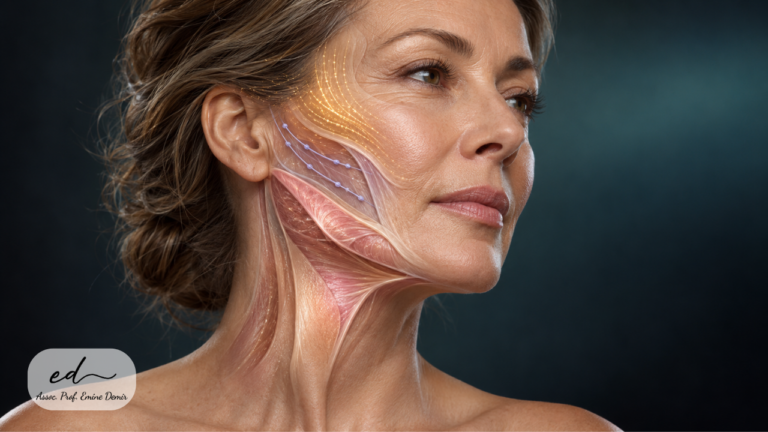
- The neck drifted back toward its pre-operative position more than the other areas
- The surgery did not produce adverse changes to the mouth or nose
The honest gap
You will often see “10 to 15 years” quoted. The study’s own author puts it more carefully: he hopes results may last ten years or more, but states that longer-term evidence is needed.
So the position is:
| Status | |
|---|---|
| ~5.5 years, lower face | Documented in follow-up |
| 10-15 years | Expectation, not a measured finding |
| Neck | Documented to regress faster |
A limitation worth knowing: these 50 patients were included because they happened to return to the practice for unrelated reasons and had pre-operative photographs available. That is not a random sample, and the results should be read with that in mind.
This matters directly for the cost calculation, which we come to below. A figure divided by 5.5 and the same figure divided by 15 are very different numbers.
What does the evidence say it changes?
Longevity is only half of value. The other half is what the result does for the person living with it.
The satisfaction data
A study using the FACE-Q — a validated patient-reported outcome instrument for facial surgery — collected responses from 53 patients. Scores run 0 to 100, higher being better.
| Domain | Mean score |
|---|---|
| Psychological well-being | 92.8 |
| Early life impact | 92.2 |
| Satisfaction with the decision to have surgery | 90.5 |
| Social confidence | 90.4 |
| Satisfaction with facial appearance | 80.7 |
Patients also felt they looked, on average, 6.9 years younger than their actual age.
⚠️ Four limitations you should weigh
These numbers are strong. The study behind them is not, and the difference matters when you are making a decision on the basis of it.
- No pre-operative baseline. Only post-operative scores were collected, so no before-and-after comparison is possible. We do not know where these patients started.
- 50.5% response rate. Of 105 patients invited, 53 responded. People satisfied with an outcome are generally more likely to complete a survey about it.
- No statistical testing. The results are descriptive means, with no significance tests.
- Self-esteem was not measured. Despite being the benefit most often claimed, it was not among the domains assessed.
What this means practically: the data supports “patients who had this surgery and responded report high satisfaction.” It does not support “this surgery will raise your self-esteem by a measurable amount.” Those are different claims, and only the first is evidenced.
The finding that should shape your expectations
Here is where two separate studies, measuring different things, point at the same place.
Regional satisfaction
| Area | Satisfaction score |
|---|---|
| Nasolabial folds | 86.2 |
| Cheeks | 86.1 |
| Lower face and jawline | 86.0 |
| Neck | 78.1 |
| Under-chin area | 67.9 |
And the longevity study found the same weak point
Recall that the neck “drifted back toward its pre-operative position more than the other areas.”
So:
The neck is both the area patients are least satisfied with and the area that holds its result least well.
Two independent studies, two different measures, one conclusion.
Why this should change your decision process
Many people considering this surgery are motivated primarily by the neck and jawline. If that describes you, this convergence is the most useful thing on this page.
It does not mean the neck cannot be improved. It means:
- Expectations for the neck should be calibrated separately from expectations for the midface
- Whether dedicated neck work is part of the plan is a specific question worth asking directly
- If the neck is your main concern, the value calculation looks different from someone whose main concern is the cheeks and nasolabial folds
The under-chin score of 67.9 is the lowest in the data by a clear margin. That is not a reason to avoid surgery; it is a reason to discuss that specific area in detail before committing.
The cost calculation — done honestly
Prices vary enormously by country, surgeon, hospital and the extent of what is included. Rather than quote figures that would be wrong for most readers, here is the method, using whatever number you have actually been quoted.
Step 1: Establish the true total
The headline surgical fee is rarely the full figure. A complete total usually includes:
- Surgeon’s fee, anaesthesia and facility costs
- Pre-operative tests and consultations
- Post-operative follow-up
- Travel and accommodation, if travelling — including for the follow-up period
- Time away from work, which is a real cost even when it is not invoiced
- A realistic allowance for the possibility of revision
For most people the honest total exceeds the quoted figure by a meaningful margin.
Step 2: Divide by a horizon you can defend
This is where most “cost per year” arguments quietly inflate the answer.
Using the evidence above, a defensible approach is to calculate across two horizons:
| Horizon | Basis | Result |
|---|---|---|
| 5.5 years | What follow-up has documented | The conservative figure |
| 10+ years | What is hoped but not yet demonstrated | The optimistic figure |
If the decision only works at the optimistic horizon, it is a fragile decision. A calculation that holds up at 5.5 years is one you can rely on.
Step 3: Build the honest comparison
The alternative is rarely “do nothing.” For most people considering surgery, it is “continue with non-surgical treatments.”
To compare properly, you need three numbers from your own provider:
- Cost per session or course of the non-surgical treatment you would otherwise use
- How often it needs repeating — this varies by device, by individual, and by provider, so ask for a specific interval rather than a general claim
- Whether the effect is maintained or diminishing over repeated courses
Multiply across the same horizon you used above. The comparison is only meaningful if both sides cover the same number of years.
Which non-surgical options do what, and where their limits lie, is covered in a separate comparison article. This guide deliberately does not repeat that analysis — here the treatments are simply inputs to the arithmetic.
Step 4: Note what the arithmetic cannot capture
Cost per year is a useful discipline, but it is not the whole picture, and it is worth being clear about what it leaves out on both sides.
It understates surgery’s cost by omitting: the recovery period, the irreversibility, and the genuine if uncommon risks.
It understates surgery’s value by omitting: the difference between a result that is present every day and one that fades and returns on a cycle.
And it ignores entirely: that non-surgical treatments require ongoing commitment — appointments, downtime, planning — which has a cost in attention as well as money.
The comparison that actually matters
There is a framing error that affects almost every “worth it” calculation.
Surgery does not stop ageing
A facelift repositions tissue. It does not pause the process that moved it.
So the correct comparison at year five is not:
“How I look at year five versus how I looked the week after surgery.”
It is:
“How I look at year five versus how I would have looked at year five without it.”
This is precisely what the longevity study measured — and why “improvements maintained at 5.5 years” is a meaningful finding rather than a modest one. The comparison baseline kept ageing too.
People who misunderstand this tend to conclude at year four or five that the result “didn’t last,” when what they are observing is five years of continued ageing layered on top of a maintained improvement.
What natural results look like over time is discussed in a separate article.
Who tends to find it worth it — and who does not
A decision guide that only lists reasons to proceed is not a decision guide.
The evidence and clinical experience point toward better alignment when:
- The concern is structural rather than textural. Surgery repositions tissue; it does not change skin quality, pigmentation or fine surface lines.
- The main concern is the midface and jawline — the areas with the highest satisfaction scores and the most durable results.
- Non-surgical treatments are already being repeated regularly without achieving what is wanted.
- The expectation is “a better version of my own face,” not a different face.
- The recovery period can genuinely be accommodated rather than squeezed in.
- The decision is internally motivated rather than prompted by someone else or by a specific event.
It is worth pausing when:
- The expectation is a fixed number of years off. The 6.9-year figure is an average of patients’ own perceptions, not a target that can be promised.
- The neck is the sole concern and expectations for it have not been discussed in detail — see the convergence above.
- The calculation only works over a 15-year horizon. Documented evidence currently reaches 5.5 years.
- The hope is that it will resolve something broader — a relationship, a career situation, a period of low mood. The data does not support this, and self-esteem was not even measured in the study most often cited for it.
- There is time pressure, whether external or self-imposed. This decision does not expire.
- Skin quality is the real issue. A different kind of treatment addresses that.
Questions worth asking yourself
Before the surgical consultation, not during it:
- What specifically bothers me? Name the areas. Vague dissatisfaction is hard to treat and hard to satisfy.
- How long has it bothered me? A concern held for years behaves differently from one that appeared after a photograph.
- What am I currently spending — in money and in time? Over the last three years.
- Does my calculation hold at 5.5 years? Not only at fifteen.
- What would make me consider this a good outcome? If the answer involves other people’s reactions, it is worth examining further.
- Can I accommodate the recovery honestly? Not optimistically.
- Is the neck my main concern? If so, this needs its own conversation.
In summary
Documented longevity is 5.5 years, not 10 to 15. Follow-up of 50 patients showed lower-face improvement maintained at an average of 5.5 years. Longer durations are hoped for but, in the author’s own words, longer-term evidence is needed. Build your calculation on the documented figure and treat anything beyond it as upside.
The neck is the weak point, and two studies agree. It drifts back toward its pre-operative position more than other areas, and it scores lowest on satisfaction — 78.1 for the neck and 67.9 under the chin, against 86 or above for the cheeks, jawline and nasolabial folds. If the neck is your main concern, that deserves a dedicated discussion.
Satisfaction data is high but methodologically limited. Psychological well-being 92.8, social confidence 90.4, satisfaction with the decision 90.5 — from 53 of 105 patients invited, with no pre-operative baseline, no statistical testing, and self-esteem not measured at all.
And the comparison that matters is not before-and-after. Surgery does not stop ageing. The meaningful question at year five is how you look compared with how you would have looked without it — which is exactly what the longevity study measured.
If you would like to work through this for your own circumstances — including which areas are realistically addressed and what that means for your own calculation — you can arrange a free video consultation.
Frequently Asked Questions
How long does a deep plane facelift last?
Published follow-up of 50 patients found lower-face improvements maintained at an average of 5.5 years, with the neck drifting back toward its pre-operative position more than other areas. Longer durations of ten years or more are commonly cited as an expectation, but the study’s author states that longer-term evidence is needed.
Is a deep plane facelift worth the cost?
That depends on your own quoted figure, the horizon you use, and what you would otherwise spend over the same period. A useful discipline is to calculate at both 5.5 years — the documented horizon — and at ten or more. If the decision only works at the longer horizon, it rests on an expectation rather than on evidence.
How much younger do patients look afterwards?
In a study of 53 patients using the FACE-Q, patients felt they looked 6.9 years younger than their actual age on average. This is a self-reported perception, not an objective measurement or a promised outcome, and the study had no pre-operative baseline.
Does a facelift improve self-esteem?
The study most often cited for this measured psychological well-being at 92.8 and social confidence at 90.4, but it did not measure self-esteem, had no pre-operative baseline, collected responses from only 53 of 105 patients invited, and performed no statistical testing. The data supports high reported satisfaction among respondents; it does not support a specific psychological benefit.
Which areas give the best results?
In regional satisfaction scoring, nasolabial folds (86.2), cheeks (86.1) and the lower face and jawline (86.0) scored highest. The neck (78.1) and the under-chin area (67.9) scored lowest. The longevity study separately found the neck regressed more than other areas.
Why do people say their facelift “stopped working” after a few years?
Surgery repositions tissue but does not halt ageing. At year five the relevant comparison is not with the week after surgery but with how you would have looked at year five without it. Continued ageing layered over a maintained improvement is often misread as the result wearing off.
Is it cheaper than non-surgical treatments in the long run?
Only your own figures can answer that. You need the cost per course of the alternative, how often your provider says it needs repeating, and whether the effect is maintained across repeated courses — then multiply over the same horizon you used for surgery. Comparisons across different time periods are not meaningful.
Should I have it if my main concern is my neck?
It warrants a specific discussion. Two independent studies found the neck to be both the least durable area and the lowest-scoring for satisfaction. This does not mean the neck cannot be improved, but expectations for it should be calibrated separately and whether dedicated neck work forms part of the plan is worth asking directly.
What should the cost calculation include?
Beyond the surgical fee: anaesthesia and facility costs, pre-operative tests, follow-up, travel and accommodation if applicable, time away from work, and a realistic allowance for the possibility of revision.
Assoc. Prof. Dr. Emine Demir — Facial Aesthetic Surgeon specialising in deep plane facelift, neck lift and endoscopic facial rejuvenation. About Dr. Demir
This content is for informational purposes only and does not constitute medical advice. The figures cited are drawn from published studies with the limitations described above; they describe group findings and do not predict individual outcomes, which vary with anatomy, age and clinical circumstances.