
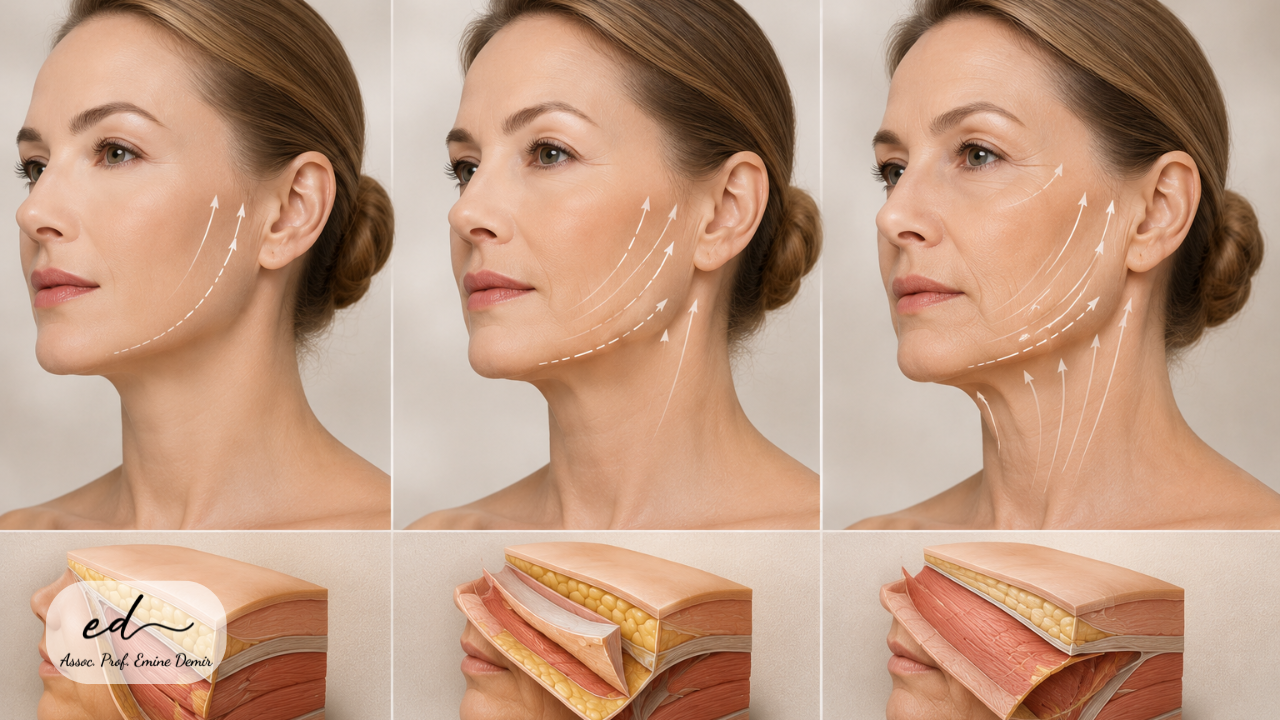
If you are researching facelift surgery, you have probably noticed one thing very quickly: there is no single “facelift.” There are mini facelifts, traditional facelifts, SMAS facelifts, deep plane facelifts, face and neck lifts, lower facelifts, ponytail lifts, short-scar lifts, and many other names that can make the decision feel confusing.
And honestly, the confusion is understandable.
Many patients begin with a simple question: “My face is starting to sag — what do I need?” But after reading online for a few hours, that simple question turns into something more complicated: “Is a mini facelift enough? Do I need deep plane? Is traditional facelift outdated? Which one lasts longer? Which one is better for my budget?”
Let’s answer these questions in a clear, balanced, and patient-friendly way.
Deep plane facelift, mini facelift, and traditional facelift are all surgical facial rejuvenation options. They can all improve signs of aging in selected patients. But they are not designed for the same level of facial aging, the same anatomy, the same recovery expectation, or the same budget range.
The best facelift technique is not the most famous one. It is the one that matches your facial structure, aging pattern, skin quality, neck condition, health status, and expectations.
For patients considering facial rejuvenation in İstanbul, Türkiye, this distinction is especially important. Many international patients travel for full face rejuvenation, but the right plan should never be based only on trend words. A detailed facial analysis is essential.
Assoc. Prof. Emine Demir, an Ear, Nose and Throat specialist and founder of Facelift Academy Türkiye, approaches facial rejuvenation with a full-face perspective. This means the face, neck, jawline, cheeks, eyelids, and skin quality are evaluated together — not as isolated areas.
So, let’s compare deep plane vs mini vs traditional facelift in a practical way.
What Is a Mini Facelift?
A mini facelift is a more limited facelift technique designed for early or mild signs of facial aging. It usually focuses on the lower face, especially early jowls and mild jawline softness.
Many people hear the word “mini” and assume it means very easy, almost like a non-surgical treatment. That is not true. A mini facelift is still surgery. It still involves incisions, tissue adjustment, healing, and possible risks.
The word “mini” generally refers to a more limited surgical scope, shorter incisions in selected cases, less extensive tissue dissection, and a more focused correction area.
A mini facelift may be considered for patients who have:
Early jowling
Mild lower face laxity
Good skin elasticity
Limited neck looseness
Mild sagging around the jawline
No major midface descent
No significant platysma bands in the neck
Realistic expectations for subtle improvement
The key word here is “mild.”
A mini facelift is not designed to correct advanced facial sagging, heavy jowls, deep neck laxity, severe skin looseness, or significant cheek descent. If those concerns are present, a mini facelift may not be enough.
Think of it like tailoring a jacket. If only a small adjustment is needed, a light alteration can work beautifully. But if the whole structure of the jacket has changed, a small stitch will not solve the problem.
What Is a Traditional Facelift?
A traditional facelift is a more comprehensive surgical procedure than a mini facelift. It usually addresses the lower face, jawline, jowls, and often the neck area when combined with neck lift techniques.
The term “traditional facelift” can mean different things depending on the surgeon. In many cases, it refers to a full facelift approach that includes skin redraping and deeper tissue support, often involving the SMAS layer.
SMAS stands for superficial musculoaponeurotic system. It is a fibrous layer beneath the skin that plays an important role in facial support and movement.
In a traditional facelift, the surgeon may lift and reposition deeper tissues, remove excess skin, and improve the contour of the lower face and jawline. If neck aging is present, a neck lift may be added.
A traditional facelift may be considered for patients with:
Moderate facial aging
Visible jowls
Lower face sagging
Jawline blurring
Moderate skin laxity
Some neck looseness
Aging that is more than mild but not necessarily advanced
A desire for more correction than a mini facelift can provide
Traditional facelift techniques are not automatically outdated. This is important.
Some marketing language online makes it sound like deep plane facelift is modern and every other facelift is old-fashioned. That is too simplistic. A well-planned traditional or SMAS-based facelift can still provide natural and meaningful improvement in suitable patients.
The real question is not “traditional or modern?” The real question is: “Which anatomical approach is right for this face?”
What Is a Deep Plane Facelift?
A deep plane facelift is a more advanced and structurally focused facelift technique. It works in deeper anatomical layers of the face, beneath the more superficial skin and tissue planes.
Instead of relying mainly on skin tightening, a deep plane facelift releases selected retaining ligaments and repositions deeper facial tissues, including cheek tissues and deeper fat compartments. This approach can be especially useful when facial aging involves deeper tissue descent.
In simple words, deep plane facelift is not just about pulling the surface. It is about moving the deeper foundation.
This technique may be considered for patients with:
Moderate to advanced facial sagging
Sagging cheeks
Deep nasolabial folds
Jowls
Lower face heaviness
Loss of jawline definition
Neck laxity when combined with neck lift
Midface descent
A desire for structural full face rejuvenation
Deep plane facelift is often discussed for patients who want a more comprehensive and longer-lasting facial rejuvenation plan. However, it is not automatically the right choice for everyone.
A younger patient with mild jowling may not need deep plane surgery. A patient whose main issue is skin texture may need skin treatments rather than a deeper facelift. A patient with significant neck aging may need a combined face and neck approach.
Deep plane facelift is powerful, but it should be used for the right indication.
Deep Plane vs Mini vs Traditional Facelift: Quick Comparison Table
| Feature | Mini Facelift | Traditional Facelift | Deep Plane Facelift |
|---|---|---|---|
| Best for aging level | Mild aging | Moderate aging | Moderate to advanced aging |
| Main focus | Early jowls, mild jawline laxity | Lower face, jowls, jawline, sometimes neck | Midface, lower face, jowls, jawline, neck when combined |
| Tissue depth | More limited tissue adjustment | Skin and deeper support layers, often SMAS-based | Deeper plane with ligament release and structural repositioning |
| Midface improvement | Limited | Moderate, depending on technique | Often stronger in suitable patients |
| Neck improvement | Limited unless combined | Moderate to significant if neck lift included | Significant if combined with deep plane neck lift |
| Incision scope | Usually shorter or more limited | More extensive than mini facelift | Usually comprehensive and anatomy-based |
| Recovery time | Often shorter | Moderate | Moderate to longer depending on extent |
| Longevity often discussed | Shorter-term, often several years | Intermediate to long-term | Often longer-term in suitable patients |
| Budget level | Usually lower | Medium to high | Usually highest |
| Best candidate | Mild laxity, good skin elasticity | Moderate laxity, visible jowls | Deeper tissue descent, cheek sagging, jowls, neck aging |
| Main limitation | May not be enough for significant sagging | May be less powerful than deep plane for midface descent | More complex, higher cost, not necessary for everyone |
| Ideal goal | Subtle refresh | Balanced lower face rejuvenation | Structural full face rejuvenation |
Which Technique Fits Which Aging Level?
Facelift choice is usually easier to understand when we look at aging stages.
Of course, every face is different. Age alone is not enough to decide. A 45-year-old patient may have more facial laxity than a 58-year-old patient due to genetics, weight changes, sun exposure, or skin quality. Still, aging level gives us a useful starting point.
Mild Aging
Mild aging usually means early changes. The jawline may look slightly softer. Small jowls may be starting. The lower face may not look as sharp as before, but there is no major sagging.
The neck is usually still relatively firm. The cheeks have not descended significantly. Skin elasticity is often still good.
In this stage, a mini facelift may be enough for selected patients.
However, if the patient expects a dramatic change, a mini facelift may disappoint. It is designed for subtle improvement, not full structural correction.
Moderate Aging
Moderate aging usually includes visible jowls, lower face laxity, softening of the jawline, and some skin looseness. The neck may also begin to show mild to moderate laxity.
At this stage, a traditional facelift or SMAS-based facelift may be considered. If the midface has also descended or the nasolabial folds are deep, deep plane facelift may be discussed.
This is the stage where proper diagnosis matters most.
Some patients with moderate aging may still be suitable for traditional facelift. Others may benefit more from deep plane because their aging pattern is deeper and more structural.
Advanced Aging
Advanced facial aging often includes significant sagging, heavier jowls, deep folds, loose neck skin, visible platysma bands, and a more noticeable disconnect between the face and neck.
In these cases, a mini facelift is usually not enough.
A deep plane facelift combined with neck lift may be more appropriate for suitable patients. A traditional facelift with neck lift may also be considered depending on anatomy and surgeon evaluation.
The main goal in advanced aging is not simply tightening skin. The deeper facial support system usually needs to be addressed.
Budget Comparison: Which Facelift Costs More?
Cost is one of the most searched topics in facelift research. But it is also one of the most variable.
Facelift cost depends on the country, surgeon’s experience, hospital or clinic setting, anesthesia, surgical time, whether a neck lift is included, whether eyelid surgery is added, and the level of postoperative care.
For patients considering facelift surgery in İstanbul, Türkiye, budget planning should be realistic and transparent. International patients should also consider accommodation, travel, recovery stay, follow-up appointments, and possible support needs after surgery.
In general:
Mini facelift is usually the lowest-cost surgical facelift option.
Traditional facelift is usually in the middle to higher range.
Deep plane facelift is usually the highest-cost option because it is more technically demanding and often more comprehensive.
However, the cheapest option is not always the best value.
If a mini facelift is performed on a patient who actually needs a full face and neck lift, the patient may not be satisfied with the level of improvement. In that case, choosing the smaller procedure only because it costs less may not be the best decision.
On the other hand, deep plane facelift is not necessary for every patient. If someone has mild aging and good skin elasticity, a more limited approach may be more appropriate and more cost-effective.
The right budget decision should be connected to the right diagnosis.
Is a Mini Facelift Enough?
This is one of the most important questions in the entire article.
A mini facelift may be enough if your aging signs are truly mild.
It may be suitable if you have early jowls, mild lower face laxity, good skin elasticity, and little to no neck looseness. It may also be appropriate if your goal is a subtle refresh rather than a dramatic transformation.
But a mini facelift is usually not enough if you have:
Significant jowls
Loose neck skin
Visible neck bands
Deep nasolabial folds
Sagging cheeks
Heavy lower face tissue
Poor skin elasticity
Advanced facial aging
A desire for full face rejuvenation
Many patients want a mini facelift because it sounds easier, cheaper, and quicker. That is understandable. Nobody wants more surgery than they need.
But the real issue is this: if the procedure is too limited for the problem, the result may also be limited.
A mini facelift should not be used as a shortcut for advanced aging. It can be a good option when the anatomy is right, but it is not a substitute for a full facelift or deep plane facelift in patients with more significant tissue descent.
Decision Flow: Which Facelift Do You Need?
Use this decision flow as a general educational guide. It does not replace a medical consultation, but it can help you understand the logic behind facelift planning.
Step 1: Is your main concern mild jawline softness?
If yes, and your skin elasticity is good, a mini facelift may be discussed.
If no, continue to the next step.
Step 2: Do you have visible jowls or lower face sagging?
If yes, a traditional facelift or deep plane facelift may be more appropriate than a mini facelift.
If no, non-surgical treatments or limited surgical options may be discussed depending on anatomy.
Step 3: Do your cheeks look descended or heavy?
If yes, deep plane facelift evaluation may be important because midface descent often requires deeper structural repositioning.
If no, a traditional facelift may be enough in selected cases.
Step 4: Do you have deep nasolabial folds?
If yes, deep plane facelift may offer an advantage in suitable patients because it can address deeper cheek descent and retaining ligament restrictions.
If no, a traditional or SMAS-based approach may still be considered depending on the lower face.
Step 5: Is your neck also loose?
If yes, facelift alone may not be enough. A neck lift may need to be included, whether the plan is traditional or deep plane.
If no, the plan may focus more on the face and jawline.
Step 6: Are you looking for subtle or comprehensive improvement?
If subtle, a mini facelift may be enough if the anatomy is suitable.
If comprehensive, traditional facelift or deep plane facelift may be more appropriate.
Step 7: Is your budget limited or flexible?
If budget is limited and aging is mild, a mini facelift may be discussed.
If budget is moderate and aging is moderate, traditional facelift may be discussed.
If budget is flexible and aging is structural, deep plane facelift may be discussed.
Step 8: What does your surgeon recommend after facial analysis?
This is the most important step.
Your face, not the internet, should decide the procedure.
Mini Facelift: Advantages and Limitations
A mini facelift can be appealing because it usually involves a more limited approach. Patients may like the idea of shorter recovery, smaller correction, and a lower budget compared to more comprehensive facelift techniques.
Advantages of Mini Facelift
A mini facelift may offer subtle improvement in early aging. It may refine the jawline, soften early jowls, and create a fresher lower face appearance in suitable patients.
It may involve a shorter surgical time compared to full facelift techniques. Recovery may also be somewhat shorter, although this varies.
For patients with mild concerns, it can be a reasonable option.
Limitations of Mini Facelift
The main limitation is scope.
A mini facelift cannot correct everything. It is not designed for advanced sagging, significant neck laxity, heavy jowls, or major midface descent.
Some patients choose a mini facelift because they want to avoid a bigger procedure, but if their anatomy requires more correction, the result may be underwhelming.
A mini facelift is best when the problem is also mini.
Traditional Facelift: Advantages and Limitations
A traditional facelift offers more correction than a mini facelift. It is often suitable for patients with moderate lower face aging, jowls, and jawline laxity.
Advantages of Traditional Facelift
Traditional facelift techniques can improve the lower face and jawline. When combined with neck lift, they may also improve neck contour.
They are well-established and can be tailored in different ways. Many traditional facelifts include SMAS support, which provides deeper reinforcement compared to skin-only lifting.
For many patients, a traditional facelift can create balanced and natural rejuvenation.
Limitations of Traditional Facelift
The term “traditional” covers many techniques, so quality and depth can vary.
Some traditional techniques may be less effective for significant midface descent or deep nasolabial folds compared to deep plane facelift. If the skin carries too much tension, the result may look pulled.
However, these limitations depend heavily on the surgeon’s technique. A well-performed traditional facelift is not automatically inferior.
Deep Plane Facelift: Advantages and Limitations
Deep plane facelift is often discussed as one of the most advanced facial rejuvenation techniques. It can be especially helpful for patients with deeper tissue descent.
Advantages of Deep Plane Facelift
Deep plane facelift focuses on deeper anatomical repositioning. It can release selected retaining ligaments and reposition the cheek, lower face, and jawline tissues more structurally.
It may be especially useful for midface descent, deep nasolabial folds, jowls, and full face rejuvenation planning.
Because the deeper tissues are repositioned, the skin may not need to be pulled with excessive tension. This can support a more natural-looking result in suitable patients.
Limitations of Deep Plane Facelift
Deep plane facelift is more complex. It requires advanced anatomical knowledge and careful technique.
It is usually more expensive than mini or traditional facelift options. Recovery may also be more involved, especially when combined with neck lift or other procedures.
It is not necessary for everyone. A patient with mild aging may not need a deep plane approach.
The technique should be chosen for the right patient, not because it is popular.
Recovery Comparison
Recovery differs from person to person. It depends on the technique, surgical extent, tissue quality, patient health, and whether procedures are combined.
A mini facelift may have a shorter recovery in selected cases because the surgery is usually more limited. However, swelling, bruising, tightness, and incision care are still part of the process.
A traditional facelift usually requires a moderate recovery period. If a neck lift is included, swelling and tightness may be more noticeable.
A deep plane facelift may involve deeper tissue swelling and a more comprehensive healing process, especially if combined with neck lift, blepharoplasty, or full face rejuvenation.
| Recovery Factor | Mini Facelift | Traditional Facelift | Deep Plane Facelift |
| Early swelling | Mild to moderate | Moderate | Moderate to significant |
| Bruising | Possible | Common | Common |
| Tightness | Common | Common | Common |
| Social recovery | Often shorter | Moderate | Moderate to longer |
| Tissue settling | Weeks to months | Months | Months |
| Scar maturation | Months | Months | Months |
| Time off work | Usually shorter | Moderate | Often longer if combined |
| Best recovery mindset | Subtle surgery still needs care | Plan for real healing time | Plan for a full recovery journey |
Patients traveling to İstanbul, Türkiye should not schedule a rushed return flight. Postoperative follow-up, swelling management, and safe recovery planning are essential.
Longevity Comparison
Longevity is not guaranteed with any facelift. Aging continues after surgery.
Still, different facelift techniques are often associated with different durability ranges.
A mini facelift generally has a shorter visible duration because it is more limited. It may be appropriate for early aging, but it may not provide long-term structural correction for deeper sagging.
A traditional facelift may provide longer-lasting improvement than a mini facelift, especially when the SMAS layer and neck are properly addressed.
A deep plane facelift is often discussed as longer-lasting because it repositions deeper facial structures. In suitable patients, it may provide more durable structural support.
However, longevity depends on many factors:
Genetics
Age
Skin quality
Sun exposure
Smoking
Weight changes
Hormonal changes
Surgical technique
Neck involvement
Postoperative care
Lifestyle
Approximate ranges often discussed in clinical communication may look like this:
| Technique | Commonly Discussed Longevity Range | Important Note |
| Mini Facelift | Often several years | Best for mild aging; less structural correction |
| Traditional Facelift | Often intermediate to long-term | Depends heavily on SMAS support and neck planning |
| Deep Plane Facelift | Often discussed around 10–15 years in suitable patients | Not a guarantee; aging continues naturally |
No ethical surgeon should promise a fixed number of years. Longevity is always personal.
Budget and Value: How Should You Think About Cost?
Budget matters. Patients are allowed to think about it. But in facial surgery, the lowest cost is not always the best value.
A mini facelift may cost less, but if it does not correct the actual aging pattern, the value may be limited. A traditional facelift may offer a strong balance between correction and cost for moderate aging. A deep plane facelift may cost more, but it may be more appropriate when deeper structural repositioning is needed.
For patients traveling to İstanbul, Türkiye, budget should include more than the surgery itself.
Consider:
Surgeon experience
Hospital or surgical facility
Anesthesia
Procedure combination
Neck lift inclusion
Blepharoplasty or other additions
Postoperative controls
Accommodation
Travel
Recovery support
Follow-up communication
VIP-level care should mean organized, clear, medically responsible planning. It should not simply mean luxury.
Which Facelift Is Best for Your Age?
Age can help guide the conversation, but it should not decide the surgery alone.
Some people age earlier because of genetics or weight loss. Others maintain good facial support for longer. Skin quality, bone structure, and lifestyle matter.
Still, here is a general guide.
Patients in Their 40s
Patients in their 40s may have early jowls, mild lower face laxity, or subtle jawline changes. If skin quality is good and aging is mild, a mini facelift may be considered.
However, some patients in their 40s have stronger tissue descent due to genetics or weight loss. In those cases, traditional or deep plane evaluation may be more appropriate.
Patients in Their 50s
This is a common age range for facelift consultation. Jowls, jawline laxity, cheek descent, and neck changes often become more visible.
Traditional facelift or deep plane facelift may be considered depending on anatomy. Mini facelift may still be enough for selected patients with mild aging, but it is not suitable for everyone.
Patients in Their 60s and Beyond
Patients in this age group may have more advanced facial and neck aging. A full facelift, deep plane facelift, and neck lift combination may be discussed.
However, health status becomes especially important. Medical evaluation, medication review, healing capacity, and surgical safety should be carefully considered.
Again, age is only one part of the decision.
Which Facelift Is Best for Jowls?
Jowls are one of the most common reasons patients consider facelift surgery.
A mini facelift may improve early jowls if the laxity is mild.
A traditional facelift can often improve moderate jowls by supporting deeper lower facial tissues and redraping the skin.
A deep plane facelift may be especially useful when jowls are part of broader cheek descent and deeper facial tissue movement.
If the neck is also loose, a neck lift may be needed for the jawline to look more defined. Treating jowls without addressing the neck may not provide enough harmony.
Which Facelift Is Best for the Neck?
If the neck is the main concern, the patient may need more than a facelift. A neck lift may be required.
Mini facelift is usually limited for neck improvement. It may not be enough for loose neck skin or platysma bands.
Traditional facelift can be combined with neck lift for moderate neck aging.
Deep plane facelift can also be combined with neck lift, especially when face and neck aging are connected.
The neck should always be evaluated together with the jawline and lower face. A strong jawline result often depends on proper neck planning.
Which Facelift Is Best for Sagging Cheeks?
Sagging cheeks usually involve midface descent. This is where deep plane facelift may offer an advantage in suitable patients.
Mini facelift is generally not designed to significantly lift the midface.
Traditional facelift may improve the lower face and jawline, but midface effect depends on the technique.
Deep plane facelift can release deeper attachments and reposition cheek tissues more structurally. This may make it more appropriate for patients whose main concern includes cheek descent and deep nasolabial folds.
Full Face Rejuvenation: When One Technique Is Not Enough
Sometimes the question is not mini vs traditional vs deep plane. Sometimes the real answer is a full face rejuvenation plan.
Facial aging may involve:
Heavy eyelids
Brow descent
Temple hollowing
Sagging cheeks
Jowls
Jawline laxity
Loose neck skin
Skin texture changes
Volume loss
If only one area is treated, the face may not look harmonious.
For example, improving the jawline but ignoring heavy eyelids may create imbalance. Lifting the face but leaving the neck untreated may make the result incomplete. Treating the neck without considering the lower face may not fully define the contour.
Assoc. Prof. Emine Demir’s full face rejuvenation focus in İstanbul, Türkiye is relevant here. A facelift should not be chosen as a single isolated product. It should be part of a personalized plan when needed.
Deep Plane vs Mini vs Traditional Facelift in İstanbul, Türkiye
İstanbul, Türkiye is a recognized destination for facial rejuvenation and international patient care. Many patients travel to İstanbul for facelift, neck lift, blepharoplasty, and full face rejuvenation procedures.
However, international patients should be careful when comparing techniques online.
A technique name alone is not enough. The surgeon must evaluate facial anatomy, skin quality, neck condition, aging pattern, and medical suitability.
Important questions for patients include:
Is my aging mild, moderate, or advanced?
Is mini facelift enough for my face?
Do I need neck lift as well?
Is my midface descended?
Would deep plane provide a meaningful advantage?
Would traditional facelift be enough?
What is realistic for my skin quality?
How much recovery time do I need in İstanbul?
What are the risks in my case?
What would look natural for my face?
A VIP-level surgical experience should include privacy, clear communication, careful planning, realistic expectations, and structured follow-up.
How to Choose Without Getting Lost in Marketing
Facelift marketing can be persuasive. Every technique can be presented as “the best.” But medicine is rarely that simple.
A mini facelift is not automatically too weak.
A traditional facelift is not automatically outdated.
A deep plane facelift is not automatically necessary.
Each technique has a place.
The right approach depends on:
Your anatomy
Your aging level
Your skin quality
Your neck condition
Your facial volume
Your expectations
Your budget
Your health status
Your recovery availability
Your surgeon’s recommendation
A responsible surgeon should explain why a technique is suitable or not suitable. If every patient is offered the same procedure, that is not personalized facial rejuvenation.
Final Decision: Which One Do You Need?
Here is a simple summary.
If your aging is mild, your skin quality is good, your neck is firm, and your main concern is early jowling, a mini facelift may be enough.
If your aging is moderate, your jawline is less defined, jowls are visible, and you need more than a subtle refresh, a traditional facelift may be considered.
If your aging is moderate to advanced, your cheeks have descended, your nasolabial folds are deep, your jowls are more pronounced, and your neck is also involved, a deep plane facelift with or without neck lift may be more appropriate.
But the final decision should never be made only from a blog article.
For patients considering facelift surgery in İstanbul, Türkiye, the most reliable next step is a detailed facial rejuvenation consultation. The goal is not to choose the most popular operation. The goal is to choose the most appropriate plan for your face.
A good facelift should not make you look like a different person. It should help your face look more balanced, supported, and naturally refreshed.
Frequently Asked Questions
What is the difference between mini facelift, traditional facelift, and deep plane facelift?
A mini facelift is a limited procedure for mild lower face aging. A traditional facelift is more comprehensive and often addresses the lower face, jawline, and sometimes neck. A deep plane facelift works in deeper anatomical layers and may reposition deeper facial tissues more structurally.
Is a mini facelift enough?
A mini facelift may be enough if aging is mild, skin elasticity is good, and the main concern is early jowling. It is usually not enough for significant sagging, loose neck skin, deep folds, or advanced facial aging.
Which facelift is best for mild aging?
For mild aging, a mini facelift may be considered in suitable patients. However, non-surgical treatments or skin quality treatments may also be discussed depending on the concern.
Which facelift is best for moderate aging?
Traditional facelift or deep plane facelift may be considered for moderate aging. The choice depends on whether the issue is mainly lower face laxity or deeper midface and cheek descent.
Which facelift is best for advanced aging?
Advanced aging often requires a more comprehensive approach, such as deep plane facelift combined with neck lift or a full face rejuvenation plan. Suitability depends on medical evaluation and anatomy.
Is deep plane facelift better than traditional facelift?
Not for every patient. Deep plane facelift may be more suitable for deeper tissue descent, while traditional facelift may be enough for selected patients with moderate lower face aging.
Is traditional facelift outdated?
No. Traditional facelift techniques, especially those involving deeper tissue support, can still provide natural and meaningful results in suitable patients.
Which facelift has the shortest recovery?
A mini facelift often has the shortest recovery because it is more limited. However, recovery varies from person to person and still requires proper postoperative care.
Which facelift lasts the longest?
Deep plane facelift is often discussed as having longer-lasting structural support in suitable patients. However, no facelift can stop aging, and longevity depends on many personal factors.
Is deep plane facelift more expensive?
Generally, yes. Deep plane facelift is usually more costly because it is more technically complex and often part of a more comprehensive facial rejuvenation plan.
Do I need a neck lift with facelift?
If the neck has loose skin, platysma bands, or under-chin fullness, a neck lift may be needed for better harmony. Facelift alone may not fully improve the neck.
Can blepharoplasty be combined with facelift?
Yes. In suitable patients, blepharoplasty may be combined with mini, traditional, or deep plane facelift as part of full face rejuvenation.
How do I know which facelift is right for me?
The right facelift depends on facial anatomy, aging level, skin quality, neck condition, health status, expectations, and recovery planning. A detailed consultation is necessary.