
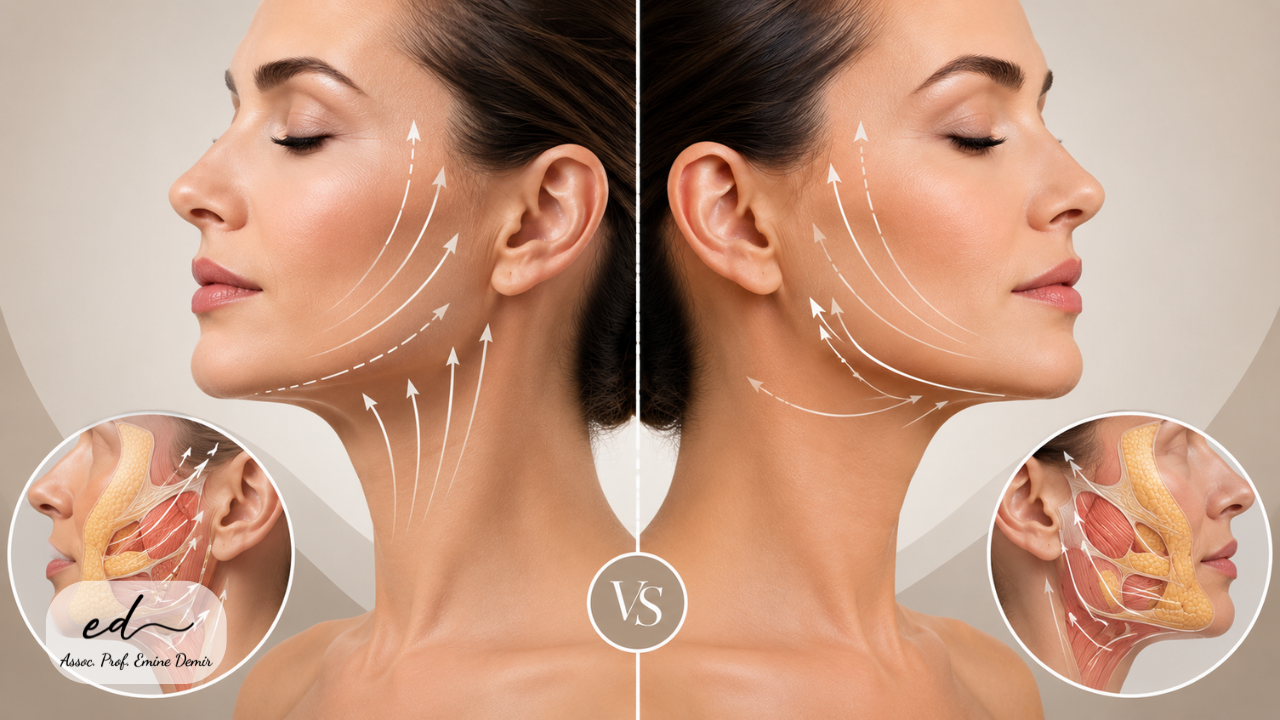
Facelift research can become confusing very quickly. One clinic says deep plane facelift is the most advanced option. Another surgeon explains that a well-performed SMAS facelift can still create excellent, natural-looking results. Then you see terms like retaining ligaments, malar fat pad, superficial musculoaponeurotic system, composite flap, skin tension, vector, midface repositioning…
It is a lot.
So, let’s slow down and compare these two facelift techniques in a clear, realistic, and patient-friendly way.
Deep plane facelift and SMAS facelift are both surgical facial rejuvenation techniques. They are both designed to improve visible signs of aging in the face and, when combined with neck lift, the neck area. Both may address concerns such as sagging cheeks, jowls, jawline laxity, deep nasolabial folds, and lower face heaviness.
But they do not work in exactly the same anatomical layer.
A SMAS facelift focuses on lifting, tightening, folding, or repositioning the SMAS layer, which is a strong fibromuscular layer beneath the skin. A deep plane facelift goes deeper by releasing selected retaining ligaments and repositioning the facial tissues as a more unified structure. In simple terms, SMAS facelift supports the deeper layer, while deep plane facelift releases and repositions deeper facial attachments more extensively.
For patients considering facial rejuvenation in İstanbul, Türkiye, the question is not simply “Which technique is better?” The better question is: “Which technique is more suitable for my facial anatomy, aging pattern, expectations, and recovery plan?”
Assoc. Prof. Emine Demir, an Ear, Nose and Throat specialist and founder of Facelift Academy Türkiye, approaches facelift surgery with a full face rejuvenation perspective. This matters because the face does not age in isolated pieces. The cheeks, jawline, neck, eyelids, temples, and skin quality all influence the final harmony.
In this guide, we will compare deep plane facelift vs SMAS facelift in terms of anatomy, technique, recovery, longevity, cost, candidate profile, advantages, limitations, and decision-making.
What Is a Deep Plane Facelift?
A deep plane facelift is a facial rejuvenation surgery that works beneath the superficial layers of the face. Instead of mainly pulling the skin tighter, it focuses on releasing deeper facial retaining ligaments and repositioning descended tissues such as the cheek fat pads, lower face tissues, and jawline support structures.
The technique became widely recognized after Sam T. Hamra’s 1990 publication, “The Deep-Plane Rhytidectomy.” His work helped bring attention to the importance of addressing the midface, nasolabial folds, and deeper facial support system rather than relying only on skin tightening.
To understand this better, imagine the face as a layered structure.
The skin is the outer covering. Beneath it, there is subcutaneous fat. Under that lies the SMAS layer. Then come deeper fat compartments, retaining ligaments, muscles, nerves, and connective tissue structures.
Aging does not happen only on the surface. The deeper layers also descend, loosen, shift, or lose support. That is why simply tightening the skin may not always create a natural or long-lasting improvement.
Deep plane facelift surgery aims to reposition the deeper foundation of the face.
This is why it is often discussed for patients with:
Sagging cheeks
Deep nasolabial folds
Jowls
Lower face heaviness
Jawline laxity
Midface descent
Neck aging when combined with neck lift
A tired or downward facial appearance
The deep plane approach is not just about lifting more. It is about lifting differently.
What Is a SMAS Facelift?
A SMAS facelift is a facelift technique that addresses the superficial musculoaponeurotic system, commonly known as the SMAS layer. This layer is stronger than skin and plays an important role in facial support and movement.
In many SMAS facelift techniques, the surgeon separates the skin from the underlying SMAS layer. The SMAS may then be tightened, folded, trimmed, lifted, or repositioned depending on the surgical plan. After the deeper support layer is adjusted, the skin is redraped more smoothly.
This is already a more advanced concept than a skin-only facelift.
A SMAS facelift may be suitable for patients with mild to moderate facial aging, lower face laxity, jowls, and skin looseness. It can create natural-looking improvement when performed with good anatomical judgment and appropriate patient selection.
There are different types of SMAS techniques, including:
SMAS plication
SMAS imbrication
SMASectomy
High SMAS facelift
Extended SMAS facelift
This is one reason comparisons can become confusing. Not every SMAS facelift is the same. A limited SMAS plication and an extended SMAS facelift are not identical procedures.
So, when comparing deep plane facelift vs SMAS facelift, we should avoid oversimplifying. A well-performed SMAS facelift can be very effective. A deep plane facelift can be powerful, but it also requires advanced anatomical knowledge and careful execution.
The name of the technique matters less than the surgeon’s understanding of the face.
Deep Plane Facelift vs SMAS Facelift: The Core Difference
The main difference is anatomical depth and tissue release.
A SMAS facelift usually works by tightening or repositioning the SMAS layer after separating the skin. A deep plane facelift works beneath or within deeper anatomical planes and releases selected retaining ligaments to reposition the facial tissues more freely.
In simple language:
SMAS facelift lifts and supports the deeper layer.
Deep plane facelift releases deeper attachments and repositions the face more structurally.
Think of facial aging like a curtain that has become loose. A skin-only facelift pulls the fabric. A SMAS facelift reinforces the fabric from a stronger backing layer. A deep plane facelift releases the fixed points holding the fabric down and repositions the entire structure more naturally.
This is why deep plane facelift is often associated with a more natural, less pulled appearance in suitable patients. Because the deeper tissues are repositioned first, the skin may not need to carry as much tension.
However, this does not mean every patient needs a deep plane facelift. If the aging pattern is mild, a SMAS technique may be enough. If the main issue is skin quality rather than tissue descent, additional skin treatments may be needed. If the neck is the main concern, a neck lift may be required.
A good facelift plan starts with diagnosis, not with a trendy technique name.
Comparison Table: Deep Plane Facelift vs SMAS Facelift
| Feature | Deep Plane Facelift | SMAS Facelift |
|---|---|---|
| Main anatomical focus | Deeper facial plane beneath/around SMAS-related structures | SMAS layer beneath the skin |
| Tissue movement | Repositions deeper soft tissues as a more unified structure | Tightens, folds, trims, or repositions the SMAS layer |
| Retaining ligament release | Usually involves release of selected retaining ligaments | May involve limited or variable ligament release depending on technique |
| Midface effect | Often stronger for cheek descent and nasolabial fold region | Can improve lower face; midface effect depends on SMAS technique |
| Skin tension | Usually aims for less surface tension because deeper tissues are repositioned | Skin tension can be low if performed well, but technique varies |
| Natural appearance potential | High in suitable patients when performed well | Also natural when performed well and matched to the patient |
| Typical candidate | Moderate to advanced facial descent, midface sagging, jowls, deeper folds | Mild to moderate lower face laxity, jowls, skin looseness |
| Recovery | Often similar or slightly longer depending on extent and combination procedures | Often moderate; may be slightly shorter in limited SMAS techniques |
| Approximate longevity often discussed in clinics | Commonly estimated around 10–15 years in suitable patients | Commonly estimated around 5–8 years for lighter SMAS approaches, but well-performed SMAS flap techniques may last longer |
| Cost | Usually higher due to complexity, time, and expertise | Usually lower than deep plane, but varies by surgeon and country |
| Surgical complexity | Higher | Moderate to high depending on SMAS technique |
| Best use case | Structural repositioning, full face rejuvenation, deeper facial descent | Lower face support, moderate laxity, patients needing less extensive surgery |
| Limitations | More technically demanding; not necessary for everyone | May be less effective for significant midface descent depending on technique |
| Key question | Does my face need deeper ligament release and tissue repositioning? | Can SMAS support provide enough improvement for my aging pattern? |
Anatomy Comparison
To compare these procedures properly, we need to understand three key structures: the SMAS layer, retaining ligaments, and facial fat pads.
The SMAS Layer
SMAS stands for superficial musculoaponeurotic system. It is a fibrous layer beneath the skin and subcutaneous fat. It connects with facial muscles and helps transmit facial movement.
In facelift surgery, the SMAS is important because it is stronger than skin. If only the skin is tightened, the result may not be as stable or natural. By supporting the SMAS, the surgeon can address deeper facial laxity.
A SMAS facelift works directly with this layer.
A deep plane facelift goes further by working in a deeper plane and often lifting the skin and SMAS-related tissues as a more connected unit in selected regions.
Retaining Ligaments
Retaining ligaments are strong connective tissue structures that anchor facial soft tissues to deeper layers. They are like natural attachment points in the face.
With aging, facial tissues descend around these ligaments. This can create folds, shadows, jowls, and uneven tissue distribution. If a surgeon pulls tissue without releasing certain ligament restrictions, the lift may be limited or may require more skin tension.
Deep plane facelift techniques commonly involve controlled release of selected retaining ligaments. This allows the cheek, jowl, and lower face tissues to move more freely.
SMAS facelift techniques may or may not involve significant ligament release. It depends on the specific SMAS method.
Deep Fat Pads
The face contains different fat compartments. Some are superficial. Some are deeper. These fat pads help create youthful facial shape.
As the face ages, fat pads may descend, shrink, or change position. This can create sagging cheeks, deeper nasolabial folds, jowls, and lower face heaviness.
Deep plane facelift surgery often aims to reposition these deeper soft tissue structures. This is one reason it may be effective for patients with midface descent.
A SMAS facelift may improve facial support, but the degree of fat pad repositioning depends on the technique used.
Technique Comparison
The difference between deep plane facelift and SMAS facelift becomes clearer when we look at how the procedures are generally performed.
Deep Plane Facelift Technique
In a deep plane facelift, the surgeon usually makes incisions around the ear and hairline region, depending on the patient’s anatomy and surgical plan. The dissection then enters a deeper anatomical plane.
The surgeon releases selected retaining ligaments. This release allows descended facial tissues to move more freely. The cheek, lower face, and jawline tissues can then be repositioned in a more natural direction.
The skin is redraped after the deeper tissues are repositioned. Ideally, the skin should not carry the main tension.
This technique may be combined with neck lift, blepharoplasty, temporal lift, fat transfer, or full face rejuvenation procedures depending on the patient’s needs.
SMAS Facelift Technique
In a SMAS facelift, the surgeon usually separates the skin from the underlying SMAS layer. The SMAS is then tightened, folded, trimmed, lifted, or repositioned.
Different surgeons use different SMAS techniques. Some are more limited. Others are more extensive.
After the SMAS is supported, the skin is redraped and excess skin is removed. A good SMAS facelift should also avoid excessive skin tension.
SMAS facelift surgery may be combined with neck lift, eyelid surgery, or other facial rejuvenation procedures when needed.
Recovery Time: Deep Plane vs SMAS Facelift
Recovery depends on the individual patient, surgical extent, tissue quality, whether a neck lift is included, and whether other procedures are performed at the same time.
Still, some general differences may be discussed.
Deep plane facelift may involve more extensive deeper tissue work, so swelling and tightness may sometimes last longer. However, because the skin is not necessarily pulled with excessive tension, some patients may experience a recovery that is comparable to other full facelift techniques.
SMAS facelift recovery may be slightly shorter when the procedure is limited. But an extended SMAS facelift combined with neck lift can still involve a significant recovery period.
A general recovery comparison may look like this:
| Recovery Factor | Deep Plane Facelift | SMAS Facelift |
| Initial swelling | Common; may be more noticeable in deeper tissue work | Common; varies by technique |
| Bruising | Common | Common |
| Tightness | Common, especially in face and neck | Common |
| Social recovery | Often 2–4 weeks depending on extent | Often 2–3 weeks for limited cases, longer if combined |
| Tissue settling | Several months | Several months |
| Scar maturation | Months | Months |
| Return to intense exercise | Surgeon-dependent; usually delayed | Surgeon-dependent; usually delayed |
| International travel planning | Requires enough stay in İstanbul for follow-up | Also requires follow-up planning |
For patients traveling to İstanbul, Türkiye, recovery should be planned before surgery. Return flights, follow-up visits, accommodation, swelling management, and emergency contact instructions should be clear.
A VIP-level medical journey is not only about the operation day. It is also about postoperative care.
Longevity: Does Deep Plane Last Longer Than SMAS?
This is one of the most searched questions: “Which facelift lasts longer?”
Many clinic-facing comparisons describe deep plane facelift results as lasting around 10–15 years and SMAS facelift results as lasting around 5–8 years. This is a common way to explain the general difference between more structural deep plane surgery and more limited SMAS techniques.
However, this topic needs a careful explanation.
Facelift longevity is not determined only by technique. It also depends on:
Age at surgery
Skin quality
Sun damage
Smoking
Weight changes
Genetics
Hormonal changes
Bone structure
Surgical technique
Neck involvement
Postoperative care
Lifestyle
Natural aging process
Also, not all SMAS facelifts are the same. A limited SMAS plication may not have the same longevity as a well-executed high SMAS or extended SMAS flap technique.
Some studies on SMAS facelift longevity have reported average durability around a decade or longer in selected cases. This means it would be misleading to say every SMAS facelift lasts only 5–8 years.
A fair summary would be:
Deep plane facelift is often preferred when longer-lasting structural repositioning is desired, especially in patients with deeper tissue descent.
Limited SMAS techniques may have shorter visible durability in some patients.
Well-performed advanced SMAS techniques may last longer than simple marketing comparisons suggest.
No facelift stops aging completely.
So, while deep plane facelift is commonly associated with 10–15 years of improvement, and lighter SMAS approaches are often described as 5–8 years, these numbers should be treated as approximate ranges rather than guarantees.
A responsible surgeon should never promise a fixed number of years.
Cost Comparison
Deep plane facelift is usually more expensive than SMAS facelift. The reasons are understandable.
Deep plane facelift is technically more demanding. It may take longer. It requires advanced anatomical knowledge and experience with facial retaining ligaments, deeper tissue planes, and facial nerve safety. It is also often performed as part of a more comprehensive face and neck rejuvenation plan.
SMAS facelift may be less costly, especially when the technique is more limited. However, cost varies widely depending on country, surgeon experience, hospital setting, anesthesia, procedure combination, and postoperative care.
For patients researching facelift surgery in İstanbul, Türkiye, cost should not be evaluated alone. A lower price may look attractive at first, but facial surgery requires safety, planning, technique, follow-up, and realistic expectations.
A better way to think about cost is this:
What exactly is included?
Is it facelift only or face and neck lift?
Is blepharoplasty included?
Is the procedure deep plane, SMAS, or another technique?
How experienced is the surgeon in facial rejuvenation?
Where will surgery be performed?
How is postoperative follow-up organized?
How many days should I stay in İstanbul?
What happens if additional care is needed?
VIP-level care should include clarity. Patients should understand what they are choosing.
Which Technique Looks More Natural?
Both techniques can look natural when performed well. Both can also look unnatural if performed poorly.
Naturalness depends less on the name of the technique and more on:
Correct diagnosis
Good patient selection
Tissue handling
Direction of lift
Avoiding excessive skin tension
Respecting facial identity
Balanced neck and jawline planning
Incision design
Surgeon experience
Deep plane facelift may offer a natural appearance in suitable patients because it repositions deeper tissues rather than pulling the skin tightly. This can help avoid the stretched look that patients fear.
SMAS facelift can also look natural, especially when the skin is not over-pulled and the deeper layer is properly supported.
The most natural result is not always the most aggressive lift. Sometimes a conservative SMAS approach is more appropriate. Sometimes a deep plane facelift is needed for deeper structural descent.
A good facelift should not make someone look like another person. It should make the face look more balanced, refreshed, and harmonious.
Which Technique Is Safer?
Both deep plane facelift and SMAS facelift are surgical procedures with possible risks.
Possible risks include:
Bleeding
Hematoma
Infection
Scarring
Swelling
Bruising
Numbness
Skin healing problems
Facial nerve weakness or injury
Asymmetry
Hairline changes
Unsatisfactory result
Need for revision surgery
Anesthesia-related risks
Deep plane facelift involves deeper dissection and ligament release, so it requires detailed knowledge of facial nerve anatomy. This does not automatically make it unsafe, but it does mean the surgeon’s experience is very important.
SMAS facelift also involves important anatomical structures and should not be considered “simple.” A poorly planned SMAS facelift can also create complications or unnatural results.
Safety depends on:
Surgeon training
Anatomical expertise
Patient health
Proper surgical setting
Careful technique
Preoperative planning
Postoperative care
Realistic indication
No facelift should be marketed as risk-free.
Candidate Comparison
Different patients may benefit from different techniques.
A Deep Plane Facelift May Be More Suitable For
A patient may be evaluated for deep plane facelift if they have:
Moderate to advanced facial descent
Sagging cheeks
Deep nasolabial folds
Jowls
Lower face heaviness
Loss of jawline definition
Neck aging when combined with neck lift
A desire for structural facial repositioning
Previous limited procedures with insufficient improvement
Good general health and realistic expectations
Deep plane facelift is often considered when the aging pattern is not only skin laxity but deeper tissue descent.
A SMAS Facelift May Be More Suitable For
A patient may be evaluated for SMAS facelift if they have:
Mild to moderate lower face laxity
Early jowling
Moderate skin looseness
Good skin quality
Less significant midface descent
A desire for facial rejuvenation without deeper plane release
Anatomy suitable for SMAS support
Realistic expectations
SMAS facelift may be appropriate when the deeper tissue descent is not severe or when the patient does not require extensive midface release.
“Which One Is Right for Me?” Decision Guide
This is the most practical question.
There is no universal answer. The right choice depends on your anatomy, not the popularity of a technique.
Choose Deep Plane Facelift Evaluation If…
You notice that your cheeks have descended.
Your nasolabial folds look deeper than before.
Your lower face feels heavy.
You have jowls and loss of jawline definition.
You want a structural approach rather than surface tightening.
You are considering full face rejuvenation in İstanbul, Türkiye.
You are willing to accept a more advanced surgical procedure and recovery process.
You understand that results vary and no technique guarantees a fixed outcome.
Choose SMAS Facelift Evaluation If…
Your aging signs are mild to moderate.
Your main concern is lower face laxity or early jowling.
Your midface descent is limited.
You want a proven facelift concept with a potentially less extensive approach.
Your surgeon believes SMAS support is enough for your anatomy.
You prefer a balanced plan without unnecessary deeper dissection.
You understand that SMAS techniques vary widely.
Consider Full Face Rejuvenation Planning If…
Your eyelids, cheeks, jawline, and neck all contribute to the aging appearance.
You feel that treating only one area may create imbalance.
You are considering blepharoplasty, neck lift, temporal lift, or facelift together.
You want the face and neck to look harmonious.
You prefer a personalized surgical plan rather than a single isolated procedure.
For many patients, the real answer is not “deep plane or SMAS?” It is “What combination of techniques will create the most balanced and natural result for my face?”
Deep Plane Facelift vs SMAS Facelift for the Midface
The midface includes the cheek area and the transition between the lower eyelid, cheek, and nasolabial fold. This is one of the most important areas in facial rejuvenation.
Deep plane facelift is often considered stronger for the midface because it allows deeper release and repositioning of cheek tissues. This may help improve cheek descent and soften the nasolabial region in suitable patients.
SMAS facelift can improve the midface depending on the technique, especially with high SMAS or extended SMAS methods. However, limited SMAS techniques may be less powerful in this area.
If the patient’s main concern is cheek descent and deep nasolabial folds, deep plane facelift may be discussed more seriously.
But if the midface is relatively stable and the main concern is mild jowling, a SMAS technique may be enough.
Deep Plane Facelift vs SMAS Facelift for the Jawline
Both techniques can improve the jawline.
SMAS facelift is often effective for jowls and lower face laxity. By tightening or repositioning the SMAS, the surgeon can improve the contour along the jawline.
Deep plane facelift can also improve the jawline by repositioning deeper descended tissues and releasing retaining ligaments that contribute to jowling.
The difference depends on the severity and location of the sagging.
If jowling is mild, SMAS support may be sufficient. If the jowls are part of broader cheek and lower face descent, deep plane surgery may offer a more structural approach.
In many cases, jawline improvement also depends on the neck. If the neck is loose, a facelift without neck lift may not fully define the lower face.
Deep Plane Facelift vs SMAS Facelift for the Neck
Neither technique should be discussed without considering the neck.
Many patients who search for facelift actually need face and neck rejuvenation. Jowls, jawline softness, platysma bands, and loose neck skin are often connected.
A deep plane facelift may be combined with a deep plane neck lift or other neck lift techniques. A SMAS facelift may also be combined with neck lift.
The choice depends on:
Skin laxity
Platysma bands
Under-chin fullness
Submandibular gland visibility
Jawline structure
Chin-neck angle
Lower face descent
If the neck is a major concern, the question should not be only deep plane vs SMAS. The surgeon should also evaluate whether a neck lift is needed.
Deep Plane Facelift vs SMAS Facelift in İstanbul, Türkiye
İstanbul, Türkiye has become an important destination for facial aesthetic surgery and international patient care. Many patients travel to İstanbul for facelift, neck lift, blepharoplasty, and full face rejuvenation procedures.
However, patients should be careful when comparing techniques online.
The term “deep plane facelift” has become popular. Because of this, some patients may assume that deep plane is always the right choice. Others may hear that SMAS facelift is “old” or “less effective.” These are oversimplified statements.
A high-quality facial rejuvenation plan should be based on:
Detailed facial analysis
Anatomical diagnosis
Surgeon experience
Patient health
Realistic expectations
Safety
Natural harmony
Full face planning when needed
Assoc. Prof. Emine Demir, founder of Facelift Academy Türkiye, focuses on facial rejuvenation with a whole-face perspective in İstanbul. This type of approach is especially important for patients who want a refined, natural-looking result rather than an exaggerated or isolated correction.
Why Technique Alone Is Not Enough
A common mistake in facelift research is focusing only on the technique name.
Deep plane. SMAS. Mini facelift. High SMAS. Extended SMAS. Composite facelift.
These terms matter, but they are not the whole story.
A facelift result depends on:
The surgeon’s diagnosis
How the tissue is handled
The direction of lift
How much tension is placed on the skin
How the neck is treated
How incisions are planned
How the patient heals
Whether the procedure matches the aging pattern
A deep plane facelift performed without proper indication may not be ideal. A SMAS facelift performed beautifully in the right patient may look excellent. A full face rejuvenation plan may sometimes include elements beyond either category.
So, instead of choosing a technique from the internet, patients should use online research to ask better consultation questions.
Questions to Ask During Consultation
Before deciding between deep plane facelift and SMAS facelift, patients may ask:
What is my main aging pattern?
Is my concern caused by skin laxity, SMAS laxity, fat descent, ligament restriction, or neck aging?
Would deep plane facelift offer a meaningful advantage in my case?
Would a SMAS facelift be enough for my anatomy?
Do I need a neck lift as well?
Do I need eyelid surgery or temporal lift for full facial harmony?
What recovery timeline should I expect?
What are the risks in my personal case?
How long should I stay in İstanbul after surgery?
What result would look natural for my face?
What can surgery improve, and what can it not change?
These questions help shift the conversation from marketing to medicine.
Common Myths About Deep Plane and SMAS Facelift
Deep Plane Is Always Better
Not always. Deep plane facelift may be more suitable for certain patients with deeper facial descent, but not everyone needs it. The right technique depends on anatomy.
SMAS Facelift Is Outdated
No. SMAS facelift remains an important facial rejuvenation technique. Advanced SMAS methods can create natural and durable results in suitable patients.
Deep Plane Always Lasts 15 Years
No facelift result can be guaranteed for a fixed number of years. Deep plane facelift is often associated with longer-lasting structural repositioning, but longevity varies.
SMAS Only Lasts 5 Years
This is too simplistic. Some lighter SMAS techniques may have shorter durability, but well-performed SMAS flap facelifts may last much longer in selected patients.
The Most Expensive Technique Is Always the Best
No. Cost may reflect complexity and expertise, but the best technique is the one that fits the patient’s anatomy and goals.
A Facelift Replaces Skin Quality Treatments
Not necessarily. A facelift repositions tissue, but it does not fully correct pigmentation, fine lines, sun damage, or skin texture. Skin quality may need separate treatment.
Final Verdict: Deep Plane Facelift vs SMAS Facelift
Deep plane facelift and SMAS facelift are both valuable surgical techniques. They are not enemies. They are different anatomical strategies.
Deep plane facelift may be more suitable for patients with moderate to advanced facial descent, cheek sagging, deeper nasolabial folds, jowls, and a need for structural repositioning. It is often preferred in comprehensive full face rejuvenation plans, especially when the midface and lower face need deeper release.
SMAS facelift may be more suitable for patients with mild to moderate aging, lower face laxity, early jowling, and anatomy that can be improved with SMAS support without deeper plane dissection.
The important point is this: technique should follow diagnosis.
For patients considering facelift surgery in İstanbul, Türkiye, the safest and most meaningful approach is a personalized consultation. The face should be evaluated as a whole — cheeks, jawline, neck, eyelids, temples, skin quality, and natural expression.
Assoc. Prof. Emine Demir’s facial rejuvenation-focused approach through Facelift Academy Türkiye reflects this philosophy. A facelift should not be planned only to tighten skin. It should be designed to support facial harmony, natural identity, and balanced rejuvenation.
A good facelift does not make a person look like someone else. It helps the face look more rested, structured, and naturally supported.
Frequently Asked Questions
What is the main difference between deep plane facelift and SMAS facelift?
The main difference is the anatomical plane. SMAS facelift works by tightening or repositioning the SMAS layer, while deep plane facelift releases selected retaining ligaments and repositions deeper facial tissues more structurally.
Is deep plane facelift better than SMAS facelift?
Not for everyone. Deep plane facelift may be more suitable for patients with deeper facial descent and midface sagging. SMAS facelift may be enough for mild to moderate aging in suitable patients.
Which facelift lasts longer?
Deep plane facelift is commonly discussed as lasting around 10–15 years in suitable patients, while lighter SMAS techniques are often described as lasting around 5–8 years. However, longevity varies widely, and well-performed SMAS flap facelifts may last longer than this general estimate.
Does deep plane facelift look more natural?
It may look very natural in suitable patients because it repositions deeper tissues and may reduce skin tension. However, natural results depend on surgeon experience, patient selection, and proper technique.
Is SMAS facelift outdated?
No. SMAS facelift is still a valuable and widely used facial rejuvenation technique. Advanced SMAS methods can create natural and durable results when matched to the right patient.
Which technique is better for jowls?
Both techniques can improve jowls. Mild jowling may respond well to SMAS facelift, while more significant jowling related to deeper facial descent may benefit from deep plane facelift evaluation.
Which technique is better for nasolabial folds?
Deep plane facelift is often considered stronger for nasolabial fold and midface improvement because it can release retaining ligaments and reposition deeper cheek tissues.
Is deep plane facelift more expensive than SMAS facelift?
Usually, yes. Deep plane facelift is often more costly because it is technically more complex and may require more surgical time and specialized experience. However, cost varies by surgeon, country, facility, and procedure combination.
Is recovery longer after deep plane facelift?
Recovery may be similar or slightly longer depending on surgical extent and whether neck lift or other procedures are combined. Swelling, bruising, tightness, and numbness are common in both procedures.
Can deep plane facelift be combined with neck lift?
Yes. Deep plane facelift is often combined with neck lift in suitable patients to improve jawline, lower face, and neck harmony.
Can SMAS facelift be combined with blepharoplasty?
Yes. SMAS facelift may be combined with blepharoplasty, neck lift, temporal lift, or other facial rejuvenation procedures when medically appropriate.
How do I know which facelift is right for me?
The right technique depends on your anatomy, aging pattern, skin quality, health status, and expectations. A detailed facial rejuvenation consultation is necessary to determine whether deep plane, SMAS, or another approach is more suitable.
Frequently Asked Questions
What is the main difference between deep plane facelift and SMAS facelift?
The main difference is the anatomical layer addressed during surgery. A SMAS facelift focuses on tightening or repositioning the SMAS layer, while a deep plane facelift works deeper by releasing selected retaining ligaments and repositioning deeper facial tissues more structurally.
Is deep plane facelift better than SMAS facelift?
Not necessarily for every patient. Deep plane facelift may be more suitable for patients with deeper facial descent, sagging cheeks, jowls, and pronounced nasolabial folds. SMAS facelift may be appropriate for patients with mild to moderate aging signs and less significant tissue descent.
Which facelift lasts longer?
Deep plane facelift is commonly associated with a longer-lasting structural effect, often discussed as approximately 10–15 years in suitable patients. SMAS facelift longevity is often described around 5–8 years for lighter techniques, although advanced SMAS techniques may last longer depending on the patient and surgical plan.
Does deep plane facelift look more natural?
It can look natural in suitable patients because the deeper tissues are repositioned rather than relying mainly on skin tension. However, natural-looking results depend on the surgeon’s technique, patient anatomy, healing process, and realistic planning.
Is SMAS facelift outdated?
No. SMAS facelift is still a valuable and widely used facial rejuvenation technique. In selected patients, a well-planned SMAS facelift can provide balanced and natural-looking improvement.
Which technique is better for jowls?
Both techniques may improve jowls. Mild jowling may respond well to SMAS facelift, while more significant jowling related to deeper facial descent may require deep plane facelift evaluation.
Which technique is better for nasolabial folds?
Deep plane facelift is often considered more effective for nasolabial fold and midface concerns because it can release deeper retaining ligaments and reposition cheek tissues more structurally.
Is deep plane facelift more expensive than SMAS facelift?
Generally, deep plane facelift may be more costly because it is technically more complex and may require more surgical time and specialized experience. However, cost varies depending on the surgeon, country, hospital setting, anesthesia, and whether additional procedures are included.
Is recovery longer after deep plane facelift?
Recovery may be similar or slightly longer depending on the extent of surgery and whether neck lift, blepharoplasty, or full face rejuvenation procedures are combined. Swelling, bruising, tightness, and numbness may occur after both techniques.
Can deep plane facelift be combined with neck lift?
Yes. In suitable patients, deep plane facelift may be combined with neck lift to improve jawline, lower face, and neck harmony.
Can SMAS facelift be combined with blepharoplasty?
Yes. SMAS facelift may be combined with blepharoplasty, neck lift, temporal lift, or other facial rejuvenation procedures when medically appropriate.
How do I know which facelift is right for me?
The right technique depends on facial anatomy, aging pattern, skin quality, health status, expectations, and recovery planning. A detailed facial rejuvenation consultation is necessary to decide whether deep plane facelift, SMAS facelift, or another approach is more suitable.