
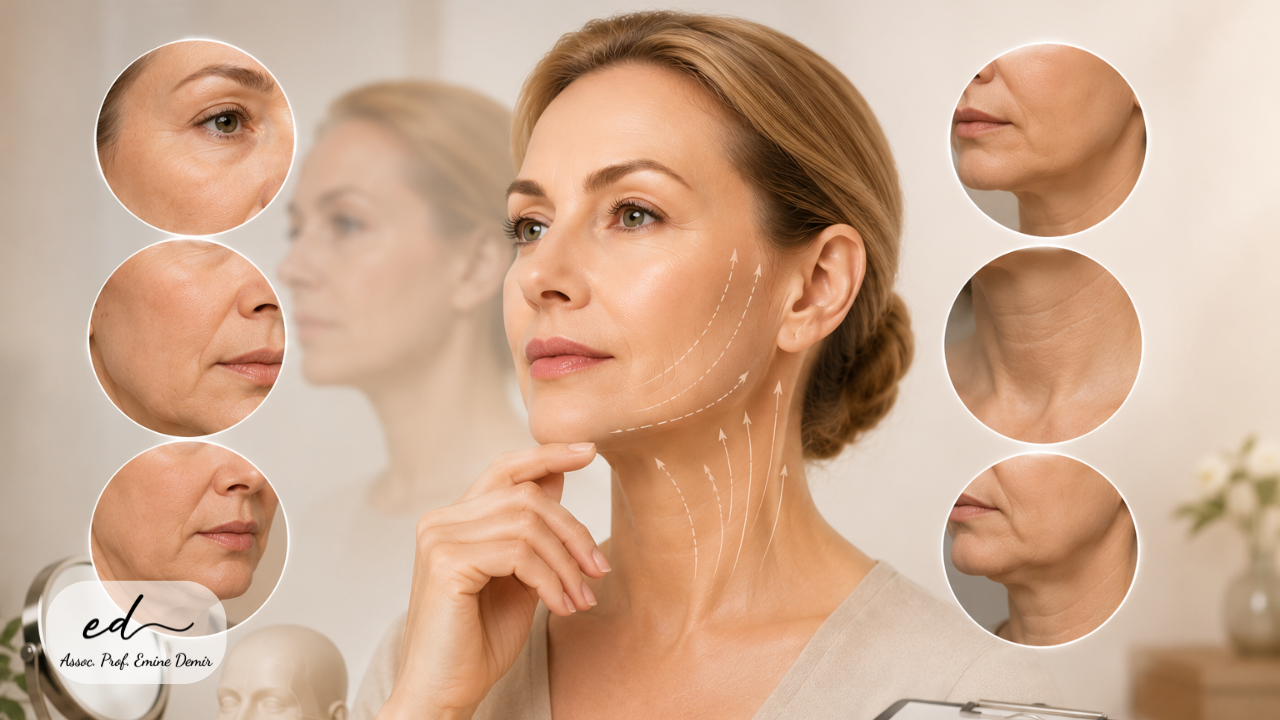
A deep plane facelift is not a procedure that should be chosen only because it is popular, advanced, or frequently discussed online. It is a highly detailed facial rejuvenation surgery that works beneath the more superficial layers of the face, focusing on deeper tissue repositioning, retaining ligaments, SMAS-related structures, cheek support, jowls, jawline definition, and often the neck.
So, who is actually a good candidate for a deep plane facelift?
The short answer is this: a good candidate is someone whose facial aging pattern matches the deep plane technique, whose general health is suitable for surgery, and whose expectations are realistic.
Age matters, but it is not the only deciding factor. This point is very important. A 45-year-old patient may have significant midface descent, jowls, and neck laxity due to genetics or weight loss. Another person in their late sixties may have good skin quality, stable health, and a facial structure suitable for surgery.
This is why the question should not be only “Am I the right age?” The better question is: “Is my anatomy suitable for a deep plane facelift?”
For patients considering deep plane facelift surgery in İstanbul, Türkiye, a personal facial analysis is essential. At the İstanbul-based practice of Assoc. Prof. Emine Demir, an Ear, Nose and Throat specialist and founder of Facelift Academy Türkiye, facial rejuvenation is evaluated with a full face perspective. This means the cheeks, jawline, neck, eyelids, temples, skin quality, and overall facial harmony are considered together.
A deep plane facelift may be powerful, but it is not automatically right for everyone. The right candidate is selected through careful anatomical, medical, and expectation-based evaluation.
What Makes Someone a Good Candidate for a Deep Plane Facelift?
A good candidate for a deep plane facelift usually has visible signs of deeper facial tissue descent rather than only mild skin looseness. This distinction matters because deep plane facelift is designed to address the deeper support structures of the face, not just tighten the skin.
Patients who may be evaluated for deep plane facelift often have concerns such as:
Midface sagging
Sagging cheeks
Pronounced jowls
Loss of jawline definition
Deep nasolabial folds
Lower face heaviness
Neck laxity
Loose skin under the chin
A tired or downward facial expression
Facial aging that feels structural rather than superficial
Many patients describe the concern in a simple way: “My face looks heavier than before.” Others say, “My jawline has disappeared,” or “My cheeks seem to have dropped.” These expressions often point to deeper soft tissue descent.
A deep plane facelift may be suitable when the face needs structural repositioning rather than surface tightening alone.
However, suitability can only be confirmed after consultation. Skin quality, bone structure, facial volume, neck condition, medical history, smoking status, and expectations all influence the decision.
Age and Deep Plane Facelift: Is There an Ideal Age?
There is no perfect age for a deep plane facelift.
In general, many deep plane facelift candidates are between their 40s and 70s. But this is only a broad clinical range, not a strict rule.
Some patients in their early 40s may be suitable if they have early but clear facial descent, especially after weight loss, genetics, or naturally weaker facial support. Some patients in their 50s may be ideal candidates because the signs of aging are visible but the skin still has enough elasticity. Some patients in their 60s or 70s may also be suitable if their general health is good and their expectations are realistic.
The key message is simple:
Age alone is not the main criterion.
A person’s biological age, skin quality, facial anatomy, tissue descent, lifestyle, and health status matter more than the number on their passport.
A 52-year-old with significant jowls and midface descent may be a stronger candidate than a 45-year-old with only mild skin laxity. Similarly, a healthy 68-year-old may be a better surgical candidate than a younger patient with uncontrolled medical problems or smoking habits.
This is why deep plane facelift planning must be individualized.
Why Age Alone Is Not Enough
Many patients ask, “Am I too young for a deep plane facelift?” Others ask, “Am I too old?”
These are understandable questions. But facial aging does not follow the same timeline for everyone.
Several factors influence how the face ages:
Genetics
Skin thickness
Bone structure
Weight changes
Sun exposure
Smoking
Hormonal changes
Lifestyle habits
Stress
Previous aesthetic treatments
Facial volume changes
Natural collagen loss
For example, a patient who has experienced significant weight loss may develop facial and neck laxity earlier. Another patient with strong bone structure and good skin quality may show fewer signs of aging at the same age.
This is why a consultation should focus on the actual face, not only the birth year.
In aesthetic surgery, the mirror often tells a more useful story than age alone.
Deep Plane Facelift Candidates in Their 40s
Patients in their 40s may be considered for deep plane facelift only when there is a clear anatomical reason. This does not mean every patient in their 40s needs surgery. In fact, many patients in this age group may be better suited for non-surgical treatments, skin quality improvement, or a more limited surgical approach.
However, some patients in their 40s do have visible structural aging.
They may have:
Early but noticeable jowls
Sagging cheeks
Softening of the jawline
Neck laxity after weight loss
Genetic lower face heaviness
Deepening nasolabial folds
Loss of youthful facial support
In these cases, deep plane facelift may be discussed if the aging pattern is deeper than mild skin looseness.
Still, conservative planning is important. The goal for younger patients should not be aggressive transformation. It should be natural support, facial balance, and long-term harmony.
For patients in İstanbul, Türkiye considering facial rejuvenation at this stage, a full face analysis helps determine whether deep plane surgery is appropriate or whether a less extensive option would be better.
Deep Plane Facelift Candidates in Their 50s
The 50s are a common age range for deep plane facelift consultation. Many patients begin to notice more visible changes in the cheeks, jawline, jowls, and neck during this period.
A patient in their 50s may say:
“My face looks tired even when I feel well.”
“My jawline is not as clear as before.”
“My cheeks have dropped.”
“My lower face looks heavier.”
“My neck makes me look older.”
These concerns often reflect the kind of deeper tissue changes that deep plane facelift is designed to address.
In this age group, skin elasticity may still be relatively favorable, while facial descent has become noticeable enough to benefit from structural repositioning. This can make the 50s an appropriate period for many suitable patients.
However, not every patient in their 50s needs deep plane facelift. Some may benefit from a traditional SMAS facelift, neck lift, blepharoplasty, or full face rejuvenation combination depending on the anatomy.
Again, technique should follow diagnosis.
Deep Plane Facelift Candidates in Their 60s and 70s
Patients in their 60s and 70s may also be good candidates for deep plane facelift if they are medically suitable and have realistic expectations.
In this age group, facial aging may include:
More pronounced jowls
Loose neck skin
Platysma bands
Deeper facial folds
Significant jawline laxity
Cheek descent
Skin excess
Aging mismatch between face and neck
Deep plane facelift combined with neck lift may be considered in selected patients when deeper facial repositioning is needed.
However, health evaluation becomes especially important. Blood pressure, diabetes control, heart health, medication use, clotting risk, smoking history, and healing capacity should all be carefully reviewed.
A healthy patient in their late 60s may be a better candidate than a younger patient with uncontrolled medical conditions.
For mature patients, the goal should be elegant rejuvenation, not overcorrection. A natural result respects age, identity, expression, and facial character.
Anatomical Signs of a Good Deep Plane Facelift Candidate
The deep plane technique is especially relevant when facial aging is caused by deeper tissue descent.
The following anatomical signs may suggest that a patient should be evaluated for deep plane facelift:
Midface Descent
The midface includes the cheek area and the transition between the lower eyelid, cheek, and nasolabial fold. When the midface descends, the cheeks may look lower, flatter, or heavier.
This can make the face appear tired or aged.
Deep plane facelift may be suitable because it can reposition deeper cheek tissues more structurally than surface-only techniques.
Pronounced Jowls
Jowls form when lower facial tissues descend over the jawline. They can blur the once-sharp transition between the face and neck.
If jowls are mild, a less extensive technique may be enough. But if they are part of deeper facial descent, deep plane facelift may be more appropriate.
Neck Laxity
The neck is closely connected to the lower face. Many patients who need deep plane facelift also need neck lift evaluation.
Loose neck skin, under-chin fullness, platysma bands, and loss of the chin-neck angle may all influence the surgical plan.
A deep plane facelift without proper neck assessment may not create enough harmony if the neck is also aged.
Deep Nasolabial Folds
Nasolabial folds run from the sides of the nose toward the corners of the mouth. They naturally exist in every face, but they may become deeper as cheek tissues descend.
Deep plane facelift may help in selected patients because it addresses deeper cheek support and retaining ligament restrictions.
Lower Face Heaviness
Some patients do not describe their concern as “jowls” or “midface descent.” They simply say, “My lower face feels heavy.”
This can be a useful clue. Lower face heaviness may indicate deeper tissue descent, which should be evaluated carefully.
Skin Quality: Why It Matters
Skin quality plays a major role in facelift planning. A deep plane facelift can reposition deeper tissues, but it does not completely change skin texture, sun damage, pigmentation, or fine surface lines.
Good candidates often have enough skin elasticity to allow smooth redraping after deeper tissue repositioning. However, patients with thinner or sun-damaged skin may still be candidates if their overall plan is realistic.
Skin quality is affected by:
Sun exposure
Smoking
Genetics
Hydration
Hormonal changes
Age
Weight changes
Skincare habits
Previous procedures
If skin quality is poor, additional skin-focused treatments may be discussed separately. These may include laser, resurfacing, medical skincare, or other treatments depending on the patient.
A facelift lifts and repositions. It does not replace every skin quality treatment.
This is an important expectation point.
Neck Condition and Candidate Suitability
The neck is one of the most important areas in deep plane facelift planning.
Many patients think they need a facelift, but when they look closely, their main concern may actually be the neck. Others have both lower face and neck aging.
A good candidate may have:
Loose skin under the chin
Visible platysma bands
Loss of jawline-neck definition
Under-chin fullness
Neck laxity after weight loss
Aging mismatch between face and neck
If the neck is involved, the surgical plan may need to include neck lift. Otherwise, the lower face may improve but the neck may still look aged.
In full face rejuvenation, the face and neck should not be treated as separate worlds. They are visually and anatomically connected.
For patients coming to İstanbul, Türkiye, this is one reason consultation should include front, side, and oblique facial analysis.
Health Requirements for Deep Plane Facelift
A good deep plane facelift candidate should be in suitable general health for surgery. This does not mean the patient must be medically perfect. It means medical risks should be understood, controlled, and evaluated before surgery.
Important health factors include:
Blood pressure control
Diabetes control
Heart health
Bleeding or clotting history
Medication use
Immune system condition
Previous anesthesia reactions
Smoking status
Healing capacity
Stable weight
General fitness
Realistic psychological readiness
Certain medical conditions can increase the risk of bleeding, poor wound healing, infection, anesthesia complications, or delayed recovery.
Patients should be honest during consultation. Hiding medical history or medication use can be dangerous.
Facelift surgery is elective. That means safety and suitability should come before the desire for aesthetic improvement.
Smoking and Deep Plane Facelift Candidacy
Smoking is one of the most important issues in facelift surgery.
Nicotine can reduce blood flow to the skin and healing tissues. This may increase the risk of wound healing problems, skin loss, infection, scarring, and other complications.
For this reason, smokers may not be ideal candidates unless they are willing and able to stop smoking before and after surgery according to the surgeon’s instructions.
This includes:
Cigarettes
Vaping
Nicotine patches
Nicotine gum
Other nicotine products
Patients sometimes say, “I only smoke a little.” But even limited nicotine exposure can matter in facial surgery because the skin and soft tissues need healthy blood supply during healing.
A responsible surgeon will take smoking seriously.
If a patient cannot stop smoking, surgery may need to be postponed or reconsidered.
Weight Stability and Deep Plane Facelift
Stable weight is another important factor.
Significant weight loss after facelift surgery may create new skin laxity. Significant weight gain may affect facial fullness and contour. This is why patients are often advised to be close to a stable, maintainable weight before surgery.
Deep plane facelift may be especially relevant for patients who have already lost weight and now have facial sagging or neck laxity. However, if a patient is still actively losing weight, it may be better to wait until weight stabilizes.
The face responds to body weight changes. A surgical plan should take this into account.
A good candidate is usually someone whose weight is relatively stable and whose facial aging pattern can be evaluated accurately.
Realistic Expectations: A Key Candidate Criterion
A good deep plane facelift candidate should have realistic expectations.
This may sound simple, but it is one of the most important parts of candidacy.
Deep plane facelift can improve facial sagging, jowls, jawline definition, cheek descent, and lower face heaviness in suitable patients. But it cannot stop aging. It cannot create a completely different face. It cannot guarantee a specific result. It cannot fix every skin texture problem. It cannot replace a healthy lifestyle.
A realistic patient may say:
“I want to look more refreshed, not completely different.”
“I understand that recovery takes time.”
“I know results vary from person to person.”
“I want a natural improvement that fits my face.”
“I understand that additional procedures may or may not be needed.”
An unrealistic patient may expect perfection, celebrity-level transformation, or a guaranteed result. That mindset can lead to dissatisfaction even after technically successful surgery.
In facial rejuvenation, the healthiest goal is usually to look like yourself — rested, balanced, and naturally supported.
Who May Not Be a Good Candidate?
Not every patient is suitable for deep plane facelift.
A person may not be a good candidate if they have:
Uncontrolled medical conditions
Active smoking or nicotine use
Unrealistic expectations
Very mild aging that does not require surgery
Poor healing capacity
Unstable weight
Certain bleeding disorders
High anesthesia risk
Severe untreated psychological distress
A desire to look like someone else
Inability to follow recovery instructions
This does not always mean surgery is impossible forever. Sometimes surgery may be postponed until health improves, smoking stops, weight stabilizes, or expectations become more realistic.
A good surgeon should be willing to say “not yet” when that is the safer answer.
Is a Deep Plane Facelift Right for Younger Patients?
Sometimes, yes — but not always.
Younger patients may be interested in deep plane facelift because they see natural-looking results online or want to avoid waiting until aging becomes more advanced. But surgery should not be performed only because a technique is trending.
A younger patient may be considered if there is clear structural descent, early jowling, cheek sagging, or neck laxity that cannot be adequately addressed with non-surgical options.
However, if the concern is only mild skin texture, small volume changes, or early fine lines, non-surgical treatments may be more appropriate.
For younger patients, restraint is important. The goal should not be over-lifting. It should be prevention of imbalance and support of natural anatomy when truly indicated.
Is a Deep Plane Facelift Right for Older Patients?
Older patients may be good candidates if they are medically suitable and have realistic expectations.
In older patients, a deep plane facelift may be considered when there is significant cheek descent, jowls, jawline laxity, neck aging, or lower face heaviness.
However, surgical planning should respect the patient’s age and identity. The goal should not be to make a 70-year-old look 35. That kind of expectation is neither natural nor realistic.
A better goal is to create a refreshed, balanced, and elegant appearance that fits the person’s own face.
Health evaluation is especially important in older patients. If the patient has well-controlled medical conditions and good healing capacity, surgery may be possible. If health risks are high, alternatives may be discussed.
Deep Plane Facelift vs Mini Facelift Candidate
Some patients ask whether they need a deep plane facelift or a mini facelift.
A mini facelift is usually more suitable for mild early aging. It may address early jowls and slight lower face laxity in patients with good skin elasticity and minimal neck concerns.
Deep plane facelift is usually considered when aging is more structural. It may be more suitable for patients with cheek descent, deeper folds, pronounced jowls, and neck involvement.
A mini facelift may not be enough if the patient has:
Significant jowls
Midface descent
Deep nasolabial folds
Loose neck skin
Platysma bands
Heavy lower face tissues
Advanced facial laxity
The key question is not “Which one sounds easier?” The key question is “Which one matches the anatomy?”
Deep Plane Facelift vs Non-Surgical Treatments
Not every patient with facial aging needs surgery. Some patients may benefit from non-surgical treatments, especially if aging is mild.
Non-surgical options may help with:
Skin texture
Mild volume loss
Fine lines
Early laxity
Skin quality
Collagen stimulation
Small contour concerns
However, non-surgical treatments cannot reposition deeper facial tissues in the same way surgery can. If the main issue is jowling, cheek descent, neck laxity, or significant tissue sagging, surgery may be more appropriate.
This is why diagnosis matters.
If the problem is skin quality, skin treatments may help. If the problem is deeper tissue descent, deep plane facelift may be considered. If both are present, a combined long-term plan may be needed.
Full Face Rejuvenation Candidate: When Deep Plane Is Only One Part
Deep plane facelift may be one part of a full face rejuvenation plan.
Some patients have aging in multiple facial areas:
Heavy upper eyelids
Lower eyelid bags
Brow descent
Temple hollowing
Sagging cheeks
Jowls
Loose neck skin
Skin texture changes
Volume loss
If only the lower face is treated, the result may not feel balanced. For example, a refreshed jawline with tired eyelids may create contrast. A lifted face with an untreated neck may also feel incomplete.
At Facelift Academy Türkiye in İstanbul, Türkiye, full face planning considers how different facial areas relate to each other. The goal is not to add unnecessary procedures. The goal is to create harmony.
A good candidate for full face rejuvenation is someone whose aging pattern involves more than one area and who understands that the surgical plan should be personalized.
Candidate Checklist
A patient may be a good candidate for deep plane facelift if most of the following apply:
You have visible midface descent.
You have sagging cheeks.
You have pronounced jowls.
Your jawline has lost definition.
You have lower face heaviness.
You have neck laxity or loose skin under the chin.
You are generally healthy enough for surgery.
Your blood pressure and medical conditions are controlled.
You do not smoke, or you are willing to stop as instructed.
Your weight is stable.
You understand that recovery takes time.
You want natural-looking rejuvenation, not a different face.
You have realistic expectations.
You are willing to follow postoperative instructions.
You are open to a personalized plan rather than a standard procedure.
This checklist is not a diagnosis. It is only a guide. A personal consultation is always necessary.
Questions to Ask During Consultation
Before deciding on deep plane facelift, patients may ask:
Is my aging pattern suitable for deep plane facelift?
Is my concern caused by skin laxity, deeper tissue descent, or both?
Do I have midface descent?
Are my jowls mild, moderate, or advanced?
Does my neck need to be treated?
Would a mini facelift be enough?
Would a SMAS facelift be enough?
Do I need blepharoplasty or temporal lift for facial harmony?
Am I healthy enough for surgery?
How does smoking affect my candidacy?
How long should I stay in İstanbul, Türkiye after surgery?
What recovery timeline should I expect?
What result would look natural for my face?
These questions help patients move beyond internet research and into personalized medical planning.
Deep Plane Facelift in İstanbul, Türkiye
İstanbul, Türkiye is a major destination for facial rejuvenation and international aesthetic surgery. Many patients travel to İstanbul for deep plane facelift, neck lift, blepharoplasty, and full face rejuvenation procedures.
However, candidacy should never be decided by travel convenience alone.
A patient should be evaluated medically and anatomically before surgery. The surgical plan should be realistic, safe, and personalized.
For international patients, additional planning is also needed:
Travel schedule
Preoperative consultation
Medical testing
Accommodation
Recovery time in İstanbul
Follow-up appointments
Return flight timing
Communication after returning home
A VIP-level experience should mean more than comfort. It should include privacy, organization, responsible planning, and clear communication.
Assoc. Prof. Emine Demir’s facial rejuvenation-focused approach in İstanbul, Türkiye supports this type of individualized candidate evaluation.
Final Thoughts
So, who is a good candidate for a deep plane facelift?
A good candidate is usually someone with visible structural facial aging: midface descent, sagging cheeks, pronounced jowls, lower face heaviness, jawline laxity, and often neck looseness. The patient should be in suitable general health, should not smoke or should be able to stop as instructed, should have stable weight, and should understand the recovery process.
The typical age range may often fall between the 40s and 70s, but age alone is not the deciding factor.
This is the most important message: deep plane facelift candidacy depends on anatomy, health, and expectations — not only age.
For patients considering deep plane facelift in İstanbul, Türkiye, a detailed consultation with Assoc. Prof. Emine Demir can help determine whether deep plane facelift, neck lift, blepharoplasty, mini facelift, SMAS facelift, or full face rejuvenation is more appropriate.
A good facial rejuvenation plan should not force every patient into the same technique. It should respect the face, the person, the health profile, and the natural identity.
If this guide helped you understand deep plane facelift candidacy more clearly, you may share it with someone researching facial rejuvenation or use it as a starting point for the questions you may want to ask during consultation.
Frequently Asked Questions
Who is a good candidate for a deep plane facelift?
A good candidate usually has visible facial tissue descent, such as sagging cheeks, pronounced jowls, deep nasolabial folds, jawline laxity, lower face heaviness, and possibly neck looseness. General health and realistic expectations are also important.
What is the ideal age for a deep plane facelift?
There is no single ideal age. Many candidates are between their 40s and 70s, but suitability depends more on facial anatomy, skin quality, health status, and aging pattern than age alone.
Is 40 too young for a deep plane facelift?
Not always. Some patients in their 40s may be candidates if they have clear midface descent, early jowls, or neck laxity. However, many patients in this age group may be better suited for less extensive treatments.
Is 70 too old for a deep plane facelift?
Not necessarily. A healthy patient in their 70s with realistic expectations may be evaluated for surgery. Medical suitability matters more than age alone.
Can smokers have a deep plane facelift?
Smoking increases the risk of poor wound healing and complications. Smokers may need to stop smoking before and after surgery according to the surgeon’s instructions. If a patient cannot stop smoking, surgery may be postponed or reconsidered.
What health conditions may affect candidacy?
Uncontrolled diabetes, high blood pressure, bleeding disorders, serious heart disease, immune problems, and high anesthesia risk may affect candidacy. Each patient should be evaluated individually.
Do I need a neck lift with deep plane facelift?
Not always, but many patients with lower face aging also have neck laxity. If the neck is loose or has visible bands, a neck lift may be recommended for better harmony.
Is deep plane facelift good for jowls?
Deep plane facelift may be suitable for pronounced jowls, especially when they are caused by deeper facial tissue descent. Mild jowls may sometimes be treated with less extensive techniques.
Can deep plane facelift improve sagging cheeks?
Yes, in suitable patients, deep plane facelift may improve sagging cheeks by repositioning deeper facial tissues rather than relying only on skin tightening.
Is deep plane facelift suitable for mild aging?
Usually, deep plane facelift is more appropriate for moderate to advanced structural aging. Patients with mild aging may be better suited for non-surgical treatments, mini facelift, or other less extensive options.
What makes someone a poor candidate?
A poor candidate may have uncontrolled medical conditions, active smoking, unrealistic expectations, unstable weight, poor healing capacity, or very mild concerns that do not require deep plane surgery.
Does skin quality affect deep plane facelift results?
Yes. Skin quality affects healing, redraping, scar maturation, and overall appearance. A facelift repositions tissues but does not fully correct sun damage, pigmentation, or fine skin texture problems.
How do I know if deep plane facelift is right for me?
A detailed consultation is necessary. The surgeon should evaluate your cheeks, jowls, jawline, neck, skin quality, health status, and expectations before recommending deep plane facelift or another approach.
Why is İstanbul, Türkiye preferred for deep plane facelift?
İstanbul, Türkiye is often preferred for facial rejuvenation because of private healthcare infrastructure, experienced surgeons, international patient coordination, and a strong price-quality balance. However, surgeon selection and personalized planning are essential.