
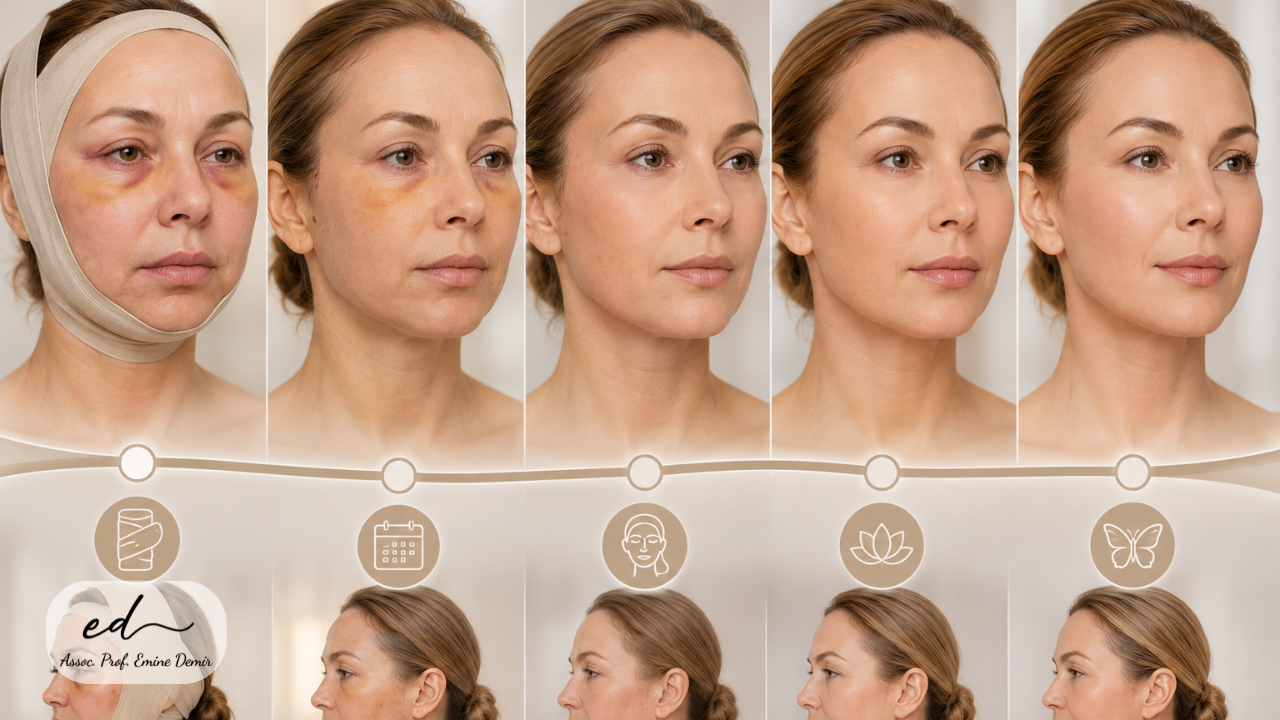
Deep plane facelift recovery is one of the most important topics patients research before deciding on surgery. And honestly, it should be. A deep plane facelift is not a quick beauty treatment. It is a detailed facial rejuvenation surgery that works beneath the superficial layers of the face, addressing deeper tissues, retaining ligaments, the SMAS-related structures, cheeks, jawline, jowls, and often the neck.
So, recovery is not only about waiting for bruises to fade.
It is about tissue healing, swelling control, incision care, emotional adjustment, gradual return to daily life, and realistic expectation management. Many patients want to know the same things: “When will I look normal?”, “When can I return to work?”, “How long does swelling last?”, “When will the final result settle?”
The honest answer is: recovery happens in stages.
For patients considering deep plane facelift surgery in İstanbul, Türkiye, understanding the recovery timeline before surgery is especially important. International patients also need to plan travel, accommodation, follow-up appointments, and return flights carefully.
Assoc. Prof. Emine Demir, an Ear, Nose and Throat specialist and founder of Facelift Academy Türkiye, approaches facial rejuvenation with a full face perspective. In a VIP-level patient journey, recovery planning should be as personalized as the surgical plan itself. The goal is not only to perform surgery, but also to guide the patient safely and realistically through the healing process.
Understanding Deep Plane Facelift Recovery
Deep plane facelift recovery is different from recovering after a small skin procedure. Since the surgery works on deeper facial tissues, the healing process involves more than surface swelling.
During a deep plane facelift, the surgeon may release selected retaining ligaments and reposition deeper facial tissues. In many patients, the procedure may be combined with neck lift, blepharoplasty, fat transfer, temporal lift, or other full face rejuvenation procedures.
Because of this, recovery can vary significantly.
A patient who has only a deep plane facelift may recover differently from a patient who has a deep plane facelift, neck lift, and eyelid surgery together. Age, skin quality, smoking history, medical conditions, medication use, bruising tendency, and lifestyle habits can also affect healing.
This is why the timeline in this article should be seen as a general educational guide, not a personal medical promise.
In aesthetic surgery, the body does not follow an exact calendar. Some patients look socially comfortable earlier. Others need more time. Both can be normal.
The First 24–48 Hours: The Beginning of Healing
The first two days after deep plane facelift surgery are usually the most controlled and medically monitored part of recovery. Patients may feel tired, swollen, tight, and slightly disoriented from anesthesia or sedation.
The face may be bandaged. There may be drains depending on the surgeon’s technique and the surgical plan. The patient may feel pressure or tightness around the face and neck. Pain is usually manageable with prescribed medication, but discomfort levels vary from person to person.
At this stage, the face will not look like the final result. This is very important.
Swelling begins early. Bruising may start to appear. The skin may feel numb, firm, or strange. Some patients feel emotionally sensitive when they first see swelling or bandages. This is completely understandable.
The first 48 hours are not the time to judge the result.
Recommendation Box: First 48 Hours
Keep your head elevated as instructed.
Use medications exactly as prescribed.
Avoid bending forward or lifting heavy objects.
Do not touch incisions unnecessarily.
Have a trusted companion or caregiver if recommended.
Avoid mirror-checking every hour.
Contact your medical team if you notice sudden severe pain, heavy bleeding, breathing difficulty, or rapidly increasing swelling.
For international patients in İstanbul, Türkiye, this early period should ideally be planned with enough rest, privacy, and easy access to the clinic.
Week 1: Swelling, Bruising, Tightness and Rest
The first week is usually the most intense part of deep plane facelift recovery. This does not mean the patient is in severe pain the whole time. Rather, the face may look swollen, bruised, tight, and unfamiliar.
Swelling and bruising often become more noticeable around the first few days. Some patients feel that they look worse before they look better. This can be emotionally challenging, but it is a normal part of the healing process.
During week 1, patients may experience:
Swelling in the cheeks, jawline, and neck
Bruising around the face or neck
Tightness or pressure
Numbness in certain areas
Mild discomfort
Limited facial movement
Fatigue
A feeling of heaviness in the face
Sleep difficulty due to positioning
Temporary emotional ups and downs
If a neck lift was performed, the neck may feel tight. If blepharoplasty was added, there may also be swelling or bruising around the eyes.
The patient should rest, follow all medical instructions, attend scheduled follow-up visits, and avoid physical strain. Walking slowly around the room or house may be encouraged depending on the surgeon’s advice, but exercise is usually avoided.
What About Drains and Bandages?
Some surgeons use drains after facelift or neck lift surgery, while others may not. If drains are used, they are usually temporary and removed when appropriate. Bandages or compression garments may also be used according to the surgeon’s protocol.
Patients should not remove or adjust dressings unless instructed.
Can You Work During Week 1?
For most patients, week 1 is not suitable for work. Even remote work may feel tiring because swelling, medication, sleep position, and emotional adjustment can affect concentration.
A deep plane facelift deserves real recovery time.
Recommendation Box: Week 1
Prioritize rest, hydration, and gentle movement.
Sleep with your head elevated if recommended.
Avoid salty foods that may worsen swelling.
Do not smoke.
Do not drink alcohol unless your surgeon allows it.
Avoid heavy housework.
Do not apply makeup over healing incisions.
Do not compare your face with online recovery photos.
Keep all follow-up appointments.
Week 1 is about protection, not productivity.
Week 2: Bruising Starts to Fade, But Swelling Remains
By the second week, many patients begin to feel more like themselves. Bruising may start to fade. Swelling may begin to decrease. Energy levels may improve. The face may still feel tight or numb, but the early intensity often becomes more manageable.
This is also the period when some patients become impatient.
They may think, “I expected to look more normal by now.” But deep plane facelift recovery is not finished in two weeks. Visible improvement may begin, but the tissues are still healing underneath.
During week 2, patients may notice:
Less bruising
Reduced swelling compared with week 1
More comfort while moving
Improved sleep
Mild tightness in the face or neck
Numbness around the cheeks, ears, jawline, or neck
Incisions beginning to look calmer
More confidence with daily activities
Some sutures or staples may be removed around this period depending on the surgeon’s protocol. The exact timing varies.
Returning to Work in Week 2
Some patients with desk-based or remote work may feel ready to return during the second week, especially if they do not need to appear on camera. Others may prefer waiting longer.
If the job involves public-facing duties, meetings, social events, travel, or physical activity, more time may be needed.
For many patients, returning to work around the second or third week may be realistic, but this depends on swelling, bruising, energy, and the type of job.
Social Recovery vs. Medical Recovery
This distinction matters.
Social recovery means the patient feels comfortable being seen by others. Medical recovery means the tissues have healed enough for normal activity. These are not the same thing.
A patient may look acceptable in public while still having internal swelling, numbness, and tissue healing. That is why activity restrictions should still be respected even if the face looks better.
Recommendation Box: Week 2
Ask your surgeon before returning to work.
Use sun protection if going outside.
Avoid intense exercise.
Avoid saunas, steam rooms, and hot environments.
Continue sleeping carefully if advised.
Do not massage the face unless your surgeon recommends it.
Be patient with asymmetrical swelling.
Remember that numbness can take time to improve.
Week 2 often feels encouraging, but the healing process is still active.
Weeks 3–4: Social Confidence Begins to Return
Weeks 3 and 4 are usually important milestones. Many patients begin to feel more comfortable with their appearance. Bruising may be minimal or easier to conceal. Swelling continues to improve. The jawline and neck contour may start to appear more defined.
This is the period when patients often say, “I can finally see where this is going.”
Still, the face may not look final. There may be residual swelling in the cheeks, jawline, under the chin, or neck. Some areas may feel firm. Numbness may continue. One side may look slightly more swollen than the other.
This is not unusual.
During weeks 3–4, patients may experience:
Improved facial definition
Less visible bruising
More natural facial movement
More comfort in social settings
Residual swelling
Firmness under the skin
Continued numbness
Mild pulling sensations
Better energy levels
More confidence in photos
Returning to Social Life
Many patients feel more comfortable attending casual social events around weeks 3–4. However, large events, professional photoshoots, weddings, important business presentations, or public appearances may still feel too early for some people.
If a patient wants to look polished for a major event, surgery should ideally be planned well in advance. A deep plane facelift result continues to refine over months, not days.
Returning to Exercise
Light walking is often allowed earlier, but more intense activity may still be restricted. Weightlifting, running, yoga inversions, high-intensity workouts, and activities that increase blood pressure may need to wait until the surgeon gives permission.
Even if the patient feels energetic, the healing tissues need time.
Recommendation Box: Weeks 3–4
Gradually return to normal routines with your surgeon’s approval.
Do not rush intense workouts.
Continue protecting incisions from sun exposure.
Be careful with hair coloring or salon treatments near incision areas.
Avoid judging the final result too early.
Take progress photos only weekly, not daily.
Ask your surgeon before facial massage, skincare devices, or aesthetic treatments.
Weeks 3–4 are encouraging, but not final.
Week 6: A More Natural Look, But Still Not the Final Result
By week 6, many patients feel significantly better. Swelling has usually reduced noticeably. The face may look more natural. The jawline and neck contour may be clearer. Patients may feel more comfortable with work, social life, and moderate daily routines.
However, week 6 is still not the final result.
This is one of the most important expectation points in deep plane facelift recovery. At six weeks, the patient may look good, but subtle swelling, firmness, numbness, and scar maturation are still ongoing.
During week 6, patients may notice:
More defined facial contours
Less tightness
Improved comfort in daily life
Better facial expression
Reduced swelling
Continued mild numbness
Incisions becoming softer
Better confidence in social settings
A more natural-looking appearance
Some patients may be cleared for more activity around this time, depending on their healing and surgeon’s protocol. Others may need additional restrictions, especially if they had extensive neck lift, blepharoplasty, or combined full face rejuvenation.
Can You See the Final Result at Week 6?
No, not completely.
Week 6 often gives a good preview of the direction of the result, but the final refinement takes longer. Deep tissues continue to settle. Scars continue to mature. Residual swelling gradually improves.
Many patients continue to see changes for several months.
Recommendation Box: Week 6
Ask your surgeon before resuming full exercise.
Continue scar care if recommended.
Protect your skin from sun exposure.
Maintain a healthy diet and hydration.
Avoid smoking.
Be patient with residual swelling.
Remember that final results take time.
Week 6 is a milestone, not the finish line.
Months 3–6: Refinement and Tissue Settling
Although the user often asks for a week-by-week timeline, it would be incomplete not to discuss the months after surgery. Deep plane facelift recovery does not stop at week 6.
Between months 3 and 6, the face usually continues to soften and settle. The result may look more natural. Incisions may continue to fade. Numbness may improve gradually. The patient may feel more comfortable with facial expressions and skin sensation.
This is often when the result becomes easier to appreciate.
The face no longer looks “recently operated.” The contours appear more integrated. The jawline, cheek, and neck may look more harmonious. Friends or colleagues may notice that the patient looks refreshed, but not necessarily know why.
This is usually the kind of result many VIP-level facial rejuvenation patients want: refined, elegant, and natural.
When Does the Final Result Settle?
The final result after deep plane facelift may take several months to fully settle. In some patients, subtle changes can continue for up to a year, especially in the neck, incision areas, and deeper tissue firmness.
This does not mean the patient looks swollen for a year. It means the fine details continue to mature.
Final settling depends on:
Skin thickness
Age
Extent of surgery
Neck lift involvement
Bruising tendency
Lymphatic drainage
Lifestyle
Smoking status
Sun exposure
Postoperative care
Genetics
A patient with thicker skin may have longer swelling. A patient who had extensive neck work may feel tightness for longer. A patient who follows recovery instructions carefully may support smoother healing.
Again, there is no single universal timeline.
Emotional Recovery After Deep Plane Facelift
This topic is not discussed enough.
Facelift recovery is not only physical. It can also be emotional. In the first days, the face looks swollen and unfamiliar. The patient may feel vulnerable, tired, or even regretful for a short period. This does not mean the surgery was a mistake. It may simply be part of the emotional recovery process.
Many patients experience a temporary emotional dip during the first or second week. The swelling is still visible, sleep may be uncomfortable, and the final result is not yet visible.
This is why expectation management is so important.
Patients should know before surgery that the early face is not the final face. Swelling can distort features. Bruising can look dramatic. Tightness can feel strange. Numbness can be unsettling.
A calm, well-informed patient usually handles recovery better.
Recommendation Box: Emotional Recovery
Do not evaluate your result in the first week.
Avoid checking the mirror too frequently.
Do not compare yourself with other patients online.
Talk to your care team if you feel anxious.
Remember that swelling changes daily.
Focus on healing, not perfection.
Give yourself permission to rest.
Recovery requires patience and self-kindness.
Swelling After Deep Plane Facelift
Swelling is expected after deep plane facelift surgery. It is usually most noticeable in the early days and gradually decreases over time.
Swelling may appear in the cheeks, jawline, under the chin, neck, and around the ears. If eyelid surgery is included, swelling may also appear around the eyes.
Some swelling can move downward due to gravity. This is why the neck may feel fuller or tighter at certain stages. Morning swelling may look different from evening swelling.
Patients sometimes worry when one side is more swollen than the other. Mild asymmetry during recovery can be normal, but sudden severe swelling, one-sided rapid enlargement, or increasing pain should be reported immediately.
What Helps Swelling?
Follow your surgeon’s instructions.
Keep the head elevated if recommended.
Avoid salty foods in the early period.
Stay hydrated.
Avoid alcohol and smoking.
Do not exercise too early.
Attend follow-up appointments.
Do not use unapproved massage or devices.
Swelling cannot be rushed completely. It must resolve safely.
Bruising After Deep Plane Facelift
Bruising is also common after facelift surgery. The degree of bruising varies widely. Some patients bruise lightly. Others develop more visible discoloration.
Bruising usually changes color as it heals. It may move downward from the face toward the neck or chest. This can look surprising, but it is often part of normal healing.
Patients using blood-thinning medications or supplements may bruise more, which is why medication review before surgery is important.
Makeup may be allowed after a certain point, but only when the surgeon says it is safe. Makeup should not be applied over open or healing incision areas unless approved.
Numbness and Tightness
Numbness and tightness are very common after deep plane facelift. The skin and deeper tissues have been lifted, repositioned, and redraped. Small sensory nerves need time to recover.
Patients may feel numbness around the ears, cheeks, jawline, neck, or incision areas. Some areas may feel firm or slightly strange to touch.
This can improve gradually, but it may take weeks or months. In some patients, small areas of altered sensation may last longer.
Tightness is also expected, especially when a neck lift is performed. The neck may feel stiff or pulled in the early period. This usually softens over time.
However, severe pain, sudden weakness, or unusual symptoms should always be discussed with the surgeon.
Returning to Work After Deep Plane Facelift
Return to work depends on the job and the patient’s recovery.
A patient who works remotely may return earlier than someone who works in public-facing roles. A patient who needs to attend meetings, speak frequently, travel, or appear on camera may need more time.
General expectations may be:
Desk-based remote work: sometimes around 2 weeks, depending on comfort
Office work: often around 2–3 weeks, depending on swelling and bruising
Public-facing work: often 3–4 weeks or more
Physically demanding work: usually longer and requires surgeon approval
This is not a rule. It is a general guide.
For international patients in İstanbul, Türkiye, return-to-work timing should also consider travel fatigue and flight-related swelling. Returning home and immediately starting an intense work schedule may not be ideal.
Returning to Exercise
Exercise should be resumed gradually and only with medical approval.
Light walking is often encouraged early because it supports circulation and reduces stiffness. But intense exercise can increase blood pressure, worsen swelling, and raise the risk of bleeding in the early recovery period.
Patients should avoid:
Heavy lifting
Running too early
High-intensity training
Yoga inversions
Sauna and steam rooms
Contact sports
Exercises that strain the neck
Sudden head movements
By around week 6, some patients may begin returning to more regular activity if healing is appropriate. But the surgeon’s approval is essential.
Scar Healing After Deep Plane Facelift
Deep plane facelift incisions are usually placed around the ear and hairline areas, depending on the surgical plan. If neck lift is included, there may also be an incision under the chin.
Scars do not mature immediately. They may look pink, firm, or slightly raised in the early period. Over time, they usually soften and fade.
Scar healing depends on:
Genetics
Skin type
Incision care
Sun exposure
Smoking
Tension on the incision
Infection risk
Postoperative instructions
Previous scar history
Patients should avoid sun exposure on healing scars and follow scar care instructions carefully.
A good facelift result is not only about lifting. Incision planning and scar management matter too.
What Is Normal and What Is Not?
Some symptoms are expected after deep plane facelift. Others need medical attention.
Common recovery symptoms may include:
Swelling
Bruising
Tightness
Numbness
Mild discomfort
Fatigue
Temporary asymmetry
Firmness under the skin
Emotional ups and downs
Symptoms that should be reported urgently may include:
Sudden severe pain
Rapidly increasing one-sided swelling
Heavy bleeding
Fever
Shortness of breath
Chest pain
Sudden facial weakness
Vision changes
Severe wound redness or drainage
Unusual odor from incision sites
Patients should always follow the emergency instructions given by their surgical team.
Recovery Tips for International Patients in İstanbul, Türkiye
Patients traveling to İstanbul for deep plane facelift should plan recovery carefully. Surgery abroad can be very smooth when organized well, but it should not be rushed.
Important planning points include:
Arrive before surgery with enough time for consultation and tests.
Stay in İstanbul long enough for early follow-up visits.
Do not schedule a return flight too soon.
Choose comfortable accommodation close to the clinic if possible.
Have a companion if recommended.
Avoid tourist activities during early recovery.
Ask what to do if you have concerns after returning home.
Keep communication open with the clinic.
İstanbul, Türkiye offers strong international patient infrastructure, but patients still need realistic recovery planning.
A VIP-level experience should include privacy, organization, and clear postoperative guidance.
Deep Plane Facelift Recovery and Full Face Rejuvenation
Deep plane facelift is often part of a full face rejuvenation plan. If other procedures are added, recovery may change.
For example:
Neck lift may increase tightness and swelling in the neck.
Blepharoplasty may add eye-area bruising and swelling.
Fat transfer may create additional facial swelling.
Temporal lift may affect upper face tightness.
Skin resurfacing may require separate skin healing time.
This is why recovery should always be explained according to the actual surgical plan.
A patient who had only facelift should not compare recovery with someone who had facelift, neck lift, eyelid surgery, and fat transfer.
Comparison creates anxiety. Personal guidance creates clarity.
Realistic Expectations: What Patients Should Know
Deep plane facelift can create meaningful facial rejuvenation in suitable patients, but recovery requires patience.
Patients should understand:
The first week is usually the hardest.
Swelling and bruising are expected.
Week 2 may still look unfinished.
Weeks 3–4 often bring more social confidence.
Week 6 is a milestone, not the final result.
Final refinement takes months.
Numbness and tightness may last longer than visible bruising.
The result should not be judged too early.
Healing is not perfectly symmetrical.
Every patient recovers differently.
The best recovery mindset is calm, informed, and patient.
Final Thoughts
Deep plane facelift recovery is a gradual process. It begins with swelling, bruising, tightness, rest, and careful medical follow-up. Over the following weeks, the face begins to soften, bruising fades, swelling improves, and the new facial contours become more visible.
The first week is usually the most intense. The second week often brings noticeable improvement. Weeks 3–4 may help patients feel more socially comfortable. By week 6, many patients look more natural and confident, but the final result still continues to settle over the following months.
For patients considering deep plane facelift in İstanbul, Türkiye, recovery planning is especially important because travel, accommodation, follow-up visits, and return flights must be organized carefully.
Assoc. Prof. Emine Demir, founder of Facelift Academy Türkiye, approaches facial rejuvenation with an anatomy-based and full face perspective. In a VIP-level patient journey, recovery should be guided with the same care as surgery itself.
A deep plane facelift result should not be rushed. The face needs time to heal, soften, and settle.
If this guide helped you understand deep plane facelift recovery more clearly, you may share it with someone researching facial rejuvenation or use it as a starting point for the questions you may want to ask during consultation.
Frequently Asked Questions
How long does deep plane facelift recovery take?
Deep plane facelift recovery happens in stages. Many patients feel more socially comfortable within a few weeks, but swelling, tightness, numbness, and tissue settling may continue for several months.
What is the hardest week after deep plane facelift?
The first week is usually the most intense because swelling, bruising, tightness, fatigue, and emotional adjustment are more noticeable during this period.
When does swelling peak after deep plane facelift?
Swelling often becomes more noticeable in the first few days after surgery. It then gradually decreases over the following weeks, although subtle swelling may continue for months.
When can I return to work after deep plane facelift?
Return to work depends on the patient’s job and healing speed. Some patients may return to remote or desk-based work around the second week, while public-facing or physically demanding jobs may require more time.
When will I look normal after deep plane facelift?
Many patients begin to feel more socially comfortable around weeks 3–4, but this varies. The face continues to refine after this period, and final settling takes longer.
Is week 6 the final result?
No. Week 6 is an important milestone, but it is not the final result. Swelling, scar maturation, numbness, and tissue softening can continue for several months.
How long does numbness last after deep plane facelift?
Numbness may last for weeks or months depending on the patient and the extent of surgery. Sensation usually improves gradually, but recovery varies from person to person.
Can I exercise after deep plane facelift?
Light walking may be allowed early, but intense exercise should only be resumed after surgeon approval. Heavy lifting, running, and high-intensity workouts are usually avoided during early recovery.
Can I travel after deep plane facelift?
Travel timing should be discussed with the surgeon. International patients in İstanbul, Türkiye should stay long enough for early follow-up visits and should not rush return flights.
Is bruising normal after deep plane facelift?
Yes. Bruising is common after facelift surgery and usually improves gradually. The amount of bruising varies from person to person.
What should I avoid after deep plane facelift?
Patients are usually advised to avoid smoking, alcohol, heavy exercise, bending forward, sun exposure, sauna, steam rooms, and unapproved facial treatments during early recovery.
Can recovery be faster with VIP postoperative care?
VIP care can make the recovery process more organized, private, and comfortable, but it cannot eliminate normal healing stages. Swelling, bruising, and tissue recovery still take time.
When can I see the final deep plane facelift result?
A noticeable improvement may be seen within weeks, but final refinement usually takes several months. Some subtle changes may continue for up to a year depending on the patient.
Is deep plane facelift recovery painful?
Pain varies. Many patients describe recovery more as tightness, pressure, swelling, or discomfort rather than severe pain. Medication and proper postoperative care help manage comfort.